The Federal Government has allocated ₦341.6bn for the payment of judges’ salaries and allowances in the 2026 Appropriation Bill, sustaining the sharp rise in judicial funding triggered by the salary review approved by the National Assembly in 2024.


The allocation is provided under statutory transfers to the National Judicial Council, the body responsible for the administration of the federal judiciary.
According to the analysis of the budget by our correspondent, the NJC vote in the appropriation bill is made up almost entirely of personnel costs tied to judges’ remuneration, with no clear capital component reflected within that line.
Budget history shows that judiciary funding remained relatively flat for several years before the recent spike.
From 2019 to 2021, statutory transfers to the NJC hovered around ₦110bn annually, rising modestly to about ₦120bn in 2022 and to roughly ₦150bn in 2023.
A major leap occurred in the 2024 budget when the National Assembly raised the council’s allocation from an initial executive proposal of ₦165bn to ₦341.63bn, making it one of the highest statutory transfers to any federal agency that year.
The elevated funding level has now been retained in the 2026 proposal.
The increase followed the passage of the Judicial Officers’ Salaries and Allowances Act (Amendment) Bill in late 2023, which introduced a new salary structure for judicial officers from January 2024.
Under the revised pay regime, the Chief Justice of Nigeria now earns about ₦5.39m monthly, while other justices of the Supreme Court and appellate courts receive comparable multi-million-naira monthly salaries.
Although the NJC allocation is almost entirely for salaries, the broader justice sector budget for 2026 contains capital provisions for court-related reforms and infrastructure under other ministries and sectoral votes.
Our correspondent noted that a sectoral analysis of the budget showed that the law and justice sector has about ₦11.64bn earmarked for capital projects, while the Ministry of Works and related agencies also have court-linked items running into several billions of naira.
This structural gap is further illustrated in the 2026 budget by a provision of ₦520m at the Federal Ministry of Justice for the purchase of fuel to power generators at its headquarters and offices, reflecting the persistence of electricity challenges even within the justice system’s top bureaucracy.
Sunday PUNCH reports that the NN520m sum reflects the deteriorating state of courts across the federation, with magistrate and high courts in several states operating from rundown buildings lacking stable electricity, functional recording facilities and basic amenities.
On one occasion, senior lawyer and human rights activist, Mike Ozekhome, SAN, lamented the state of the Nigerian courts, describing them as “dilapidated infrastructure” where judges often had to write proceedings with longhand.
During an interview on Channels Television’s “Hard Copy” program in June 2025, Ozekhome said, “The judiciary has been ignored for too long,” stressing that judges must be “treated respectfully” and be “well funded,” to insulate them from societal pressures.
A senior lawyer based in Abuja, who spoke with our correspondent on the condition of anonymity, said, “There is no point in rewarding judges handsomely if the courts they preside over are unsafe, lack electricity, or cannot accommodate litigants.”
According to him, the budget provision revealed the skewed priorities of the Federal government, pointing out that ensuring better court conditions should be of greater concern.
“Order Justice Omolaye-Ajileye’s Electronic Evidence Books Now” — Essential Guides On Evidence Act, Case Law And Digital Proof
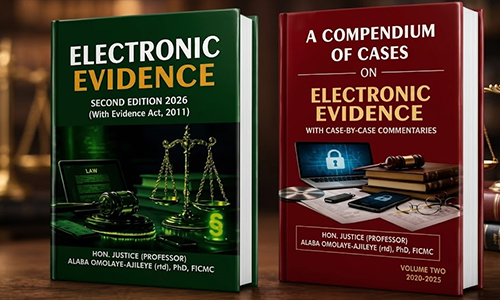

 Interested buyers are encouraged to place their orders and enquiries via:
0704 444 4777, 0704 444 4999, 0818 199 9888
Website: www.alexandernigeria.com
Interested buyers are encouraged to place their orders and enquiries via:
0704 444 4777, 0704 444 4999, 0818 199 9888
Website: www.alexandernigeria.com