By Ebun-Olu Adegboruwa, SAN

Per OGBUINYA, J.S.C. at pages 383-384, paras. E-B:
“It cannot be gainsaid that the absence of stab wound/scar or injury on the appellant is a clear manifestation, via inference, that the deceased did not attack or stab her with the knife, exhibit F. Put the other way round, the drawable inference is that the appellant was the aggressor or one who provoked the encounter, not the deceased, as pontificated by the appellant. In this wise, the law forbids her from taking shelter under the exculpating sanctuary of self-defence. In the same vein, the moment the appellant gallantly dispossessed the deceased of the knife, an offensive weapon par excellence in law, the deceased became armless and destitute of any lethal weapon. In that situation, there ceased, if it existed, any imminent danger to the appellant’s life, either real or apparent. At once, even if the deceased attacked the appellant with bare hands, her mode of retaliation was disproportionate to the mode of attack. This is a serious coup de grace to the defence of self-defence. See Nwokearu v. State (2013) 16 NWLR (Pt. 1380) 207; Edoko v. State (supra). Again, once the deceased was disrobed of the knife weapon, the appellant’s precious life was no longer enveloped in danger even as she had the opportunity to retreat and escape from the deceased’s alleged threat, perceived or imagined, to her life.”
Per ABIRU, J.S.C. at pages 395-396, paras. C-B:
“In the present case, the evidence showed that at no time throughout the encounter did the deceased use the knife to cause any injury to the appellant. The appellant did allege that the deceased stabbed her with the knife, but she failed to lead evidence in proof of the allegation. The threat to the life or of bodily grievous harm to the appellant from the tenure of the evidence was when the car was in motion and the deceased had the knife in his hand. This threat became temporarily suspended when the deceased parked the vehicle in front of Comet Shipping Company and the appellant succeeded in switching off the engine of the vehicle and the knife fell from the hand of the deceased. There is no evidence to show that anything prevented the appellant from dashing out of the car at this point and running towards the gate of the company, where security guards were visibly stationed. Further, the nature and the location of the stab wounds that the appellant inflicted on the deceased in the course of the scuffle that followed the dropping of the knife by the deceased on the floor of the car and the appellant picking up same, multiple stab wounds on the neck, back and buttocks of the deceased, show how ferocious the attack by the appellant on the deceased was….The above showed that the attack by the appellant on the deceased progressed beyond self-defence and into the realm of retaliation. There is no doubt that the action of the deceased in s3xually harassing the appellant was despicable, however, the law does not support and/or protect an act of retaliation. This is because, as the saying goes, an eye for an eye makes the world go blind. The response of the appellant to the threat posed to her by the deceased was disproportionate. The findings of the two lower courts that the defence of self-defence was not opened to the appellant cannot be faulted.”
The Importance of Facts in the Determination of Cases:
The essence of facts in the determination of cases cannot be overemphasised. Facts are the forerunners and arrowheads of the law. They act like magnets with the potential to turn around the fortune or misfortune of a case completely. They define the success or failure of cases. In the heydays of the Roman law, they were couched as: Ex facto oritur jus – law has its offspring on the fact.
The Purport of the Doctrine of Stare Decisis:
The ancient doctrine of stare decisis et non quieta movere – to stand by things decided and not to disturb settled points – is deeply rooted in our corpus juris. It was invented to ensure certainty and eschew fluidity in law.
The Relevance of Facts to Doctrine of Stare Decisis:
The doctrine of stare decisis breeds and thrives where and when the facts of cases are in pari materia. On the contrary, it is lame where facts of cases are not on all fours. In the instant case, insofar as the material facts of the two cases, Laoye v. State (1985) 2 NWLR (Pt. 10) 832 and the instant appeal remained distinguishable, the doctrine of stare decisis was disabled and impotent to grant the Supreme Court the needed imprimatur to kowtow to its decision in Laoye v. State.
When a Verdict of Court is Perverse:
A verdict of court is perverse when:
(a) it runs counter to the pleadings and evidence before it; or (b) a court takes into account matters it ought not to take into consideration; or (c) a court shuts its eyes to the evidence; or (d) a court takes irrelevant matters into account; or (e) it has occasioned a miscarriage of justice. In the instant case, the judgment of the Court of Appeal was not perverse nor occasioned a miscarriage of justice to warrant the interference of the Supreme Court.
The Duty on Appellant Appealing to the Supreme Court Against Concurrent Findings of the Trial Court and the Court of Appeal:
An appellant who presents an appeal to the Supreme Court against concurrent findings of the two lower courts faces the unenviable difficult task of convincing the Court that the findings are perverse, in that they are not supported by the evidence on record, thereby occasioning a miscarriage of justice, or that the findings have offended some principles of procedural or substantive law. Where the findings are not shown to have suffered from any of the deficiencies highlighted, the attitude of the Supreme Court is to steer clear of disturbing or interfering with such findings as uniformly arrived at by the two lower courts. In the instant case, the appellant was unable to show the existence of any exceptional circumstances to persuade the Supreme Court to interfere with the concurrent findings grounding the decisions of the trial court and the Court of Appeal. The Supreme Court therefore affirmed the judgment of the Court of Appeal which affirmed the judgment of the trial Court which convicted and sentenced the appellant.
What the Principle of Necessity Guides Against and on What it is Premised:
The principle of necessity guards against the use of measures which are excessive and not necessary in response to an armed attack. These principles are premised on the understanding that all human beings, even those who commit or attempt to commit serious crimes, have a right to life.
Whether the Use of Lethal Force is Permissible Against Lesser Threats Than a Threat to Life:
The reason we are permitted to kill someone who threatens our life is that the right to life of the aggressor is temporarily forfeited by virtue of becoming an unjust immediate threat to the life of another. Thus, the use of lethal force is not permissible against lesser threats than a threat to life.
CONCLUSION
This case highlights the fact that our law enforcement agencies can perform if properly funded. Due commendation therefore goes to the State Criminal Investigation Department of the Lagos Command of the Nigeria Police Force, popularly known as “Panti”, a name it earned from the circumstances of its physical location on Panti Street in Ebute-Metta, Yaba area of Lagos State. “Panti” means refuse and the Street was so named because towards the end is a deep gully that used to be inaccessible so it was gradually converted into a dump site by cart pushers and waste disposal companies. Growing up as a young man in the area, I became very familiar with that terrain, especially in the course of mobilisation for revolutionary struggles. I was also detained at “Panti” along with the late Dr. Beko Ransome-Kuti, Comrade Chima Ubani and other Comrades, during the June 12 struggles. In modern day Nigeria, what has emerged from that SCID by way of forensic investigation and crime detection and prevention can no longer be described as “Panti”. Government should therefore fund and equip the Police for better performance. From my personal experiences both as a detainee and counsel, the state of dilapidation of the facilities and infrastructure in this critical department of the police force is totally undeserving of Nigerians, given that security of lives and property is one of the primary purposes of government. The prosecution department of the Lagos State Ministry of Justice has become (if not) the best that Nigeria can boast of. From my days as a young man, I followed Directors of Public Prosecution in this Ministry like Hon. Justice Bayo Manuwa, Hon Justice Bode Rhodes-Vivour, Dr. Fola Arthur-Worry, up to Dr. Babajide Martins, the current DPP. The deliberate investment of the Lagos State Government in training and exposure for officers of this critical Department is highly commendable and should be sustained for the common good. Above all, the case of Saheed v The People of Lagos is a clear example of how failure of governance can impact and endanger the lives of people negatively. The unfortunate reality is that nothing has changed from the time of this case. As the saying goes, people only deserve the kind of life that is equal to the type of leadership that they vote for or rig into office. An unfortunate case for both the deceased and the appellant but we can and should learn the lessons of life from the facts as reported.
 Interested buyers are encouraged to place their orders and enquiries via:
0704 444 4777, 0704 444 4999, 0818 199 9888
Website: www.alexandernigeria.com
Interested buyers are encouraged to place their orders and enquiries via:
0704 444 4777, 0704 444 4999, 0818 199 9888
Website: www.alexandernigeria.com

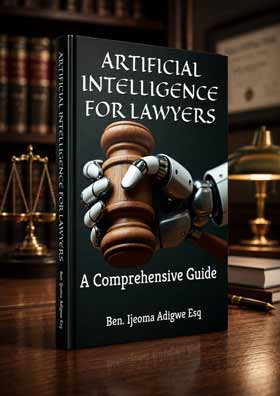 The book also examines Nigeria's legal ecosystem, focusing on the LPELR and NBA AI Guidelines. As a bonus, every purchase comes with a FREE eBook titled: How to Use the AI Features in LegalPedia and LawPavilion.
Ohio Books Ltd praises the publication, stating:
"....this is the only Nigerian book I know of on the topic."
How to Order:
📞 Call, Text, or WhatsApp: 08034917063 | 07055285878
📧 Email: benadigwe1@gmail.com
🌎 Website: www.benadigwe.com
Ebook Version: Access it directly online at https://selar.com/prv626
Authored by Ben Ijeoma Adigwe Esq., ACIarb (UK), LL.M, Dip. in Artificial Intelligence, Director at the Delta State Ministry of Justice, Asaba, Nigeria.
_______________________________________________________________________
The book also examines Nigeria's legal ecosystem, focusing on the LPELR and NBA AI Guidelines. As a bonus, every purchase comes with a FREE eBook titled: How to Use the AI Features in LegalPedia and LawPavilion.
Ohio Books Ltd praises the publication, stating:
"....this is the only Nigerian book I know of on the topic."
How to Order:
📞 Call, Text, or WhatsApp: 08034917063 | 07055285878
📧 Email: benadigwe1@gmail.com
🌎 Website: www.benadigwe.com
Ebook Version: Access it directly online at https://selar.com/prv626
Authored by Ben Ijeoma Adigwe Esq., ACIarb (UK), LL.M, Dip. in Artificial Intelligence, Director at the Delta State Ministry of Justice, Asaba, Nigeria.
_______________________________________________________________________