By Dr. Olumide Babalola
About a week ago, the Federal High Court delivered what has been widely described as a landmark decision in one of the most publicized criminal trials (involving university lecturer and a sexually violated student) in recent Nigerian history. The trial involved the prosecution and conviction of a university lecturer, Professor Cyril Osim Ndifon, for sexual offences. While commentary on the case has primarily focused on the criminality and public interest aspects, what particularly caught my attention were the privacy issues embedded in both the charge and the subsequent judgment. These privacy considerations raise important questions about how personal data and witness identities are handled in Nigerian criminal proceedings. In the succeeding paragraphs, I reflect on these issues and offer my perspective.
Pseudonymization of the Principal Witness’s Identity
The first count in the charge reads as follows: “That you, Professor Cyril Osim Ndifon (M) sometime between the months of May and September, 2023, or thereabout at Calabar, the Cross River State Capital, within the jurisdiction of this Honourable Court, while being in the employ of the University of Calabar as Dean of Faculty of Law, caused one MISS TKJ (not real name), a diploma student of the University of Calabar, to send pornographic, indecent, and obscene photographs of herself to you through your mobile telephone number: 0803**, vide WhatsApp chats, and you thereby committed an offence contrary to and punishable under section 24 of the Cybercrime (Prohibition & Prevention) Act 2015.”
Notably, the charge replaces the real name of the principal witness with the pseudonym “MISS TKJ.” In privacy and data protection parlance, this practice is referred to as pseudonymization.
Pseudonymization is a data security technique whereby personally i information is processed so that it cannot be attributed to a specific individual without the use of additional information. In simpler terms, pseudonymization replaces direct identifiers (such as names, telephone numbers, email addresses, or national identification numbers) with coded references, aliases, or keys, so that the individual’s identity is protected unless someone has access to the additional information that links the code to the real person.
The prosecution and the court are to be commended for employing pseudonymization to protect the principal witness. This approach aligns with Section 39(2)(a) of the Nigeria Data Protection Act 2023 (NDPA) and Article 26(b) of the NDPA-General Application and Implementation Directive (GAID), which require data controllers to consider the suitability of pseudonymization whenever circumstances demand it. By masking the principal witness’s identity, the prosecution demonstrated a conscious effort to adhere to privacy principles while fulfilling its duty to pursue justice.
The Privacy Paradox in the Prosecution
Despite the commendable pseudonymization of the principal witness’s name, the charge also exposes certain contradictory practices that undermine privacy protections, a phenomenon often referred to as the privacy paradox.The privacy paradox describes the situation where actors (be they individuals, organizations, or institutions) express concern for privacy but, in practice, engage in actions that compromise it.
In this case, while the prosecution concealed the witness’s name, it openly disclosed her telephone number. In today’s digital age, phone numbers are highly sensitive personal identifiers, often linked to social media profiles, banking information, and other private data. Revealing the telephone number therefore partially negates the privacy safeguards afforded by pseudonymization, exposing the witness to potential intrusion, harassment, or identity compromise.
Moreover, the judgment illustrates a discrepancy in privacy protection across victims. While the principal witness’s name was concealed, other victims in the case, such as a 20-year-old rape victim, did not receive similar protections. This inconsistency highlights a broader issue: privacy protections in court proceedings are often piecemeal and dependent on discretionary decisions rather than being uniformly applied. Every victim, especially in sexual offence cases, is entitled to privacy protections, not just the principal witness.
A Silver Lining for Privacy in Court Proceedings
Despite these shortcomings, the prosecution’s decision to pseudonymize the principal witness is a positive development in the ongoing effort to create privacy-conscious court procedures in Nigeria. It underscores the importance of balancing transparency in judicial proceedings with the need to safeguard sensitive personal data, particularly for vulnerable witnesses.
This case sets a precedent and offers valuable lessons for future prosecutions i.e: pseudonymization should be applied consistently, not selectively, to all victims and witnesses in sensitive cases; direct identifiers beyond names, (such as telephone numbers, email addresses, or other unique personal data) should also be masked or partially redacted to prevent re-identification.
Ultimately, FRN v Prof. Ndifon demonstrates both the potential and the limitations of privacy measures in Nigerian criminal proceedings. While the pseudonymization of the principal witness’s name represents progress, the partial disclosure of other identifiers illustrates that there is still work to be done. The case serves as a call to action for prosecutors, judges, and legal practitioners to adopt more comprehensive privacy practices to protect witnesses and victims while maintaining the integrity of the justice system.
Conclusion
The FRN v Prof. Ndifon judgment presents a mixed but instructive picture of witness privacy in Nigerian courts. Pseudonymization of the principal witness’s identity demonstrates a conscious effort to comply with privacy principles, aligning with emerging statutory obligations under the NDPA. However, selective protection and the disclosure of other sensitive personal data reveal gaps in the application of these principles. As Nigeria continues to evolve its data protection and privacy landscape, it is imperative that judicial processes integrate comprehensive privacy safeguards, ensuring that all victims and witnesses can participate in the justice system without fear of unnecessary exposure. FRN v Prof. Ndifon offers both a benchmark and a lesson for achieving this balance.
[A MUST HAVE] Evidence Act Demystified With Recent And Contemporary Cases And Materials

Available now for NGN 40,000 at ASC Publications, 10, Boyle Street, Onikan, Lagos. Beside High Court, TBS. Email publications@ayindesanni.com or WhatsApp +2347056667384. Purchase Link: https://paystack.com/buy/evidence-act-complete-annotation
______________________________________________________________________ “Enhance Legal Practice With Authoritative Reports” — Alexander Payne Offers Comprehensive Law Reports, Spanning Over A Century Of Nigerian Jurisprudence Interested buyers are encouraged to place their orders and enquiries via:
0704 444 4777, 0704 444 4999, 0818 199 9888
Website: www.alexandernigeria.com
Interested buyers are encouraged to place their orders and enquiries via:
0704 444 4777, 0704 444 4999, 0818 199 9888
Website: www.alexandernigeria.com
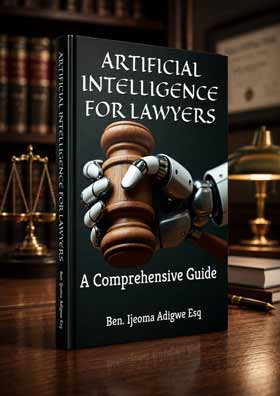 The book also examines Nigeria's legal ecosystem, focusing on the LPELR and NBA AI Guidelines. As a bonus, every purchase comes with a FREE eBook titled: How to Use the AI Features in LegalPedia and LawPavilion.
Ohio Books Ltd praises the publication, stating:
"....this is the only Nigerian book I know of on the topic."
How to Order:
📞 Call, Text, or WhatsApp: 08034917063 | 07055285878
📧 Email: benadigwe1@gmail.com
🌎 Website: www.benadigwe.com
Ebook Version: Access it directly online at https://selar.com/prv626
Authored by Ben Ijeoma Adigwe Esq., ACIarb (UK), LL.M, Dip. in Artificial Intelligence, Director at the Delta State Ministry of Justice, Asaba, Nigeria.
______________________________________________________________________
The book also examines Nigeria's legal ecosystem, focusing on the LPELR and NBA AI Guidelines. As a bonus, every purchase comes with a FREE eBook titled: How to Use the AI Features in LegalPedia and LawPavilion.
Ohio Books Ltd praises the publication, stating:
"....this is the only Nigerian book I know of on the topic."
How to Order:
📞 Call, Text, or WhatsApp: 08034917063 | 07055285878
📧 Email: benadigwe1@gmail.com
🌎 Website: www.benadigwe.com
Ebook Version: Access it directly online at https://selar.com/prv626
Authored by Ben Ijeoma Adigwe Esq., ACIarb (UK), LL.M, Dip. in Artificial Intelligence, Director at the Delta State Ministry of Justice, Asaba, Nigeria.
______________________________________________________________________