The Senate has approved a maximum 14-year jail term and a minimum of five years without the option of a fine for anyone convicted of sexually harassing students in tertiary educational institutions across Nigeria.


The upper chamber, on Wednesday, passed for third reading the Sexual Harassment of Students (Prevention and Prohibition) Bill, 2025 (HB.1597), which seeks to prevent and prohibit sexual harassment of students in educational institutions and other places nationwide.
The bill, presented for concurrence by the Senate Leader, Senator Opeyemi Bamidele (APC, Ekiti Central), is designed to protect students from all forms of sexual misconduct and abuse within academic environments while establishing clear legal frameworks for enforcement and punishment of offenders.
According to Senator Bamidele, the legislation aims to “promote and protect ethical standards in tertiary education, uphold the sanctity of the student–educator fiduciary relationship, and safeguard human dignity by ensuring students are protected from sexual harassment by educators.”
Under the new law, anyone found guilty of committing offences outlined in Clauses 4(1), (2), and (3) faces imprisonment of up to 14 years but not less than five years, without an option of a fine. Offences under Clauses 4(4) to (6) attract between two and five years imprisonment, also without the option of a fine.
The bill also allows students who are victims of sexual harassment to file civil actions for breach of fiduciary duty, with the standard of proof consistent with other civil proceedings. It provides for the establishment of Independent Sexual Harassment Prohibition Committees in institutions to handle complaints in accordance with its provisions.
It further stipulates that criminal proceedings must take precedence over internal disciplinary measures, prohibiting any institutional body from conducting separate disciplinary actions while a case is pending in court.
Offences under the bill include any act of sexual intercourse or demand for sexual favors from students by educators, intimidation, creating a hostile environment, or engaging in any form of physical or verbal sexual harassment.
The law also criminalizes the display or transmission of sexually explicit materials to students and unwanted touching, hugging, or comments of a sexual nature.
It clarifies that consent from a student is not a valid defense, though legal marriage between the educator and student constitutes a lawful exception.
During deliberations, several lawmakers commended the bill’s intent but suggested expanding its scope beyond the education sector.
Senator Adams Oshiomhole (APC, Edo North) argued that sexual harassment legislation should not be limited to academic environments, noting, “There is no need to restrict sexual harassment issues to students. We should craft this law in a way that gives it universal application.”
Senator Anthony Ani supported the position, emphasizing that sexual harassment “is everywhere” and that limiting the bill to tertiary institutions “is a misnomer.”
However, Deputy Senate President Barau Jibrin (APC, Kano North), who presided over the session, clarified that the bill, being a concurrent legislation from the House of Representatives, was not open to extensive debate but could only be amended.
He added that existing laws already address harassment in workplaces and other public institutions.
After brief deliberations, the Senate passed the bill for third reading, marking a major step toward protecting students and strengthening accountability within Nigeria’s tertiary education system.
 Interested buyers are encouraged to place their orders and enquiries via:
0704 444 4777, 0704 444 4999, 0818 199 9888
Website: www.alexandernigeria.com
Interested buyers are encouraged to place their orders and enquiries via:
0704 444 4777, 0704 444 4999, 0818 199 9888
Website: www.alexandernigeria.com

“Order Justice Omolaye-Ajileye’s Electronic Evidence Books Now” — Essential Guides On Evidence Act, Case Law And Digital Proof
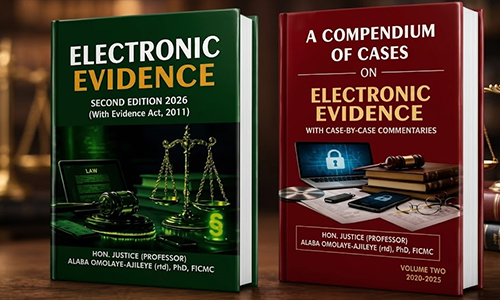
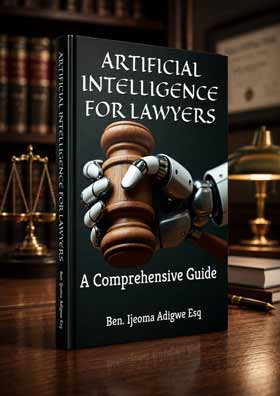 The book also examines Nigeria's legal ecosystem, focusing on the LPELR and NBA AI Guidelines. As a bonus, every purchase comes with a FREE eBook titled: How to Use the AI Features in LegalPedia and LawPavilion.
Ohio Books Ltd praises the publication, stating:
"....this is the only Nigerian book I know of on the topic."
How to Order:
📞 Call, Text, or WhatsApp: 08034917063 | 07055285878
📧 Email: benadigwe1@gmail.com
🌎 Website: www.benadigwe.com
Ebook Version: Access it directly online at https://selar.com/prv626
Authored by Ben Ijeoma Adigwe Esq., ACIarb (UK), LL.M, Dip. in Artificial Intelligence, Director at the Delta State Ministry of Justice, Asaba, Nigeria.
_______________________________________________________________________
The book also examines Nigeria's legal ecosystem, focusing on the LPELR and NBA AI Guidelines. As a bonus, every purchase comes with a FREE eBook titled: How to Use the AI Features in LegalPedia and LawPavilion.
Ohio Books Ltd praises the publication, stating:
"....this is the only Nigerian book I know of on the topic."
How to Order:
📞 Call, Text, or WhatsApp: 08034917063 | 07055285878
📧 Email: benadigwe1@gmail.com
🌎 Website: www.benadigwe.com
Ebook Version: Access it directly online at https://selar.com/prv626
Authored by Ben Ijeoma Adigwe Esq., ACIarb (UK), LL.M, Dip. in Artificial Intelligence, Director at the Delta State Ministry of Justice, Asaba, Nigeria.
_______________________________________________________________________