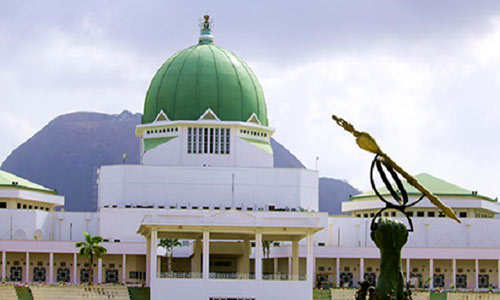
The National Assembly is considering a major shift in Nigeria’s electoral timetable, proposing that presidential and governorship elections be moved from the traditional February or March dates to November 2026.


The proposal is contained in draft amendments to the Electoral Act 2022, discussed during a one-day public hearing held on Monday in Abuja.
According to Section 4(7) of the proposed bill, elections into the offices of the President and governors “shall be held not later than 185 days before the expiration of the term of office of the last holder of the office.”
Given that the current administration ends on May 29, 2027, the next presidential and governorship elections would be held around November 2026.
Similarly, Section 4(5) provides that elections into the National Assembly and State Houses of Assembly shall be conducted “not later than 185 days before the date on which each of the Houses stands dissolved.”
Explaining the rationale, the Chairman of the House Committee on Electoral Matters, Hon. Adebayo Balogun, said the adjustment aims to ensure that all election litigations are concluded before newly elected leaders are inaugurated.
“We are proposing that all election cases be resolved before the swearing-in. To achieve this, tribunal judgments will take 90 days, while appellate and Supreme Court decisions will each take 60 days — all within 185 days before inauguration,” Balogun said.
He added that corresponding amendments to Sections 285 and 139 of the 1999 Constitution would align the new timelines.
Stakeholders, including the Independent National Electoral Commission (INEC) represented by Prof. Abdullahi Zuru, expressed support for reforms that would enhance transparency through electronic voting and result transmission.
Under the proposed Section 60(5), presiding officers must transmit results electronically and manually, with non-compliance attracting a one-year jail term, a ₦1 million fine, or both.
The draft also introduces early voting for security personnel, INEC officials, journalists, observers, and ad hoc staff, allowing them to vote up to 14 days before the main election.
Another key provision seeks to move election timelines from the Constitution to the Electoral Act to allow future adjustments without constitutional amendment.
At the hearing, Senate President Godswill Akpabio and House Speaker Abbas Tajudeen described the reform as crucial to sustaining democracy and ensuring leadership legitimacy.
Abbas, represented by House Leader Prof. Julius Ihonvbere, said:
“Our democracy rests on credible elections. Unless contests are freer, fairer, cheaper, and less contentious, we endanger the Fourth Republic.”
He explained that the proposed bill seeks to strengthen measures against electoral fraud, improve accessibility for persons with disabilities, and establish firmer timelines for resolving disputes.
“Our goal is to make elections less litigious, reduce costs through single-day voting, and make party primaries more democratic,” he added.
He noted that the reforms — including electronic result transmission, creation of an Electoral Offences Commission, and fixed deadlines for dispute resolution — were informed by submissions from citizens, civil society, and election observers.
“We must make the ballot sacred and ensure every vote counts,” Abbas emphasized.
Akpabio, represented by Senate Whip Senator Mohammed Tahir Monguno, described electoral reform as “the lifeblood of democracy.”
“When citizens believe their votes count, they invest faith in the Republic. Our duty as legislators is to build a system where every Nigerian knows their vote is sacred and immune to manipulation,” he said.
Senator Simon Lalong noted that the hearing demonstrated the legislature’s commitment to public participation in lawmaking.
“Elections are the lifeblood of democracy. Our goal is to strengthen integrity and public confidence in the process,” he stated.
Balogun acknowledged that while the Electoral Act 2022 introduced innovations like BVAS, lessons from the 2023 general elections revealed gaps in technology, internal party democracy, and campaign financing.
INEC’s Prof. Zuru proposed an amendment to Section 47(1) to allow electronically downloadable voter cards, early voting for essential workers, and legal backing for diaspora voting.
“This happens in many countries; why not Nigeria?” he asked.
Cynthia Rowe, Head of Development Cooperation at the Foreign, Commonwealth and Development Office (FCDO), commended the National Assembly’s bipartisan approach, describing the hearing as “a testament to Nigeria’s democratic progress.”
“Public hearings give citizens a voice. Reforms must not just be for the people but with the people. The decisions taken here will have far-reaching implications for credible, transparent elections that include all Nigerians,” she said.
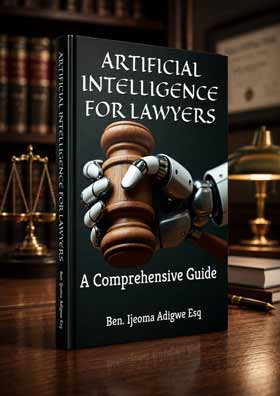 The book also examines Nigeria's legal ecosystem, focusing on the LPELR and NBA AI Guidelines. As a bonus, every purchase comes with a FREE eBook titled: How to Use the AI Features in LegalPedia and LawPavilion.
Ohio Books Ltd praises the publication, stating:
"....this is the only Nigerian book I know of on the topic."
How to Order:
📞 Call, Text, or WhatsApp: 08034917063 | 07055285878
📧 Email: benadigwe1@gmail.com
🌎 Website: www.benadigwe.com
Ebook Version: Access it directly online at https://selar.com/prv626
Authored by Ben Ijeoma Adigwe Esq., ACIarb (UK), LL.M, Dip. in Artificial Intelligence, Director at the Delta State Ministry of Justice, Asaba, Nigeria.
_______________________________________________________________________
The book also examines Nigeria's legal ecosystem, focusing on the LPELR and NBA AI Guidelines. As a bonus, every purchase comes with a FREE eBook titled: How to Use the AI Features in LegalPedia and LawPavilion.
Ohio Books Ltd praises the publication, stating:
"....this is the only Nigerian book I know of on the topic."
How to Order:
📞 Call, Text, or WhatsApp: 08034917063 | 07055285878
📧 Email: benadigwe1@gmail.com
🌎 Website: www.benadigwe.com
Ebook Version: Access it directly online at https://selar.com/prv626
Authored by Ben Ijeoma Adigwe Esq., ACIarb (UK), LL.M, Dip. in Artificial Intelligence, Director at the Delta State Ministry of Justice, Asaba, Nigeria.
_______________________________________________________________________
“Order Justice Omolaye-Ajileye’s Electronic Evidence Books Now” — Essential Guides On Evidence Act, Case Law And Digital Proof
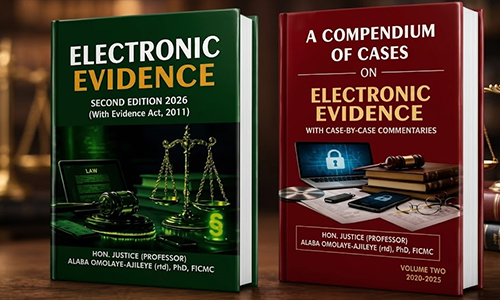

 Interested buyers are encouraged to place their orders and enquiries via:
0704 444 4777, 0704 444 4999, 0818 199 9888
Website: www.alexandernigeria.com
Interested buyers are encouraged to place their orders and enquiries via:
0704 444 4777, 0704 444 4999, 0818 199 9888
Website: www.alexandernigeria.com