By Douglas Ogbankwa
The Nigerian society is currently plagued by numerous legal and economic maladies. Historically, citizens’ accounts were frozen based on letters or bankers’ orders—a document issued by magistrates. However, such orders have been deemed illegal, as they merely permit inspection of accounts rather than authorize freezing. This principle was clearly enunciated in the celebrated case of GTB PLC v. Adedamola (2019) 5 NWLR (Pt. 1664), 30 at 45. The case further established that when freezing an account via an Ex Parte Order, the filing of the Ex Parte must accompany a motion on notice, which must be served on the bank customer along with the freezing order to ensure fair hearing.
Despite this, the police, the EFCC, and other security agencies often obtain court orders to freeze citizens’ accounts without affording them the opportunity to be heard. Their justification is frequently that the referenced payments originated from “suspicious sources,” as if ordinary business transactions between citizens constitute a crime. Merely depositing money into an individual’s account is not proof of money laundering or any plot to destabilize Nigeria.
In today’s era of international commerce and cooperation, cross-border transactions are prevalent. To freeze an account based on a suspicious transaction, there must be proof of an alleged infraction.
The freezing of accounts has had severe economic consequences, including job losses due to comatose businesses. No serious investor would risk investing in an economy where the safety of their savings or investments is uncertain. Financial institutions themselves often benefit from frozen accounts, as they can utilize the funds without paying interest or offering returns. In effect, a frozen account becomes a forced fixed deposit by the system, yielding no return on investment. The practice assumes criminal dimensions, particularly when done without due process.
Sudden account freezes by security agencies have dampened investor confidence in Nigeria, presenting the country as unsafe for investments. How can international investors bring funds to a country where the government may unilaterally direct a court to freeze accounts without giving the owners an opportunity to be heard? In the 21st century, this is simply ludicrous.
Constitutional Basis for Fair Hearing
Section 1(1) of the Constitution of the Federal Republic of Nigeria, 1999 (as amended), provides:
“This Constitution is supreme, and its provisions shall have binding force on the authorities and persons throughout the Federal Republic of Nigeria.”
Accordingly, any provisions in the CBN Act or EFCC Act that empower these agencies to freeze citizens’ finances without affording them a fair hearing—as guaranteed under Section 36(1), (3), and (6) of the Constitution—are null and void to the extent of their inconsistency with the Constitution. This principle is well established in numerous judicial authorities.
The use of Ex Parte Orders to freeze accounts contravenes the constitutional principle of fair hearing. Citizens are entitled to be heard before any such action occurs. In fact, the law now mandates that a motion on notice must be served on the bank customer following the freezing of an account.
Section 36(1) of the Constitution further affirms:
“In the determination of his civil rights and duties, including any question or decision by or against any government or authority, a person shall be entitled to a fair hearing within a reasonable time by a court or other tribunal established by law.”
The principle of fair hearing, one of the twin pillars of natural justice, dates back to the Garden of Eden, when even the Almighty allowed Adam to defend himself.
In Uzowolu (Oduah) & Ors. v. Akpor & Ors. (2014) LCN/6777 (CA), the Court of Appeal succinctly stated:
“A party’s right to fair hearing is of fundamental and constitutional significance and cannot be compromised or whittled down by the court for any reason. Any decision reached in breach of fair hearing is a nullity and liable to be set aside.”
Multiple judicial authorities reiterate this principle, including FBN PLC (15 NWLR Pt. 1216, 247), Otapo v. Adeyemi (Pt. 58, 587), and UBA Ltd v. Achoru (1990, 6 NWLR Pt. 156, 254). The message is clear: owners of frozen accounts should be allowed to defend themselves, and violations of this right may warrant punitive damages and public apology.
The Court of Appeal, per Helen Morineke Ogumiwunju (as he then was, now a Supreme Court Justice), further questioned the powers of government bodies to clamp down on citizens’ finances via Ex Parte Orders, even in tax matters, in Independent Television/Radio v. Edo State Board of Internal Revenue (2015) 12 NWLR (Pt. 1474) 442.
Banking Law: Compliance With EFCC Directives
A landmark case illustrating these principles is:
CASE TITLE: Guaranty Trust Bank PLC v. Odeyemi Oluyinka Joshua (2021) LPELR 53173 (CA)
JUDGMENT DATE: 26th February 2021
COURT DIVISION: Lagos
JUSTICES: Oyebisi Folayemi Omoleye, JCA; James Shehu Abiriyi, JCA; Frederick Oziakpono Oho, JCA
The respondent, a customer of GTB, contended that his account was frozen without his knowledge pursuant to a letter from the EFCC, and without any valid court order. He sought declarations that the freezing was illegal, an order to unfreeze his account, perpetual injunction against further freezing, and general damages.
The trial court ruled in favor of the respondent, and the bank appealed. The Court of Appeal dismissed the appeal, affirming that:
- Banks must ensure that any directive from the EFCC to freeze a customer’s account is accompanied by a valid court order.
- Section 34 of the EFCC Act permits the EFCC to apply for an Ex Parte Order if it suspects funds were obtained through an offence; without such an order, the bank cannot freeze accounts.
- Compliance with unlawful EFCC directives without due verification exposes banks to liability.
Conclusion and Call to Action
It is imperative for courts to uphold the Constitution and stop issuing orders contrary to its provisions. Government adherence to the rule of law is essential for a peaceful and stable society. As Hon. Justice Chukwudifu Oputa (JSC) once stated:
“Fishes live in water in obedience to aquatic laws, just as humans stay within the ambit of the rule of law. Any society that does not exist under the ambit of the rule of law, like a fish out of water, will surely perish.”
The immediate defreezing of accounts and payment of compensation to victims is warranted. Courts must act as protectors of liberties, not mere rubber stamps for government actions that contravene the law.
About the Author
Douglas Ogbankwa, Esq. (douglasogbankwa@gmail.com), immediate past Director of Strategic Communications of the African Bar Association (AfBA), is the Convener of the Vanguard for the Independence of the Judiciary and the Security Situation Room.
[A MUST HAVE] Evidence Act Demystified With Recent And Contemporary Cases And Materials

Available now for NGN 40,000 at ASC Publications, 10, Boyle Street, Onikan, Lagos. Beside High Court, TBS. Email publications@ayindesanni.com or WhatsApp +2347056667384. Purchase Link: https://paystack.com/buy/evidence-act-complete-annotation
______________________________________________________________________ “Enhance Legal Practice With Authoritative Reports” — Alexander Payne Offers Comprehensive Law Reports, Spanning Over A Century Of Nigerian Jurisprudence Interested buyers are encouraged to place their orders and enquiries via:
0704 444 4777, 0704 444 4999, 0818 199 9888
Website: www.alexandernigeria.com
Interested buyers are encouraged to place their orders and enquiries via:
0704 444 4777, 0704 444 4999, 0818 199 9888
Website: www.alexandernigeria.com
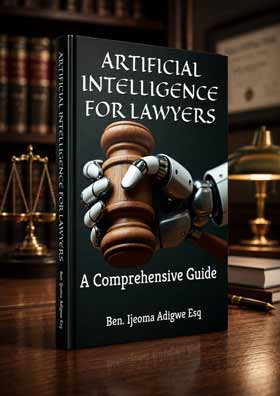 The book also examines Nigeria's legal ecosystem, focusing on the LPELR and NBA AI Guidelines. As a bonus, every purchase comes with a FREE eBook titled: How to Use the AI Features in LegalPedia and LawPavilion.
Ohio Books Ltd praises the publication, stating:
"....this is the only Nigerian book I know of on the topic."
How to Order:
📞 Call, Text, or WhatsApp: 08034917063 | 07055285878
📧 Email: benadigwe1@gmail.com
🌎 Website: www.benadigwe.com
Ebook Version: Access it directly online at https://selar.com/prv626
Authored by Ben Ijeoma Adigwe Esq., ACIarb (UK), LL.M, Dip. in Artificial Intelligence, Director at the Delta State Ministry of Justice, Asaba, Nigeria.
______________________________________________________________________
The book also examines Nigeria's legal ecosystem, focusing on the LPELR and NBA AI Guidelines. As a bonus, every purchase comes with a FREE eBook titled: How to Use the AI Features in LegalPedia and LawPavilion.
Ohio Books Ltd praises the publication, stating:
"....this is the only Nigerian book I know of on the topic."
How to Order:
📞 Call, Text, or WhatsApp: 08034917063 | 07055285878
📧 Email: benadigwe1@gmail.com
🌎 Website: www.benadigwe.com
Ebook Version: Access it directly online at https://selar.com/prv626
Authored by Ben Ijeoma Adigwe Esq., ACIarb (UK), LL.M, Dip. in Artificial Intelligence, Director at the Delta State Ministry of Justice, Asaba, Nigeria.
______________________________________________________________________