A former Kano State Governor and chieftain of the Peoples Democratic Party (PDP), Ibrahim Shekarau, has emphasised that the only coalition that can defeat President Bola Ahmed Tinubu in 2027 is for the coalition to be party-centred and not based on individuals.

He urged all opposition parties to explore ways and means of reinvigorating the existing platform to achieve such goals.
Shekarau disclosed this in a statement made available to newsmen, suggesting several efforts by him and other patriots to berth in 2011 a coalition to oust former President Goodluck Jonathan from office.
The former governor alluded to his recent comments regarding attempts by some political gladiators to coalesce into the African Democratic Congress (ADC) to wrest power from the ruling All Progressives Congress (APC) come 2027.
According to him, he didn’t say it was impossible for any coalition to dislodge the APC come 2027, but for such an initiative to succeed, the initiators must be established political parties and not individuals angling for power.
While clarifying his position with regards to the coalition initiative, Shekarau said, “Some people did not perceive my message correctly. For the sake of clarity, I did not say the coalition could not defeat Tinubu in 2027. What I said was that a coalition of ‘individuals’ rather than parties could not.”
He gave examples of attempts made by some now defunct political parties such as the Action Congress of Nigeria (ACN), Congress for Progressive Change (CPC) and the All Nigeria Peoples Party (ANPP) in 2011 to buttress his position.
He added that the participation he is alluding to refers to registered political parties with already elected governments and legislators on the ground, and with very reasonable grassroots followership at the time they made the attempt into a coalition.
He said, “I was a principal actor in the 2011 attempted coalition, being a Presidential candidate of the ANPP then. We had several meetings at President Tinubu’s residence in Abuja in 2011.
“At a point, (late former President Muhammadu) Buhari, (Nuhu) Ribadu and I, as the Presidential candidates of CPC, ACN and ANPP respectively, met at Buhari’s residence in Abuja to further discuss the coalition in 2011. But it did not work. So, each of us went into the election separately under our respective parties.
“This was a lesson to all of us, as individuals, and to our parties, too. Consequently, in 2012, the three parties CPC, ACN and ANPP decided to give the coalition business another go.”
He stated that the approach used in 2015 eventually paid off, owing to the fact that the leaders who took part in the former initiative better appreciated the importance of bargaining with their respective political platforms, rather than as individuals.
“This time, however, we employed a different approach. We pursued the process, not as individual candidates/aspirants or those who wanted to become this or that, but as representatives of our respective parties.
“The three parties each set up a 21-member committee, and I had the privilege of leading the ANPP committee,” he stated, just as he gave a breakdown of the series of events and activities that culminated in the emergence of the APC.
“The ACN committee was led by High Chief Tom Ikimi, while the CPC team was chaired by Alhaji Garba Gadi. All the then-serving governors and former governors of the three parties were members of their respective committees.
“So, 63 of us went into work as a joint ‘coalition team’. About three weeks into our work, Governor Rochas (Okorocha) of APGA approached us with a request to join the coalition talks. After clearing with our respective parties, APGA was granted permission to join with 21 members, too.
“Again, halfway into the coalition talk, a faction of the PDP came forward and was granted a membership of 5. This staggering figure of 89 members from five registered political parties worked as a coalition team, which in the end midwifed the birth of the APC,” he said.
He further added that the coalition talks without established opposition parties on the ground with elected members, such as the PDP, Labour Party (LP), and the Social Democratic Party (SDP), were doomed to fail.
“A few days ago, the SDP National Chairman said on BBC Hausa service that SDP was not in any coalition talks, and would not be involved, or even merge with any party.
“Where then did people like Mallam Nasiru El Rufai stand with his recent joining of the SDP? And yet he is a prominent member of the ongoing coalition talks. This means he was on his own in the coalition talks.
“Similarly, PDP and LP had issued statements that they knew nothing about the coalition talks despite the presence of Atiku and Obi on the panel of the coalition talks.
“One may argue that PDP and LP are currently experiencing serious disquiet in their leadership structures at the national level. Nonetheless, I feel that they should not be ignored and/or abandoned.
“For, ignoring them, with their structures and followers all over the Federation, may constitute possible additional minuses in the coalition process. My advice is that key and concerned senior members of both PDP and LP should put aside all factional sentiments and face, head-on, the leadership crisis in these parties. I strongly believe that the situation is not totally unsustainable.
“Politics is about people, and elections are about political parties. Hence, my argument is that, why do we not reinvigorate the existing opposition parties now on the ground with governments, legislators and structures across the country, and get them into the coalition moves, and if possible, into a merger to form one strong force to face the APC in 2027?
“As I said earlier, it is still not late. It is on record, it took only eight months from the start of the coalition talks, which produced the APC, to its eventual registration. We started the joint-committee meetings of ACN, ANPP, CPC, APGA and later a faction of DPP in November 2012 and got APC registered in July 2013.
“I, therefore, did not in any way say, or even imply, that no coalition will defeat Tinubu in 2027. I, in fact, started my last statement by appreciating and welcoming the coalition moves by some respected and very senior politicians.
“So, my word of caution does not in any way suggest pessimism. I am very optimistic that it will work.
“I even concluded my last statement by saying, with the correct vision, mission and focus, plus a genuine sense of righteousness, the narrative in the opposition parties can be changed within this year 2025 for success in the 2027 elections.
“But I said, unfortunately, so far, none of the registered opposition parties were involved. And I said it was still not too late to engage and carry the opposition parties along, because in the end, there has to be a common political platform upon which the opposition can contest elections and challenge the sitting government,” he stated.
 Interested buyers are encouraged to place their orders and enquiries via:
0704 444 4777, 0704 444 4999, 0818 199 9888
Website: www.alexandernigeria.com
Interested buyers are encouraged to place their orders and enquiries via:
0704 444 4777, 0704 444 4999, 0818 199 9888
Website: www.alexandernigeria.com

“Order Justice Omolaye-Ajileye’s Electronic Evidence Books Now” — Essential Guides On Evidence Act, Case Law And Digital Proof
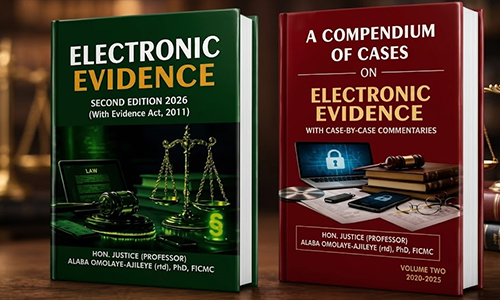
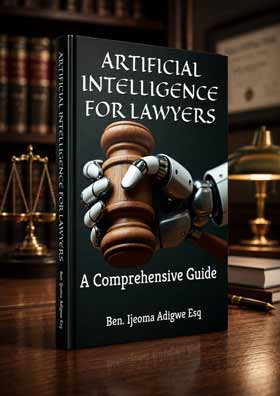 The book also examines Nigeria's legal ecosystem, focusing on the LPELR and NBA AI Guidelines. As a bonus, every purchase comes with a FREE eBook titled: How to Use the AI Features in LegalPedia and LawPavilion.
Ohio Books Ltd praises the publication, stating:
"....this is the only Nigerian book I know of on the topic."
How to Order:
📞 Call, Text, or WhatsApp: 08034917063 | 07055285878
📧 Email: benadigwe1@gmail.com
🌎 Website: www.benadigwe.com
Ebook Version: Access it directly online at https://selar.com/prv626
Authored by Ben Ijeoma Adigwe Esq., ACIarb (UK), LL.M, Dip. in Artificial Intelligence, Director at the Delta State Ministry of Justice, Asaba, Nigeria.
_______________________________________________________________________
The book also examines Nigeria's legal ecosystem, focusing on the LPELR and NBA AI Guidelines. As a bonus, every purchase comes with a FREE eBook titled: How to Use the AI Features in LegalPedia and LawPavilion.
Ohio Books Ltd praises the publication, stating:
"....this is the only Nigerian book I know of on the topic."
How to Order:
📞 Call, Text, or WhatsApp: 08034917063 | 07055285878
📧 Email: benadigwe1@gmail.com
🌎 Website: www.benadigwe.com
Ebook Version: Access it directly online at https://selar.com/prv626
Authored by Ben Ijeoma Adigwe Esq., ACIarb (UK), LL.M, Dip. in Artificial Intelligence, Director at the Delta State Ministry of Justice, Asaba, Nigeria.
_______________________________________________________________________