By Odatse P. Echo Esq.
INTRODUCTION
In Nigerian law, we have a statutory presumption of death but no matching presumption of life. Section 164(1) of the Evidence Act 2011 provides to the effect that: if a person has not been heard of by those who would naturally have heard of him for seven continuous years, he “is presumed to be dead”, unless the contrary is proved. By contrast, there is no express statutory certificate or presumption of life – indeed, nothing formally recognises a living person except the absence of a death record. In practice, this means a Nigerian who is alive is simply assumed to be alive until and unless death is proven. But that default state is an evidentiary lacuna: the law has no official document or presumption that declares “this person is alive” with legal weight. Echoing this gap, I have succinctly observed in my earlier article that: “Not all men who are still alive are recognized as still living and in existence, and not all men who are dead are presumed dead by law”.
In other words, it would appear that our law could currently let a living person be treated as legally presumed dead, and another dead person treated as alive, depending on the circumstances of the case and proofs adduced. One could say that instances may abound where it could be irresistibly submitted that not all living persons are in fact, alive, living and in existence and not all dead persons are actually dead. Some persons are alive but not living, or in existence while some are dead but still living.
This presumption gap breeds real-world problems. Take succession and inheritance, where families must prove a breadwinner’s death to divide an estate in certain circumstances. In Salihu v Wasiu (2016) 5 NWLR (Pt. 1506) 425, for instance, a man named Abdulmuminu vanished for 60 years with no evidence of his fate or whereabout. The court declined to distribute his estate because “the death of Abdulmuminu had not been confirmed and his age mates were still alive,” so his estate would not be divided until death was proven. Even decades of silence could not suffice. Similarly, where no “living certificate or Certificate of Life” exists, heirs may languish with estates in limbo unless they persuade a court to presume an absentee, dead under Section 164 of the Evidence Act. Conversely, someone presumed dead and whose assets are distributed may later surface, only to find their property dissipated. In short, property law suffers when living people lack a legally recognised status.
Identity and civil status also suffer. It is a fact of common knowledge that Nigeria issues birth certificates and death certificates – but no official certificate of existence for the living. This absence means, for example, that elderly Nigerians must rely on some stringent proofs, or informal proof (or face repeated bureaucracy) to prove they are alive for pensions, bank accounts, or travel documents. It also enables fraud: as unscrupulous persons might use the ambiguity to declare living pensioners dead (or vice versa) to misappropriate benefits. But beyond pension law, there appears to be no permanent life-status register in Nigeria, currently in force. The result is dangerous uncertainty. How can a widow claim her husband’s pension or insurance if the state never officially recorded that he was indeed alive up to his last contribution? How can officials cleanse voter register of the truly dead if they have no living-certificate trail to check against? In recent years, Nigeria has grappled with “ghost pensioners”, “ghost workers” and phantom voters – problems that better documentation might head off. In short, succession, identity, pensions, electoral rolls and general legal certainty all suffer when we lack a formal presumption or proof that someone is living.
These are not abstract worries. The Evidence Act itself hints at a presumption regime. Section 164(1) creates the death presumption after seven years of unexplained absence. Symmetrically, Section 167(b) embodies a presumption of continuance: if something has been shown to exist for a period shorter than its usual life-span, it “is still in existence.” This is classically applied to human life. As one leading authority explains, Section 167(b) means “a thing or state of things which has been shown to be in existence within a period shorter than that within which such things…usually cease to exist is still in existence.” Thus “one of the most common applications of this presumption is the presumption in favour of the continuance of human life”. In plain terms: if a person’s expected lifespan has not run out and no evidence of death appears, the law presumes the person is still alive unless proven otherwise. This has long been the rule in evidence law: an adult’s life is presumed to continue until age expectancy unless confronted by proof of demise.
In practice, Nigerian courts have affirmed both ends of this doctrine. Section 164(1) and Section 167(b) work together: we presume death only after seven years of silence, and we presume life if the death occurs prematurely. For example, in Kehinde Olude v. The State (2018) LPELR-44070(SC), the Supreme Court reaffirmed that “Section 164(1) of the Evidence Act 2011 raises a presumption of death where a person has not been seen or heard from for a period of 7 years”. But the very next statutory paragraph cautions that proof of the death of a person must be made and a person who cannot be reached or who is said to have died “within a period shorter than the normal life expectancy” is presumed to be alive by default – a corollary confirmed by Section 167(b). Echo Odatse Esq. has distilled this tension: “a person may be presumed dead by law after seven years of being incommunicado…although such a person perhaps could be alive” and conversely “no one is expected to be absent for over 7 years thus…circumstances abound where a person may be alive and living well, but may be presumed dead by law.”
The Court in Salihu v. Wasiu itself gave judicial imprimatur to this position. In the instant case, Abdulmuminu’s 60-year disappearance and uncertainty as to heirs did not permit simply treating him as dead – his death had never been confirmed, so his estate had to remain intact. (see: https://barristerng.com/know-the-law-as-it-is-v-115-a-person-may-be-alive-but-presumed-and-declared-dead-while-another-may-be-dead-but-presumed-alive-and-declared-still-existing-by-law-an-opinion-by-echo-odatse/)
In short, Nigerian jurisprudence already recognises a presumption gap: life is presumed by default, death only when triggered. But the law currently offers no concrete document or periodic check to reinforce that presumption of life. We rely entirely on absence of proof of death, an inherently unstable basis, methinks. This evidentiary gap cries out for reform. If our law painstakingly prescribes when to presume death, does it not strain logic that it leaves the living without any affirmative recognition beyond silence?
It is therefore submitted that every Nigerian urgently needs a statutory “Certificate of Life” (or Living Certificate) to complement the death certificate regime. Such a certificate would reverse the evidentiary burden in a practical way: instead of assuming existence from non-existence of a death record, every person would have a government-issued confirmation of life on record.
It is proposed that:
Upon birth, every Nigerian child should automatically receive a Certificate of Life (in addition to a birth certificate), valid until a death certificate is issued. This immediately records the new person’s existence in an official registry.
Say for instance, every 15 years, the certificate database would be renewed or updated free of charge (at, say, ages 15, 30, 45, 60, etc.) with minimal formalities. – This periodic renewal keeps the registry current and provides checkpoints for identity updates.
A National Register of the Living should be maintained (perhaps by NIMC or a dedicated agency), cross-referencing the living certificates with identity numbers and vital records. This registry would serve authorities (courts, pension funds, electoral commissions, banks, etc.) whenever proof of life, or proof of being alive is needed.
Such a framework has obvious jurisprudential and practical benefits. Legally, it brings symmetry as every citizen would have documented “living status,” eliminating the blind spot that currently leaves many questions open. It reinforces the general presumption of life enshrined in Section 167(b) with a tangible record.
Moreso, in the light of technology advancement such as cloning and human modifications via surgeries and artificial implants, it is possible for a person who is physically present to be in fact death a long time ago. A verified living certificate or a certificate of life would help clarify such a person’s correct status amongst real human beings.
Practically, a Certificate of Life or Living Certificate would protect rights and prevents fraud. For inheritance, it would allow executors and co-owners to prove survivorship without waiting for mysterious disappearances to lapse into presumption. In pension and insurance administration, it would prevent schemes where fraudulent actors declare lives prematurely ended to claim benefits. For electoral integrity, it would enable INEC to cleanse voter lists of only those whose death is certified – not mistakenly purge the living or keep the dead on the rolls.
Critically, it would enhance legal certainty and governance. Imagine a widower of advanced age approaching retirement: a fresh living certificate at 60 could save him years of paperwork to secure his pension or clear a loan. Or consider a Nigerian abroad for decades: a living certificate recognized at home would ensure that absence abroad doesn’t make him “unheard of,” and thus safe from any presumption of death. The reform would also bolster confidence in public data: courts, regulators and the public would know that absence of a death certificate really does mean “living, until we see otherwise.”
Why the Certificate of Life should be issued upon birth, free of charge and only cancelled with a death certificate, the record and database of each citizen should be subject to 15-year update and renewals? This interval strikes a balance: it parallels many identity-document lifecycles and requires minimal bureaucracy. Legally it aligns with actuarial and social rhythms (15 years covers the major life stages: childhood, early adulthood, middle age, senior years). Free updates and renewal is essential to avoid creating a permanent “life-status toll,” and ensures universal coverage. One can envisage integration with existing systems: for example, linking the certificate of life to the National Identity Management Commission’s database or embedding it in a digital ID to be updated periodically. This would be far cheaper and more effective in the long run than chasing phantom estates or prosecuting fake deaths.
Some might ask: Isn’t the common law maxim omnia praesumuntur rite esse acta (“all things are presumed to have been done rightly”) enough? But it is a fact that mere abstraction on paper does not bind commerce and families. Today, without a living certificate, citizens rely on costly affidavits, Court’s declaration or secondary proofs (medical reports, police report/confirmations) to show they’re alive. Our call is: let us seize the legislative reins. Let us do more than rely on default presumptions that can be overturned by a single contradictory fact.
It is submitted that the future is here and when the future finally comes, the current presumption gap in Nigerian law would be untenable. We have a clear statutory route to presume death, but no formal counterpoint to presume life or document it. Creating a statutory certificate of life (with birth issuance and quinquennial renewal) would fill this evidentiary void and harmonise our law. Such reform would enrich our jurisprudence, thus, cementing consistency with Section 167(b) and vastly improve legal certainty. It would assure citizens that the state recognises their continuing existence and protect them from the scenario of being “officially presumed dead” while alive.
Lawmakers and Legal scholars alike should ask: Why should only death be certified, but not life? By providing a government-backed affirmation of life, we would enhance trust in our legal institutions and clarify identity status for all. This measure would close a critical gap in our evidence law, safeguard succession and social benefits, and ultimately strengthen the rule of law. It is indeed high time Nigeria legislated a Certificate of Life to ensure that the law no longer neglects the living even as it rightly attends to the dead.
Let all living persons be issued a Certificate of Life or Living Certificate while Alive
A statutory Living Certificate regime would yield far-reaching advantages for national development and legal certainty which amongst others includes:
Accurate Demographics: It would create a continuous, reliable population register. The government could track births and deaths seamlessly, greatly improving statistics on population growth, health, education needs, and more. Policy-making and resource planning (schools, hospitals, infrastructure) would be guided by real-time data on the living population.
Fraud Prevention: A living certificate would help eliminate “ghost” entries in pension and social-welfare systems. Pensions would be paid only to verified living recipients (who present their valid certificate). Banks and insurers could cross-check accounts against the living register, preventing fraudulent claims on deceased persons’ accounts. In sum, the security of financial and social systems would be greatly enhanced.
Legal Efficiency: Courts and administrators would benefit from eliminating needless status disputes. Before distributing an estate, a registrar could confirm (via the living register) whether the person is alive or dead. The Salihu dilemma – properties held indefinitely in trust for a possibly dead owner – would largely vanish, because the death registry would already show the outcome (or its absence). Probate, inheritance, divorce, and family law cases would proceed with a clear official record of life status, saving time and expense.
Security and Governance: A register of living citizens aids electoral integrity and security agencies in maintaining accurate identity records. Fraudulent voting by dead persons or identity theft can be curbed. It also promotes a sense of accountability: if everyone’s continued existence is recorded, individuals and officials alike become more accountable to the law and to each other.
Humanitarian Benefits: Families get certainty. A person missing abroad, for instance, would at least appear in the living database until shown otherwise, protecting their assets and rights during absence. Conversely, relatives seeking to resolve a disappearance need not wait years for a court declaration of death – they could rely on certified evidence if death had been determined.
These merits all flow from providing a clear, on-going proof of life. In British-style common law fashion, such a reform respects the presumption of life by making it administratively concrete, rather than leaving it implicit and untethered.
Addressing Objections
Some might object that requiring citizens to have a life certificate is burdensome or intrusive. However, the gains in legal clarity far outweigh any nominal inconvenience. Societies routinely require periodic certification for driving, voting, or passports. These are processes that nobody views as onerous due to their public benefit. A similar small civic duty to acquire one’s living certificate would be comparable. It is in fact an overdue duty of citizenship: by updating the state on one’s life status, each person contributes to the common good of the society ( which includes accurate records and fair benefit distribution, etc.).
Conclusively, it is submitted that the current Nigerian legal framework suffers a surprising lacuna: the universal presumption of life is recognised only implicitly, without any official documentation. This gap undermines legal certainty and efficient governance. A bold legislative reform mandating a Certificate of Life for all citizens, with periodic updates and centralized registration – would correct this imbalance. Such a measure honours the principle that life deserves formal recognition, just as death does. It would transform a tacit assumption into a positive, verifiable right: every person born alive would be certified as alive throughout their lifetime, until lawfully declared otherwise.
This proposal is as pragmatic as it is principled. It builds on our existing civil-registration system (birth and death certificates) to complete the circle. A life certificate is missing. Far from being merely academic, it would yield tangible benefits: better data for national development, reduced fraud, and fewer painful legal limbos for families. Indeed, it is high time Nigeria reimagined how the law treats life itself. By enacting a living-certificate scheme, lawmakers would fill a glaring legal void and bring the presumption of life into the light of law—a truly modern reform befitting our jurisprudence and public policy needs.
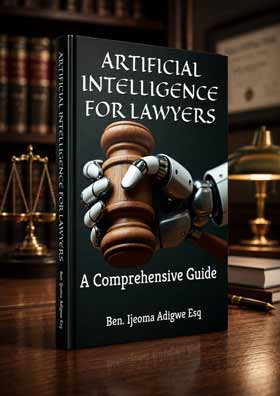 The book also examines Nigeria's legal ecosystem, focusing on the LPELR and NBA AI Guidelines. As a bonus, every purchase comes with a FREE eBook titled: How to Use the AI Features in LegalPedia and LawPavilion.
Ohio Books Ltd praises the publication, stating:
"....this is the only Nigerian book I know of on the topic."
How to Order:
📞 Call, Text, or WhatsApp: 08034917063 | 07055285878
📧 Email: benadigwe1@gmail.com
🌎 Website: www.benadigwe.com
Ebook Version: Access it directly online at https://selar.com/prv626
Authored by Ben Ijeoma Adigwe Esq., ACIarb (UK), LL.M, Dip. in Artificial Intelligence, Director at the Delta State Ministry of Justice, Asaba, Nigeria.
______________________________________________________________________
[A MUST HAVE] Evidence Act Demystified With Recent And Contemporary Cases And Materials
The book also examines Nigeria's legal ecosystem, focusing on the LPELR and NBA AI Guidelines. As a bonus, every purchase comes with a FREE eBook titled: How to Use the AI Features in LegalPedia and LawPavilion.
Ohio Books Ltd praises the publication, stating:
"....this is the only Nigerian book I know of on the topic."
How to Order:
📞 Call, Text, or WhatsApp: 08034917063 | 07055285878
📧 Email: benadigwe1@gmail.com
🌎 Website: www.benadigwe.com
Ebook Version: Access it directly online at https://selar.com/prv626
Authored by Ben Ijeoma Adigwe Esq., ACIarb (UK), LL.M, Dip. in Artificial Intelligence, Director at the Delta State Ministry of Justice, Asaba, Nigeria.
______________________________________________________________________
[A MUST HAVE] Evidence Act Demystified With Recent And Contemporary Cases And Materials

 Interested buyers are encouraged to place their orders and enquiries via:
0704 444 4777, 0704 444 4999, 0818 199 9888
Website: www.alexandernigeria.com
Interested buyers are encouraged to place their orders and enquiries via:
0704 444 4777, 0704 444 4999, 0818 199 9888
Website: www.alexandernigeria.com