By Oluwapelumi Mojolaoluwa Mofoluwawo, LLB, BL, LLM (UK)

Written for S.O Ajayi, SAN (Ibadan)
The Supreme Court of Nigeria is not final because it is infallible; rather, it is infallible because it is final, as it has said itself on several occasions. This means that its decisions are binding and non-negotiable not because they are perfect and flawless, but because it is indeed the court of last resort. After the Supreme Court of Nigeria, you turn to God- that is if you had not already put Him in contemplation at the inception of litigation. Recently however, the Supreme Court, despite its infallibility, has been accused of issuing conflicting judgments and rulings, essentially approbating and reprobating- giving rise to a wave of jurisprudential uncertainties. Unjustified and unqualified inconsistencies as such, could weaken the fabric of the nation’s jurisprudence and water down the faith the Clapham omnibus man reposes in the court as a just arbiter and the last hope of the common man. One of such instances of inconsistencies, is the notable divergence in the decisions in Omega Bank (Nig.) Plc. v. O.B.C. Ltd. (2005)8 NWLR pt928 pg 547 @576, and Baba v. Yahuza (2023)11 NWLR pt 1895 pg 243 @ 283 as regards the evidential value of unsigned documents.
In Omega Bank (Nig.) Plc. v. O.B.C. Ltd., a commercial bank (the appellant) and its customer (the respondent) were involved in a dispute over a N5 million Nigerian Export and Import Bank (NEXIM) revolving loan. The respondent, an exporter of cocoa, applied for the loan through the appellant to purchase and export cocoa. The NEXIM loan scheme is designed to promote non-oil sector trade, offering lower interest rates than commercial bank loans. Commercial banks process applications and send them to NEXIM for approval, but remain primarily responsible for repaying the loan to NEXIM. The appellant secured a N6 million NEXIM loan for the respondent and was the primary obligor to NEXIM for the loan. It then conveyed approval with conditions in a letter dated January 10, 1992 (Exhibit P7), which the respondent rejected as “onerous.” The respondent, however, insisted that an unsigned internal memorandum addressed to the bank from its head office (Exhibit P6) was the actual reply to its loan application and that the conditions in Exhibit P7 amounted to a breach of a previously concluded contract. The respondent sued the appellant for breach of contract, claiming various damages. The appellant counter-claimed for N2, 169, 930.10 with interest.
The High Court ruled in favor of the respondent, and held that there was a concluded NEXIM loan agreement, and a breach of the agreement by the appellant. It awarded most of the respondent’s claimed reliefs and also awarded the appellant N640,593.53 on its counter-claim. The appellant was unsatisfied, it therefore appealed to the Court of Appeal, and the respondent cross-appealed regarding the counter-claim. The Court of Appeal dismissed the appellant’s appeal and partially allowed the respondent’s cross-appeal by reducing the award of damages from N640,593.53 to N38,947.09. Dissatisfied again, the appellant further appealed to the Supreme Court, which unanimously allowed the appeal.
The internal memorandum (Exhibit P6), dated December 2, 1991, sent from Omega Bank’s head office to its Akure branch where the respondent had applied for a loan was the star document in question. It was an unsigned document and not addressed to the respondent (O.B.C) yet the respondent claimed that the memo constituted an acceptance of the offer made by him to obtain a NEXIM loan facility from the bank. The crux of the matter thus had to be the evidential value and validity of Exhibit P6, as well as its import, to determine if there was a contract in the first place, and then a breach of same in the second instance. The lower courts agreed with and held for the respondent. However, the Supreme Court differed.
The apex court in this case unequivocally stated that an unsigned document is a worthless document, which does not have any efficacy in law. The Court held that where a document is unsigned, it may not be admitted in evidence, and even if it is admitted, the court should not attach any probative value to it. This is because an unsigned document lacks an origin in terms of its maker. In the context of Exhibit “P6”, the Supreme Court found that since its maker did not sign it, it was not available to the lower courts to attach probative value to it. Per Niki Tobi, J.S.C., a “worthless document cannot be efficacious” and therefore, Exhibit “P6” was “wrongly admitted and given probative value by the lower courts.” The Supreme Court further held that while relevance is the key to admissibility, probative value comes after admissibility. However, without a maker to tender or attest to its veracity, an unsigned document would not attract any probative value.
Consequently, the Supreme Court held that Exhibit P6 could not form the basis of a valid contract between the bank and its customer due to its worthlessness and attaching any worth to it would amount to creating a contract for the parties, something that was not the responsibility of the court.
Hon. Nasiru Audu Baba v. Hon. Abubakar Maidala-Ilu Yahuza & Ors. on the other hand, took a different turn. This case bothered on a pre-election dispute regarding the nomination of a candidate for the Jalingo 1 State constituency in the Taraba State House of Assembly. Hon. Nasiru Audu Baba, an aspirant of All Progressives Congress (APC, the 2nd respondent), sought to become its candidate. The party had initially communicated to the Independent National Electoral Commission (INEC, the 3rd respondent) on May 25, 2022, that it would use indirect primaries for the nomination. All aspirants, including Baba and Hon. Abubakar Maidala-Ilu Yahuza (the 1st respondent), were screened and cleared.
However, on the scheduled date of May 26, 2022, for the primary election, the electoral committee failed to appear, and thus, no primary election was conducted. Despite this, the 1st respondent, Yahuza, began parading himself as the party’s nominated candidate. Aggrieved, Baba filed a suit at the Federal High Court, seeking declarations that Yahuza’s purported nomination was invalid due to the non-conduct of a proper primary election in line with the Electoral Act, 2022, and the party’s guidelines.
In support of his case, Baba presented documentary evidence regarding the mode of conducting the primaries. He presented Exhibit “NB9”, a document which indicated that the party’s National Working Committee (NWC) adopted direct primaries for other states (Abia, Benue, Osun) on May 25, 2022, and Exhibit “NB10”, a press statement which showed a revised timetable for various primary elections dated May 23, 2022. Conversely, Yahuza claimed his emergence was ratified by affirmation of delegates and monitored by INEC, who issued a report tendered as Exhibit “AM3”. He also deposed to the fact that aspirants were informed by the screening committee that the party had decided to adopt direct primaries for Taraba State due to ongoing litigations.
The trial court, after considering the evidence, found no clear directive from the party’s NWC changing the initially adopted indirect primary mode for Taraba State. It therefore concluded that if a direct primary mode had been approved for Taraba, it would have been communicated to INEC as done for other states. Consequently, the trial court held that the primary election was invalid for not being conducted according to the guidelines, nullified Yahuza’s nomination, and granted Baba’s reliefs. However, the Court of Appeal overturned this decision, holding that there was no sufficient evidence to support Baba’s claim that the party adopted the indirect mode of primary election for the Taraba State House of Assembly. Dissatisfied with this, Baba appealed to the Supreme Court, which then considered the lower courts’ findings in light of Sections 84(4), (5)(c)(i), and (13) of the Electoral Act, 2022, concerning direct and indirect primaries and the consequences of non-compliance.
The appellant, Baba, contended that the 2nd respondent (APC) failed to comply with the Electoral Act, 2022, and its own guidelines. He relied heavily on Exhibit “NB10”, a press statement dated May 23, 2022, detailing a revised timetable for primary elections. This document was unsigned. The 1st and 2nd respondents thus challenged Exhibit “NB10”, and argued that it was worthless because it had no signature. However, the Supreme Court, in its unanimous decision, took an interestingly different position regarding the probative value of unsigned documents. While it held that unsigned documents were typically worthless with no evidential or probative value, the Court clarified that this is not an absolute rule.
The Supreme Court explained further, that the legal requirement for a signature is to determine the document’s origin and authenticity therefore, an unsigned document could be admissible and possess probative value if there is evidence on record disclosing its authorship. Specifically, if a party’s pleading or deposition shows that an unsigned document was given to or handed over by them, it becomes admissible in proof of what is alleged. In this case, the Court found that Exhibit “NB10” was issued by the 2nd respondent’s National Publicity Secretary, and the 1st and 2nd respondents did not deny its authorship. Furthermore, the document itself had the word “SIGNED” at the appropriate section, indicating the author’s intention for it to be treated as signed. The Supreme Court therefore concluded that Exhibit “NB10” was not worthless and could not be disregarded or discountenanced. This approach means that authenticity and origin, when established through other means, can validate an unsigned document.
The question one would then ask is this, is the Supreme Court at liberty to take a strict approach at interpretation in some cases, and a relaxed approach in some others? Should the Supreme Court’s position differ in similar circumstances? In Omega Bank v. OBC, the Supreme Court had held that the absence of a signature defeated the proof of a document’s origin and authenticity because an unsigned document is inherently “worthless” and should not be afforded any probative value, even if admitted into evidence. These were the words of the Supreme Court in 2005. 18 years later however, the Supreme Court made a U-turn to say that while unsigned documents generally lack validity, they could have probative value if their authorship is clearly disclosed in pleadings and not denied, especially if there is evidence of an intention for the document to be treated as authored by the purported maker. As such, it had shifted the goal post from physical signature to otherwise ascertainable origin and authenticity of a document. It would thus appear that the 2005 decision looked at the form whilst the 2023 decision looked at the intent like a Court of Equity.
Can we then say that OBC was only too early in time? Perhaps it could have had a more favorable outcome if its case had come up for adjudication in 2023 or later? Can the apex court really approbate and reprobate at will? Will it grant equity to one litigant and apply the harshness of common law to another? Is the Supreme Court now departing from its own infallibility at will because it is final? What becomes of law students and lawyers who have to battle with understanding conflicting decisions on a singular issue from one and same court? Indeed, this sort of divergence creates uncertainty for litigants and legal practitioners in Nigeria. To make matters worse, the Supreme Court neither distinguished Omega v O.B.C from Baba v Yahuza, nor did it indicate that this later position has superseded the former to become the law on unsigned documents. This, despite Baba’s reliance on Omega v O.B.C as an authority on unsigned documents. A complete ignoring of binding precedence.
But hey, that’s the Supreme in the Supreme Court! Therefore, we may expediently take Baba v. Yahuza as jurisprudential development, and dare to hold brief for the Supreme Court. The Court seems to have said- ditch rigid adherence to signatures, if the author or origin is otherwise discernible, we can assume authenticity and give the document evidential weight on that basis, essentially creating an exception to the general rule on the probative value of unsigned documents. Omega v. OBC therefore is the rule whilst Baba v. Yahuza is the exception.
Furthermore, the Supreme Court’s stance in Baba v. Yahuza is in tandem with the clichéd proclamation that the Nigerian justice system is no longer in the era of technicalities- a stance that is seemingly only applied where convenient, nonetheless a progressive outlook. Jurisprudence appears to have shifted from a rigid position to a more pragmatic one that considers the context, the clear identification of the author, and the absence of a denial of authorship by the party against whom the document tendered. It means that if the origin and content are clearly attributable to a party, and that party does not dispute having issued it, the absence of a physical signature may not render the document entirely without value, especially when it supports a pleading. This is the new law, as pronounced by the Supreme Court.
The court approbated. The court reprobated. The reprobation is now law. One can only appeal for clarity in the future, for uniformity in how similar cases are decided and distinct direction on departure from one position of law to another. This will engender consistency and predictability in the application of the law. The Supreme Court remains infallible because it is final.
Oluwapelumi Mojolaoluwa Mofoluwawo, LLB, BL, LLM(UK) is a Nigerian lawyer and Principal at OM Livingstones & Co. She can be reached at houseoflivingstones@gmail.com and on youtube – Bar Talk with Ola.
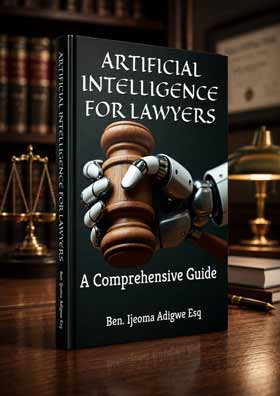 The book also examines Nigeria's legal ecosystem, focusing on the LPELR and NBA AI Guidelines. As a bonus, every purchase comes with a FREE eBook titled: How to Use the AI Features in LegalPedia and LawPavilion.
Ohio Books Ltd praises the publication, stating:
"....this is the only Nigerian book I know of on the topic."
How to Order:
📞 Call, Text, or WhatsApp: 08034917063 | 07055285878
📧 Email: benadigwe1@gmail.com
🌎 Website: www.benadigwe.com
Ebook Version: Access it directly online at https://selar.com/prv626
Authored by Ben Ijeoma Adigwe Esq., ACIarb (UK), LL.M, Dip. in Artificial Intelligence, Director at the Delta State Ministry of Justice, Asaba, Nigeria.
_______________________________________________________________________
“Enhance Legal Practice With Authoritative Reports” — Alexander Payne Offers Comprehensive Law Reports, Spanning Over A Century Of Nigerian Jurisprudence
The book also examines Nigeria's legal ecosystem, focusing on the LPELR and NBA AI Guidelines. As a bonus, every purchase comes with a FREE eBook titled: How to Use the AI Features in LegalPedia and LawPavilion.
Ohio Books Ltd praises the publication, stating:
"....this is the only Nigerian book I know of on the topic."
How to Order:
📞 Call, Text, or WhatsApp: 08034917063 | 07055285878
📧 Email: benadigwe1@gmail.com
🌎 Website: www.benadigwe.com
Ebook Version: Access it directly online at https://selar.com/prv626
Authored by Ben Ijeoma Adigwe Esq., ACIarb (UK), LL.M, Dip. in Artificial Intelligence, Director at the Delta State Ministry of Justice, Asaba, Nigeria.
_______________________________________________________________________
“Enhance Legal Practice With Authoritative Reports” — Alexander Payne Offers Comprehensive Law Reports, Spanning Over A Century Of Nigerian Jurisprudence
 Interested buyers are encouraged to place their orders and enquiries via:
0704 444 4777, 0704 444 4999, 0818 199 9888
Website: www.alexandernigeria.com
Interested buyers are encouraged to place their orders and enquiries via:
0704 444 4777, 0704 444 4999, 0818 199 9888
Website: www.alexandernigeria.com