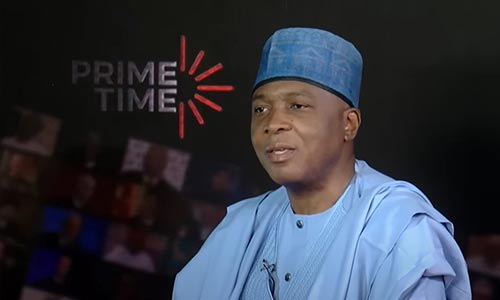
The People’s Democratic Party (PDP), once Africa’s largest political party, is grappling with a deepening internal crisis that threatens its position as Nigeria’s leading opposition force. In an exclusive interview with Arise News, former Senate President and ex-Governor of Kwara State, Senator Bukola Saraki, who heads the PDP’s Reconciliation Committee, addressed the party’s ongoing challenges, spate of defections, and its path to rebuilding ahead of the 2027 general elections.


Credited with major achievements such as Nigeria’s return to democracy in 1999, mobile phone proliferation, banking reforms, and the launch of Sub-Saharan Africa’s first Earth satellite in 2003, the PDP is now confronting an existential crisis. Internal divisions, high-profile defections, and disputes over leadership positions have intensified the spotlight on the party’s instability.
Saraki acknowledged that the PDP’s difficulties are not unique, noting that the ruling All Progressives Congress (APC) is also experiencing its own internal turmoil, including reports of the recent resignation of its national chairman, Dr. Abdullahi Ganduje. “All parties are having their challenges at this time,” he said, adding that while the PDP’s issues may be more publicized, they are not insurmountable.
A critical part of Saraki’s mandate is negotiating a truce among the party’s warring factions. One major flashpoint is the postponed National Executive Committee (NEC) meeting originally scheduled for June 30, 2025. Acting National Chairman, Umar Damagum, delayed the meeting, citing the legal requirement for a 21-day notice to the Independent National Electoral Commission (INEC). However, a faction within the National Working Committee (NWC) argued that the meeting should still hold, viewing it as a continuation of an already postponed session.
Saraki clarified that the dispute stemmed from a procedural flaw: the notification letter to INEC was signed solely by Damagum and not co-signed by the party’s recognized secretary, Senator Samuel Anyanwu, rendering it invalid under INEC’s rules.
To avert further conflict and maintain compliance with electoral regulations, Saraki proposed holding an expanded stakeholders’ meeting on June 30 in place of the NEC meeting. This would enable the party to deliberate on critical issues without flouting procedural requirements. “Our primary focus is ensuring the PDP remains a stable platform for candidates in 2027,” he said, citing examples like Plateau State where legal disputes had previously cost the party hard-won electoral victories.
Addressing the party’s widening cracks, Saraki warned that more defections could occur, possibly involving one or two sitting governors and several senators. He referenced the reconciliation between Rivers State Governor Siminalayi Fubara and former Governor Nyesom Wike—brokered by President Bola Tinubu—as an example of fluid political alignments that may affect PDP’s structure.
Nonetheless, Saraki expressed confidence in the PDP’s grassroots resilience. He noted that despite high-level defections, many local chapters remain steadfastly loyal. “The grassroots are not even aware of what’s happening in Abuja,” he remarked, asserting that these shifts are often elite-driven and do not reflect the party’s foundation.
A major stumbling block remains the ongoing dispute over the national secretary position. While INEC recognizes Senator Samuel Anyanwu as the legitimate secretary, opposition from some Southeast stakeholders has created a rift. Saraki emphasized that the party must align with INEC’s position to prevent legal liabilities that could hinder its ability to field candidates in 2027. “We must tread the path of caution to protect our aspirants,” he warned, stressing that resolving the secretary issue is a prerequisite for convening a lawful NEC meeting and ultimately organizing a national convention.
Looking forward, Saraki expressed cautious optimism about the party’s revival. He drew parallels with global political parties that have rebounded from major defeats and highlighted PDP’s 26-year legacy, which includes significant contributions to Nigeria’s political and cultural development, such as the growth of Nollywood and Afrobeats.
According to him, the upcoming national convention represents a critical opportunity for reform. He advocated for a shift from token representation to meaningful inclusion of youth and women in leadership positions. “The upcoming convention is an opportunity for a rebirth,” he said, urging the party to prioritize dynamic leadership, inclusivity, and innovation.
Saraki also issued a stark warning: PDP’s failure to reposition itself could leave Nigeria vulnerable to becoming a one-party state, weakening democratic checks and balances. “A strong opposition is key to a good democracy,” he stressed, calling on party members, civil society, and the media to support PDP’s internal rebuilding process.
As the PDP navigates these stormy waters, Saraki remains focused on resolving the secretary impasse, convening a legitimate NEC meeting, and organizing a national convention to elect a new executive. While he acknowledged the emotional and political tensions involved, he urged members to put the party’s stability above personal ambitions. “The consequences of not having a strong opposition are not just for the PDP but for the nation,” he concluded.
Ultimately, the PDP’s ability to resolve its internal conflicts and present a united front will determine its relevance in Nigeria’s political future and its capacity to mount a credible challenge to the APC in 2027.
“Order Justice Omolaye-Ajileye’s Electronic Evidence Books Now” — Essential Guides On Evidence Act, Case Law And Digital Proof
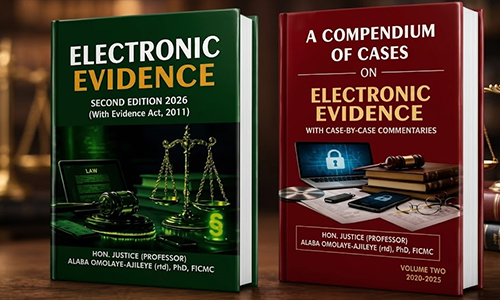
[A MUST HAVE] Evidence Act Demystified With Recent And Contemporary Cases And Materials

Available now for NGN 40,000 at ASC Publications, 10, Boyle Street, Onikan, Lagos. Beside High Court, TBS. Email publications@ayindesanni.com or WhatsApp +2347056667384. Purchase Link: https://paystack.com/buy/evidence-act-complete-annotation
______________________________________________________________________ “Enhance Legal Practice With Authoritative Reports” — Alexander Payne Offers Comprehensive Law Reports, Spanning Over A Century Of Nigerian Jurisprudence Interested buyers are encouraged to place their orders and enquiries via:
0704 444 4777, 0704 444 4999, 0818 199 9888
Website: www.alexandernigeria.com
Interested buyers are encouraged to place their orders and enquiries via:
0704 444 4777, 0704 444 4999, 0818 199 9888
Website: www.alexandernigeria.com
 The book also examines Nigeria's legal ecosystem, focusing on the LPELR and NBA AI Guidelines. As a bonus, every purchase comes with a FREE eBook titled: How to Use the AI Features in LegalPedia and LawPavilion.
Ohio Books Ltd praises the publication, stating:
"....this is the only Nigerian book I know of on the topic."
How to Order:
📞 Call, Text, or WhatsApp: 08034917063 | 07055285878
📧 Email: benadigwe1@gmail.com
🌎 Website: www.benadigwe.com
Ebook Version: Access it directly online at https://selar.com/prv626
Authored by Ben Ijeoma Adigwe Esq., ACIarb (UK), LL.M, Dip. in Artificial Intelligence, Director at the Delta State Ministry of Justice, Asaba, Nigeria.
______________________________________________________________________
The book also examines Nigeria's legal ecosystem, focusing on the LPELR and NBA AI Guidelines. As a bonus, every purchase comes with a FREE eBook titled: How to Use the AI Features in LegalPedia and LawPavilion.
Ohio Books Ltd praises the publication, stating:
"....this is the only Nigerian book I know of on the topic."
How to Order:
📞 Call, Text, or WhatsApp: 08034917063 | 07055285878
📧 Email: benadigwe1@gmail.com
🌎 Website: www.benadigwe.com
Ebook Version: Access it directly online at https://selar.com/prv626
Authored by Ben Ijeoma Adigwe Esq., ACIarb (UK), LL.M, Dip. in Artificial Intelligence, Director at the Delta State Ministry of Justice, Asaba, Nigeria.
______________________________________________________________________