The Nigerian Senate on Wednesday, May 21, engaged in a spirited debate over a new bill aimed at regulating employment in the country’s vast informal sector through the use of licensed private employment agencies.


The bill, sponsored by Senator Musa Sani, seeks to empower the National Directorate of Employment (NDE) to license, monitor, and regulate private agencies tasked with managing recruitment, social security, and employee data for informal workers such as domestic staff, apprentices, and interns.
In presenting the bill, Senator Musa described the informal sector as largely unregulated and labour-intensive, often comprising small-scale businesses that rely on family labour and apprenticeships.
“The informal sector of Nigeria’s economy shows evidence of violation of employees’ rights and non-implementation of labour regulations,” Musa said.
He cited the absence of fair wages, safe working conditions, training, and collective bargaining in the informal workforce as signs of a “decent work deficit”, and noted that Nigeria is currently falling short of obligations under International Labour Organisation (ILO) conventions.
“The primary goal of this bill is to regulate this sector to promote rights at work, employment, social protection, and social dialogue,” he added.
While the bill received support from some senators for its intent to formalise and protect informal sector workers, others raised serious concerns about potential loopholes that could legitimise exploitation.
Senator Adams Oshiomhole, former president of the Nigeria Labour Congress (NLC), expressed reservations about the bill, warning it could institutionalise existing exploitative practices.
“Public and private sector agencies use third parties to recruit low-level staff. Recruitment agencies charge ₦150,000 to ₦200,000 per person, but staff earn as little as ₦40,000 monthly,” Oshiomhole said.
He argued that empowering NDE to facilitate such hiring processes could further entrench unfair labour practices and diverge from its original mandate of providing vocational training and employment support to jobseekers.
Senator Diket Plang, chairman of the Senate Committee on Labour and Productivity, noted the existence of a similar bill regulating domestic help employment, which has already passed a public hearing and is due for a third reading.
“This job is already the statutory responsibility of the Federal Ministry of Labour,” Plang said, suggesting the bill might be better integrated into existing labour legislation or amendments to the NDE Act.
Following extensive deliberations, Senate President Godswill Akpabio called for a vote. The bill passed its second reading and was referred to the Committee on Employment, Labour, and Productivity for further legislative review.
 Interested buyers are encouraged to place their orders and enquiries via:
0704 444 4777, 0704 444 4999, 0818 199 9888
Website: www.alexandernigeria.com
Interested buyers are encouraged to place their orders and enquiries via:
0704 444 4777, 0704 444 4999, 0818 199 9888
Website: www.alexandernigeria.com

“Order Justice Omolaye-Ajileye’s Electronic Evidence Books Now” — Essential Guides On Evidence Act, Case Law And Digital Proof
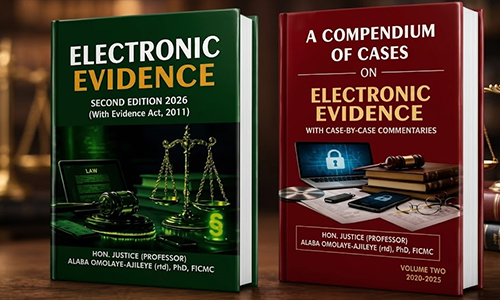
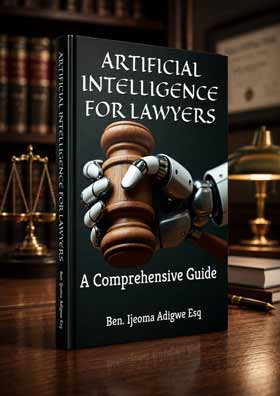 The book also examines Nigeria's legal ecosystem, focusing on the LPELR and NBA AI Guidelines. As a bonus, every purchase comes with a FREE eBook titled: How to Use the AI Features in LegalPedia and LawPavilion.
Ohio Books Ltd praises the publication, stating:
"....this is the only Nigerian book I know of on the topic."
How to Order:
📞 Call, Text, or WhatsApp: 08034917063 | 07055285878
📧 Email: benadigwe1@gmail.com
🌎 Website: www.benadigwe.com
Ebook Version: Access it directly online at https://selar.com/prv626
Authored by Ben Ijeoma Adigwe Esq., ACIarb (UK), LL.M, Dip. in Artificial Intelligence, Director at the Delta State Ministry of Justice, Asaba, Nigeria.
_______________________________________________________________________
The book also examines Nigeria's legal ecosystem, focusing on the LPELR and NBA AI Guidelines. As a bonus, every purchase comes with a FREE eBook titled: How to Use the AI Features in LegalPedia and LawPavilion.
Ohio Books Ltd praises the publication, stating:
"....this is the only Nigerian book I know of on the topic."
How to Order:
📞 Call, Text, or WhatsApp: 08034917063 | 07055285878
📧 Email: benadigwe1@gmail.com
🌎 Website: www.benadigwe.com
Ebook Version: Access it directly online at https://selar.com/prv626
Authored by Ben Ijeoma Adigwe Esq., ACIarb (UK), LL.M, Dip. in Artificial Intelligence, Director at the Delta State Ministry of Justice, Asaba, Nigeria.
_______________________________________________________________________