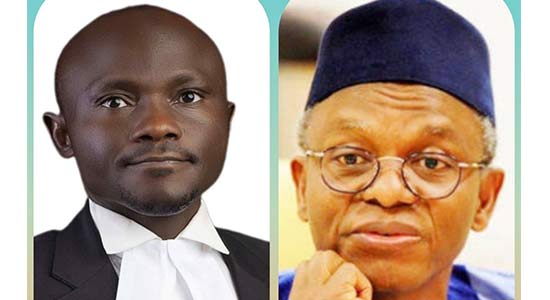
By Levi I. Shaapera, Esq.
Former Kaduna State Governor, Nasir El-Rufai, has found himself in the ironic position of lamenting the unlawful detention of his personal assistant, Bashir Saidu—a scenario eerily reminiscent of the judicial defiance that defined his tenure. This is not, in any way, an attempt to justify executive lawlessness but to affirm the saying that those who live by the sword die by the sword. As the self-styled “Powerless Minister of Wailers” now champions the rule of law, it is only fitting to revisit his administration’s blatant disregard for court rulings, which set a dangerous precedent for executive impunity.
One of the most striking cases of judicial disobedience under El-Rufai’s administration was the illegal removal of 77 district heads across Kaduna State. In 2017, the governor carried out a mass sacking of traditional rulers, citing cost-cutting measures. The affected district heads challenged the decision in court, and on 21st November 2018, Justice Kabir Dabo of the Zaria High Court (whose house was burnt to ashes on 12th March 2025) issued an order restraining the Kaduna State Government from proceeding with the sackings.
Despite being served with the court’s decision, El-Rufai ignored the ruling and installed new district heads. Justice Dabo, in his judgment, categorically stated that the governor had “no constitutional right to tamper with judicial matters pending in a court of law.” He further condemned El-Rufai’s actions as a “disrespect for court orders, which contravened Section 6(6) of the 1999 Constitution.”
Rather than comply, the governor doubled down on his decision, refusing to reinstate the sacked district heads despite the clear judicial directive. The order remained unenforced till the end of his tenure.
Another glaring example of El-Rufai’s disdain for court orders was the controversial demolition of Durbar Hotel, a property linked to the Abacha family. The dispute over ownership had long been in the courts, with an appeal ruling favouring the Abacha family.
On 21st January 2021, Justice Hannatu Balogun of the Kaduna High Court (as he then was) issued an injunction restraining the Kaduna State Government from demolishing or taking over Durbar Hotel. However, El-Rufai disregarded this ruling. By May 2021, government officials had already mobilized heavy-duty equipment to clear the land, allegedly to convert it into a public park.
The lawyer representing the Abacha family R.O. Atabo, SAN, condemned the act, stating:
“There is already an injunction restraining them from interfering with the land. But we were surprised to see caterpillars clearing the site. This is against the court order. It is contempt of court, and the Kaduna State governor should be held responsible.”
Despite multiple legal warnings and ongoing litigation at both the Supreme Court and the Kaduna High Court, El-Rufai pressed ahead with his plans, effectively bulldozing the rule of law along with the hotel.
El-Rufai’s weaponisation of security agencies was another hallmark of his tenure. He allegedly used the police and other state apparatuses to illegally arrest and detain critics, including
- Barack Zebedee: A PhD student at Ahmadu Bello University, Zaria, arrested in May 2017 following comments made in a WhatsApp group mobilizing assistance for victims of the Southern Kaduna massacre.
- Gabriel Idibia: A journalist with The Union newspaper, prosecuted for allegedly requesting El-Rufai to declare his assets as mandated by law.
- Jacob Dickson: A journalist with Authentic News, arrested and charged with incitement in May 2016 after reporting that youths had pelted El-Rufai with objects.
- Luka Binniyat: The Kaduna Bureau Chief of Vanguard, detained for over 130 days without bail in February 2017 following a report under his byline; El-Rufai allegedly influenced Vanguard to terminate his employment.
- Midat Joseph: A journalist with Leadership, arrested in April 2017 for a post in a WhatsApp group, charged with incitement.
- Sunny Yayock: A freelance journalist, arrested, detained, and charged for supporting a call for peaceful demonstration on social media; he spent two days in police custody before being granted bail.
- Adamu Abdullahi: A social media activist, arrested by Kaduna police for retweeting a post about El-Rufai being pelted with objects.
- Segun Onibiyo: A journalist with Radio Nigeria, arrested and charged on El-Rufai’s orders on November 14, 2019, for alleged incitement in his social media posts; he spent most of December 2019 detained before being released after 24 days.
- John Danfulani: A lecturer at Kaduna State University, suspended, arrested, detained, and charged for incitement allegedly due to criticizing the governor in a Facebook post; he was detained for many days before being granted bail and was later dismissed from his position.
- Nasiru Jagaba: A national youth leader of the Southern Kaduna Peoples Union, arrested and prosecuted for protesting against El-Rufai’s policies.
These instances highlight a pattern of actions taken against individuals perceived as critics of El-Rufai’s administration, raising concerns about the suppression of dissent and freedom of expression during his tenure. Now, he finds himself at the receiving end of a similar power play, as his close ally Bashir Saidu finds himself in the hands of the Independent Corrupt Practices and Other Related Offences Commission (ICPC) over allegations of money laundering.
Suffice to add, that in August 2020, the Nigerian Bar Association (NBA) withdrew its invitation to Governor Nasir El-Rufai to speak at its Annual General Conference. This decision followed widespread protests from lawyers and civil society groups who cited concerns over his administration’s handling of security issues in Southern Kaduna and allegations of human rights violations. The NBA’s National Executive Committee resolved to withdraw the invitation.
Prior to the withdrawal, several lawyers had expressed their dissatisfaction with El-Rufai’s inclusion as a speaker. Some even deregistered from the conference in protest, highlighting concerns over his administration’s actions and policies.
It is both ironic and hypocritical that the same El-Rufai who repeatedly ignored judicial orders throughout his eight-year tenure is now lamenting the unlawful detention of his personal assistant. His sudden advocacy for the rule of law appears self-serving rather than principled.
The former governor’s legacy is one of executive impunity, where court rulings were treated as mere suggestions rather than binding legal mandates. Now, as he experiences the consequences of a system he helped undermine, El-Rufai finds himself wailing from the sidelines—powerless, for once, to bend the law to his will.
If his tenure in Kaduna State taught Nigerians anything, it is that the rule of law is only as strong as those willing to uphold it. The judiciary’s authority must be respected not only when convenient but as an essential pillar of democracy. El-Rufai’s record shows that his commitment to justice was questionable at best.
As he wails, Nigerians must ask: does El-Rufai truly believe in the rule of law, or is he merely upset now that the tables have turned?
 Interested buyers are encouraged to place their orders and enquiries via:
0704 444 4777, 0704 444 4999, 0818 199 9888
Website: www.alexandernigeria.com
Interested buyers are encouraged to place their orders and enquiries via:
0704 444 4777, 0704 444 4999, 0818 199 9888
Website: www.alexandernigeria.com

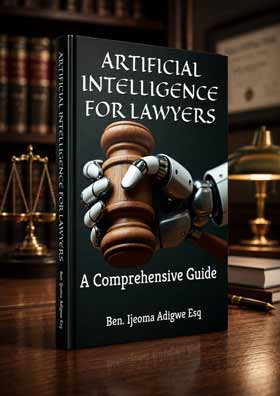 The book also examines Nigeria's legal ecosystem, focusing on the LPELR and NBA AI Guidelines. As a bonus, every purchase comes with a FREE eBook titled: How to Use the AI Features in LegalPedia and LawPavilion.
Ohio Books Ltd praises the publication, stating:
"....this is the only Nigerian book I know of on the topic."
How to Order:
📞 Call, Text, or WhatsApp: 08034917063 | 07055285878
📧 Email: benadigwe1@gmail.com
🌎 Website: www.benadigwe.com
Ebook Version: Access it directly online at https://selar.com/prv626
Authored by Ben Ijeoma Adigwe Esq., ACIarb (UK), LL.M, Dip. in Artificial Intelligence, Director at the Delta State Ministry of Justice, Asaba, Nigeria.
_______________________________________________________________________
The book also examines Nigeria's legal ecosystem, focusing on the LPELR and NBA AI Guidelines. As a bonus, every purchase comes with a FREE eBook titled: How to Use the AI Features in LegalPedia and LawPavilion.
Ohio Books Ltd praises the publication, stating:
"....this is the only Nigerian book I know of on the topic."
How to Order:
📞 Call, Text, or WhatsApp: 08034917063 | 07055285878
📧 Email: benadigwe1@gmail.com
🌎 Website: www.benadigwe.com
Ebook Version: Access it directly online at https://selar.com/prv626
Authored by Ben Ijeoma Adigwe Esq., ACIarb (UK), LL.M, Dip. in Artificial Intelligence, Director at the Delta State Ministry of Justice, Asaba, Nigeria.
_______________________________________________________________________