By David O. Ogundipe, Esq.


Earnest Attorneys LP
Caveat: Fact is the fountainhead of law, as laws are applied on a case-by-case basis. This piece does not represent an exhaustive legal opinion or consultation on the subject or for your peculiar case. Please, consult a lawyer and seek case-specific advice.
Debates on the rights of parties in a marriage to properties acquired, or which acquisition was completed in the course of a marriage seem endless. Both lawyers and non-lawyers have proposed many interesting schemes which they deem guaranteed to protect the matrimonial property interests of parties in marriage. The author’s interrogation of some of these suggestions in line with settled case laws and statutory provisions revealed that very few of these suggestions are fit for purpose.
The instant article sets to do an exposition on the property rights of parties to a marriage, particularly properties either acquired during the marriage or which acquisition or improvement was completed during the marriage, regardless of whether the title documents carry the names of one or both parties.
Most times, questions about rights and entitlement to properties acquired in the course of marriage arise when a marriage is in stormy waters or on the death of a party to the marriage. The first scenario typically falls within the domain of matrimonial causes, while the other can be placed in the realm of administration of estate. In both cases, there have been reports of one spouse or a surviving spouse being disentitled to properties acquired in the course of marriage because such party’s name is not contained in the title or improvement documents. As a matter of fact, many women rights groups have alleged, albeit erroneously, that Nigerian laws do not support women in cases of this nature. They reasoned that the courts stick to strict statutory provisions, particularly on the question of whose name is on the title documents or payment receipts in determining the rights to matrimonial properties, an approach they deem to be unfavourable to women.
Contrary to the above, this author argues that Nigerian courts do not pay unthinking deference to statutory provisions and have, in deserving cases been progressive in resolving issues bordering on rights to matrimonial properties. There have been demonstrated shifts from the name on the title deed of a property approach to a more balanced and just measure. In other words, having the title documents in one’s name is no longer foolproof of sole ownership when matrimonial causes are concerned.
Firstly, the concept of constructive trust, which Lord Denning described as a trust imposed by law wherever justice and good conscience require applies here. It is said to be a remedy through which the Court can enable an aggrieved spouse or party to obtain restitution, and the success of the party’s case does not depend on his or her direct physical or monetary contribution to the building or acquisition of the property. In other words, where a property is held in the name of a party to a marriage, that party is construed as holding it in trust for himself and the spouse. On this point, we call in aid the celebrated English cases of FALCONER v. FALCONER (1970) 1 WLR 1333 and HUSSEY v. PALMER (1972) 1 WLR 1286.
In OKERE v. AKALUKA (2014) LPELR-24287(CA), the husband abandoned the wife and kids in the matrimonial home, moved in with a concubine, and sold off the matrimonial home, which the buyer argued was in the husband’s sole name. While analysing the concept of constructive trust and lauding the English decisions on the point, the Court of Appeal of Nigeria stated verbatim: “(and we see no reason why this principle should not be applicable in Nigeria especially in this Millennium), the Courts have held that if matrimonial property is purchased in the name of one of the parties (as in this case); the party in whose name the property was conveyed held same as a constructive trustee for the benefit of both.”
Beyond the protection offered under the umbrella of constructive trust, the Courts have admonished that in cases like this, monied rights should not be prioritised over social justice and that the courts should protect the position of a wife or husband who has a share. Share in this context has been given an interpretation that extends beyond monetary contribution.
In IBEABUCHI v. IBEABUCHI (2016) LPELR-41268(CA), where the Court of Appeal stated that two of the most firmly established guidelines in determining a question of settlement of property is whether or not the property was acquired by the parties during the course of the marriage, and if so, what was the contribution of each party to the cost of acquisition. In the instant case, the first leg has been answered in the positive, as this exposition is about properties acquired in the course of the marriage. In the case of Ibeabuchi under reference, the Court held that it is correct that the contribution of a party does not necessarily have to be in the nature of cash outlay for the purchase or development of the property. It can be by way of moral contribution to the business of a husband by a wife or other forms of input during the pendency of the marriage. However, the most important yardstick is that the property must have been acquired or completed in the course of the marriage. See OGUNNUBI v. OGUNNUBI (2021) LPELR (53497) 1 AT 2931. In fact, we find OGUNNUBI’s case as having a place of pride in the instant case, given the very didactic and progressive dictum of the Court of Appeal, which we quote verbatim thus:
“The guidelines which a Court adopts in applying the settlement of property principles in matrimonial causes include determining whether or not the property in question or some other property was acquired by the parties or one of the parties during the course of the marriage, and if so, what was the contribution of each party to the cost of acquisition. See RIMMER vs. RIMMER (1952) 2 ALL ER 863, ANADI vs. NWOSU (1992) 6 SCNJ 59 and ADEROUNMU vs. ADEROUNMU (2003) 2 NWLR (PT 803) 1. The Appellant argues that the Respondent did not produce any document to authenticate her claim that she contributed to the ownership of the properties. I am not enthused by this contention. It has to be remembered that the relationship between the parties was not a business relationship. They were in a marital relationship, for better for worse until death do them part; though the irretrievable breakdown of the marriage made them part; but then, given the marital relationship, it would have been strange for the Respondent to have kept documents showing what she was expending in building the house for their marital union. In this regard, I agree with the lower Court, when it held as follows at page 179 of the Records: “It happens often that a good number of transactions embarked upon during the course of a marriage are done on trust based on the relationship of marriage and as such, it is not expected that such transactions would be documented as in a business/commercial relationship.” Be that as it may, it is pertinent to state that the contribution of a party does not necessarily have to be in the nature of a cash outlay for the purchase or development of the property. It can be by way of moral and/or financial contribution to the business of a husband by a wife where the property is purchased from the profits of the business. It is however, essential that the property should have been purchased in the course of the marriage or where the property was purchased before the marriage, that the payment for the property or some development on the property was completed after and in the course of the marriage. See generally SANDERS vs. SANDERS (1967) 116 CLR 366, WATCHEL vs. WATCHEL (1973) ALL ER 829 and KAFI vs. KAFI (1986) 3 NWLR (PT 27) 175.
In SUNMONU v. SUNMONU (2021) LPELR-56002 (CA), where the land upon which the matrimonial home was built was even acquired before the marriage by the husband but the development was done during the marriage, the Court of Appeal held that the critical consideration is whether it was just and equitable in the circumstances to give the wife and the children of the marriage possession of the matrimonial home. The Court concluded that it would be unjust that the only circumstances in which a party can be given possession of marital property should be limited to cases where the party has made only monetary contributions.
Consistent with the case laws is Section 72 (1) of the Matrimonial Causes Act which provides that:
“The court may, in proceedings under this Act, by order require the parties to the marriage, or either of them, to make, for the benefit of all or any of the parties to, and the children of, the marriage, such a settlement of property to which the parties are, or either of them is, entitled (whether in possession or reversion) as the court considers just as equitable in the circumstances of the case”.
It should be noted that the above provision, like the case law, also does not make monetary contribution or any other conditions a prerequisite for the exercise of the court’s discretion on this point, provided that parties are married and that either or both parties to the marriage are entitled to the said property in possession or reversion.
In conclusion, the key points from this article are:
- Having the name of a party to a marriage on the title document or receipt of a matrimonial property does not automatically disentitle the other party;
- Properties acquired in the course of a marriage or which acquisition was completed in the course of the marriage are deemed as matrimonial properties; and
- Property rights of parties to a marriage are not only ascertained by monetary contribution.
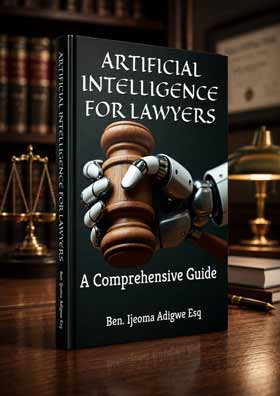 The book also examines Nigeria's legal ecosystem, focusing on the LPELR and NBA AI Guidelines. As a bonus, every purchase comes with a FREE eBook titled: How to Use the AI Features in LegalPedia and LawPavilion.
Ohio Books Ltd praises the publication, stating:
"....this is the only Nigerian book I know of on the topic."
How to Order:
📞 Call, Text, or WhatsApp: 08034917063 | 07055285878
📧 Email: benadigwe1@gmail.com
🌎 Website: www.benadigwe.com
Ebook Version: Access it directly online at https://selar.com/prv626
Authored by Ben Ijeoma Adigwe Esq., ACIarb (UK), LL.M, Dip. in Artificial Intelligence, Director at the Delta State Ministry of Justice, Asaba, Nigeria.
______________________________________________________________________
[A MUST HAVE] Evidence Act Demystified With Recent And Contemporary Cases And Materials
The book also examines Nigeria's legal ecosystem, focusing on the LPELR and NBA AI Guidelines. As a bonus, every purchase comes with a FREE eBook titled: How to Use the AI Features in LegalPedia and LawPavilion.
Ohio Books Ltd praises the publication, stating:
"....this is the only Nigerian book I know of on the topic."
How to Order:
📞 Call, Text, or WhatsApp: 08034917063 | 07055285878
📧 Email: benadigwe1@gmail.com
🌎 Website: www.benadigwe.com
Ebook Version: Access it directly online at https://selar.com/prv626
Authored by Ben Ijeoma Adigwe Esq., ACIarb (UK), LL.M, Dip. in Artificial Intelligence, Director at the Delta State Ministry of Justice, Asaba, Nigeria.
______________________________________________________________________
[A MUST HAVE] Evidence Act Demystified With Recent And Contemporary Cases And Materials

 Interested buyers are encouraged to place their orders and enquiries via:
0704 444 4777, 0704 444 4999, 0818 199 9888
Website: www.alexandernigeria.com
Interested buyers are encouraged to place their orders and enquiries via:
0704 444 4777, 0704 444 4999, 0818 199 9888
Website: www.alexandernigeria.com