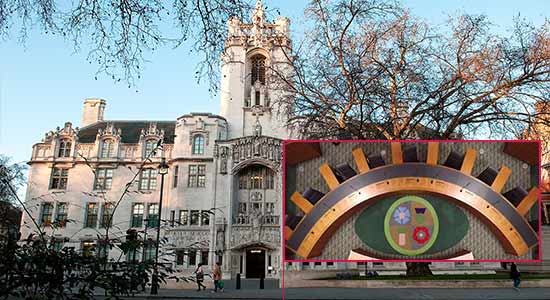
Artificial intelligence cannot be listed as an inventor on a patent application, the U.K.’s highest court ruled Wednesday, in a decision likely to have a significant impact as AI tools grow in use.


The case originated with two patent applications filed by Stephen Thaler in 2018, one for a food packaging shape and one for a type of flashing light.
Rather than listing himself as the inventor, he named his AI machine, called “DABUS.” He then listed his personal right to the patents as being “ownership of the creativity machine ‘DABUS.’”
The U.K. Intellectual Property Office initially responded that he had failed to comply with patent stipulations requiring a person to be listed as the inventor, and for a description of how his ownership rights derived from that person (in this case AI).
Thaler appealed the decision and maintained he had met all requirements under 1977 patent legislation, which was denied.
He made further appeals in the U.K’s High Court and Court of Appeal, both of which dismissed his claim by denying that AI could be listed as an inventor.
The Supreme Court said in its judgment Wednesday that it was not ruling on the broad question of whether technical advances created by AI-powered tools and machines should be patentable, or whether the meaning of the term “inventor” should be expanded.
However, it found that under existing patent law, the specified “inventor” must be a “natural person.”
It also rejected Thaler’s contention that “he was nevertheless entitled to file applications for and obtain the grant of patents for the inventions described and disclosed in each of the applications on the basis of his ownership of DABUS.” That was again on the basis that a patent application must list an inventor, and that inventor must be a person.
The Supreme Court noted, “Dr Thaler has made clear that he is not an inventor; that his case is that the inventions described in the applications were made by DABUS; and that his right to the grant of patents for those inventions arises from his ownership of DABUS.”
In a statement provided to Reuters, Thaler’s lawyers said that the judgment “establishes that UK patent law is currently wholly unsuitable for protecting inventions generated autonomously by AI machines.”
Thaler has made similar appeals over the same products in the U.S. courts, which have also ruled that patents must have human inventors.
“Whilst it is increasingly easy to anthropomorphise AI and its accomplishments, the UK Supreme Court has reiterated that the Patents Act requires an inventor to be a natural person to obtain a patent,” said Tim Harris, patent litigator at law firm Osborne Clarke, in emailed comments.
“If it had been Dr Thaler’s case that he was the inventor and had used DABUS as a highly sophisticated tool, the outcome of the proceedings may have been different. However, the Supreme Court was not asked to decide this question. Neither was it asked to determine broader questions such as whether technical advances generated by AI acting autonomously should be patentable.”
 Interested buyers are encouraged to place their orders and enquiries via:
0704 444 4777, 0704 444 4999, 0818 199 9888
Website: www.alexandernigeria.com
Interested buyers are encouraged to place their orders and enquiries via:
0704 444 4777, 0704 444 4999, 0818 199 9888
Website: www.alexandernigeria.com

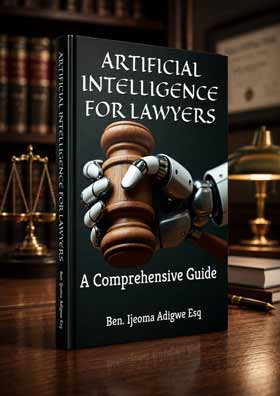 The book also examines Nigeria's legal ecosystem, focusing on the LPELR and NBA AI Guidelines. As a bonus, every purchase comes with a FREE eBook titled: How to Use the AI Features in LegalPedia and LawPavilion.
Ohio Books Ltd praises the publication, stating:
"....this is the only Nigerian book I know of on the topic."
How to Order:
📞 Call, Text, or WhatsApp: 08034917063 | 07055285878
📧 Email: benadigwe1@gmail.com
🌎 Website: www.benadigwe.com
Ebook Version: Access it directly online at https://selar.com/prv626
Authored by Ben Ijeoma Adigwe Esq., ACIarb (UK), LL.M, Dip. in Artificial Intelligence, Director at the Delta State Ministry of Justice, Asaba, Nigeria.
_______________________________________________________________________
The book also examines Nigeria's legal ecosystem, focusing on the LPELR and NBA AI Guidelines. As a bonus, every purchase comes with a FREE eBook titled: How to Use the AI Features in LegalPedia and LawPavilion.
Ohio Books Ltd praises the publication, stating:
"....this is the only Nigerian book I know of on the topic."
How to Order:
📞 Call, Text, or WhatsApp: 08034917063 | 07055285878
📧 Email: benadigwe1@gmail.com
🌎 Website: www.benadigwe.com
Ebook Version: Access it directly online at https://selar.com/prv626
Authored by Ben Ijeoma Adigwe Esq., ACIarb (UK), LL.M, Dip. in Artificial Intelligence, Director at the Delta State Ministry of Justice, Asaba, Nigeria.
_______________________________________________________________________