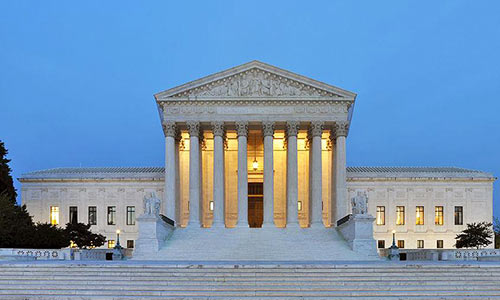
The Supreme Court on Friday blocked in full a lower court ruling that would have curbed the Biden administration’s ability to communicate with social media companies about contentious content on such issues as Covid-19.


The decision in a short unsigned order puts on hold a Louisiana-based judge’s ruling in July that specific agencies and officials should be barred from meeting with companies to discuss whether certain content should be stifled.
The Supreme Court also agreed to immediately take up the government’s appeal, meaning it will hear arguments and issue a ruling on the merits in its current term, which runs until the end of June.
Three conservative justices noted that they would have denied the application: Samuel Alito, Clarence Thomas and Neil Gorsuch.
“At this time in the history of our country, what the court has done, I fear, will be seen by some as giving the government a green light to use heavy-handed tactics to skew the presentation of views on the medium that increasingly dominates the dissemination of news. That is most unfortunate,” Alito wrote in a dissenting opinion.
GOP attorneys general in Louisiana and Missouri, along with five social media users, filed the underlying lawsuit, alleging that U.S. government officials went too far in what they characterize as coercion of social media companies to address posts, especially those related to Covid-19. The individual plaintiffs include Covid-19 lockdown opponents and Jim Hoft, the owner of the right-wing website Gateway Pundit.
They claim that the government’s actions violated free speech protections under the Constitution’s First Amendment.
“This is the worst First Amendment violation in our nation’s history. We look forward to dismantling Joe Biden’s vast censorship enterprise at the nation’s highest court,” Missouri Attorney General Andrew Bailey said in a statement Friday.
A spokesman for the Department of Justice in Washington declined to comment.
The lawsuit makes various claims relating to activities that occurred in 2020 and before, including efforts to deter the spread of false information about Covid-19 and the presidential election. Donald Trump was president at the time, but the district court ruling focused on actions taken by the government after President Joe Biden took office in January 2021.
Judge Terry Doughty, who was appointed by Trump, barred officials from “communication of any kind with social-media companies urging, encouraging, pressuring, or inducing in any manner the removal, deletion, suppression, or reduction of content containing protected free speech.”
The 5th U.S. Circuit Court of Appeals subsequently narrowed the scope of Doughty’s injunction. But the appeals court still required the White House, the FBI and top health officials not to “coerce or significantly encourage” social media companies to remove content the Biden administration considers misinformation.
Affected officials would have included White House press secretary Karine Jean-Pierre and Surgeon General Vivek Murthy.
The administration turned to the Supreme Court hoping to freeze Doughty’s ruling in full.
The district court ruling was on hold while the Supreme Court decided what steps to take.
Solicitor General Elizabeth Prelogar wrote in court papers that Doughty’s decision was “an unprecedented injunction” that “flouts bedrock principles” of federal law.
“The court imposed unprecedented limits on the ability of the President’s closest aides to use the bully pulpit to address matters of public concern, on the FBI’s ability to address threats to the Nation’s security, and on the CDC’s ability to relay public health information at platforms’ request,” she added.
Prelogar argued that the original injunction is “vastly overbroad,” saying “it covers thousands of federal officers and employees, and it applies to communications with and about all social media platforms” regarding content moderation on such topics as national security and criminal matters.
Lawyers for the states and plaintiffs said in court papers that the lower courts had both found “egregious, systematic First Amendment violations” by the government when officials put pressure on the companies to “censor disfavored viewpoints.”
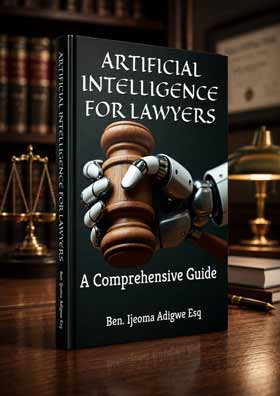 The book also examines Nigeria's legal ecosystem, focusing on the LPELR and NBA AI Guidelines. As a bonus, every purchase comes with a FREE eBook titled: How to Use the AI Features in LegalPedia and LawPavilion.
Ohio Books Ltd praises the publication, stating:
"....this is the only Nigerian book I know of on the topic."
How to Order:
📞 Call, Text, or WhatsApp: 08034917063 | 07055285878
📧 Email: benadigwe1@gmail.com
🌎 Website: www.benadigwe.com
Ebook Version: Access it directly online at https://selar.com/prv626
Authored by Ben Ijeoma Adigwe Esq., ACIarb (UK), LL.M, Dip. in Artificial Intelligence, Director at the Delta State Ministry of Justice, Asaba, Nigeria.
_______________________________________________________________________
“Enhance Legal Practice With Authoritative Reports” — Alexander Payne Offers Comprehensive Law Reports, Spanning Over A Century Of Nigerian Jurisprudence
The book also examines Nigeria's legal ecosystem, focusing on the LPELR and NBA AI Guidelines. As a bonus, every purchase comes with a FREE eBook titled: How to Use the AI Features in LegalPedia and LawPavilion.
Ohio Books Ltd praises the publication, stating:
"....this is the only Nigerian book I know of on the topic."
How to Order:
📞 Call, Text, or WhatsApp: 08034917063 | 07055285878
📧 Email: benadigwe1@gmail.com
🌎 Website: www.benadigwe.com
Ebook Version: Access it directly online at https://selar.com/prv626
Authored by Ben Ijeoma Adigwe Esq., ACIarb (UK), LL.M, Dip. in Artificial Intelligence, Director at the Delta State Ministry of Justice, Asaba, Nigeria.
_______________________________________________________________________
“Enhance Legal Practice With Authoritative Reports” — Alexander Payne Offers Comprehensive Law Reports, Spanning Over A Century Of Nigerian Jurisprudence
 Interested buyers are encouraged to place their orders and enquiries via:
0704 444 4777, 0704 444 4999, 0818 199 9888
Website: www.alexandernigeria.com
Interested buyers are encouraged to place their orders and enquiries via:
0704 444 4777, 0704 444 4999, 0818 199 9888
Website: www.alexandernigeria.com