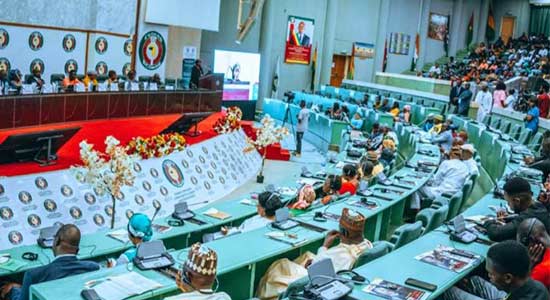
The Economic Community of West African States (ECOWAS) Parliament convened on Saturday to deliberate on the best approach to tackle the political turmoil triggered by the recent coup in Niger Republic. The parliamentary session revealed stark divisions among its members regarding the most effective strategy to address the crisis.

While a faction of parliamentarians advocated for measures to prevent military intervention in governance within the region, another faction emphasized the significance of pursuing dialogue and diplomacy as the primary means to resolve the situation.
The conflicting stances emerged during an extraordinary virtual meeting attended by 22 parliamentarians, specifically convened to discuss the ongoing impasse in Niger Republic.
A segment of the parliamentarians, aligned against military intervention, highlighted the potential dire consequences for the populace if external forces attempted to dislodge the coupists through military action. Ali Djibo, a representative from Niger Republic, stressed the importance of dialogue over armed conflict, citing the negative economic impacts and the exacerbation of regional challenges that war could entail.
Djibo articulated, “War will only compound the economic woes the peoples of the sub-region are already going through. As we speak, over a thousand trucks, loaded with goods, are stranded at the border. If a coup happened in Nigeria or Cote’d’Ivoire tomorrow, where’s the ECOWAS going to mobilize troops to fight the Nigerian or Ivorian military? How many borders are we going to close? We must also bear in mind that if we’re applying the ECOWAS treaty, it should be applicable to all.”
Awaji-Inombek Dagomie Abiante from Rivers State stressed the significance of addressing the root causes of coups within ECOWAS countries, advocating for diplomatic solutions.
However, some members expressed support for a military approach to the Niger Republic situation. They argued that dialogue and diplomacy had not effectively curbed the spread of coups in the West African region. A notable advocate for this position was Linda Ikpeazu, who drew attention to the lack of substantial consequences in past cases, such as Mali, Burkina Faso, and Guinea, contributing to the current crisis in Niger Republic.
Adebayo Balogun asserted that the proposed military action was not aimed at launching a full-scale war, but rather to dislodge the ruling junta. Balogun also highlighted that Niger was a signatory to ECOWAS’ revised protocol on non-military intervention.
In contrast, Bashir Dawodu believed that alongside dialogue, a military option should remain open to exert pressure on the coupists. He warned against relying solely on external support, noting that Russia alone would not be able to defend the junta.
Idris Wase and Ali Ndume, on the other hand, spoke out against a military invasion of Niger Republic. Wase, the first Deputy Speaker of the Parliament of ECOWAS, criticized President Bola Tinubu, the ECOWAS Chairman, accusing him of taking unilateral actions such as closing the Nigerian-Niger border and cutting electricity without the approval of the Nigerian National Assembly.
Senator Ndume emphasized the importance of reflecting the will of the people in determining the course of action. He revealed that President Tinubu had communicated the planned military intervention in Niger to the Nigerian Senate, but the Senate vehemently opposed the use of force. Instead, they advocated for dialogue as the preferable means to resolve the impasse.
Senator Ndume further criticized President Tinubu for his actions regarding the border closure and electricity reduction, emphasizing that such decisions required the approval of the Nigerian National Assembly. He highlighted that the negative consequences of these actions primarily impacted innocent citizens, rather than the ruling junta in Niger.
 Interested buyers are encouraged to place their orders and enquiries via:
0704 444 4777, 0704 444 4999, 0818 199 9888
Website: www.alexandernigeria.com
Interested buyers are encouraged to place their orders and enquiries via:
0704 444 4777, 0704 444 4999, 0818 199 9888
Website: www.alexandernigeria.com

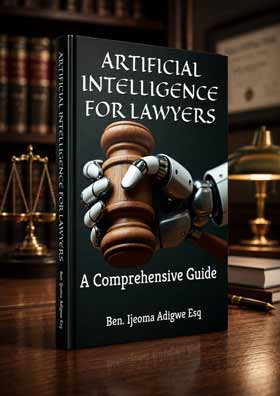 The book also examines Nigeria's legal ecosystem, focusing on the LPELR and NBA AI Guidelines. As a bonus, every purchase comes with a FREE eBook titled: How to Use the AI Features in LegalPedia and LawPavilion.
Ohio Books Ltd praises the publication, stating:
"....this is the only Nigerian book I know of on the topic."
How to Order:
📞 Call, Text, or WhatsApp: 08034917063 | 07055285878
📧 Email: benadigwe1@gmail.com
🌎 Website: www.benadigwe.com
Ebook Version: Access it directly online at https://selar.com/prv626
Authored by Ben Ijeoma Adigwe Esq., ACIarb (UK), LL.M, Dip. in Artificial Intelligence, Director at the Delta State Ministry of Justice, Asaba, Nigeria.
_______________________________________________________________________
The book also examines Nigeria's legal ecosystem, focusing on the LPELR and NBA AI Guidelines. As a bonus, every purchase comes with a FREE eBook titled: How to Use the AI Features in LegalPedia and LawPavilion.
Ohio Books Ltd praises the publication, stating:
"....this is the only Nigerian book I know of on the topic."
How to Order:
📞 Call, Text, or WhatsApp: 08034917063 | 07055285878
📧 Email: benadigwe1@gmail.com
🌎 Website: www.benadigwe.com
Ebook Version: Access it directly online at https://selar.com/prv626
Authored by Ben Ijeoma Adigwe Esq., ACIarb (UK), LL.M, Dip. in Artificial Intelligence, Director at the Delta State Ministry of Justice, Asaba, Nigeria.
_______________________________________________________________________