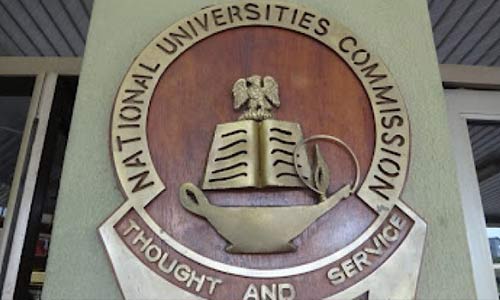
The National Universities Commission (NUC) has responded to claims made by the Academic Staff Union of Universities (ASUU) that it is not within the commission’s mandate to develop or review curricula for Nigerian universities.

Dr Noel Biodum Saliu, the Deputy Executive Secretary (Academics), issued a statement on Friday in Abuja, urging ASUU to stop misleading Nigerians on such a vital issue.
Dr Saliu stated, “The attention of the National Universities Commission (NUC) has been drawn to the publication of the Academic Staff Union of Universities (ASUU) with respect to its concerns over the Core Curriculum Minimum Academic Standards. The said publication contains some misinformation that must be corrected in the interest of all.”
He clarified that there are two acts of the enabling law under which the NUC operates that provide the legal framework for the quality assurance and regulatory mandates of the commission.
The first act is the National Universities Commission Act No. N81 Laws of the Federation Nigeria (L.F.N.) 2011, which established the NUC as a body corporate responsible for advising the federal and state governments on all aspects of university education and the general development of universities in Nigeria.
The second act is the Education (National Minimum Standards and Establishment of Institutions) Act No. E3 L.F.N. 2004, which empowers the NUC to set minimum standards for universities and other institutions of higher learning in the federation and to accredit their degrees and other academic awards in consultation with the universities and with prior approval from the president.
Dr Saliu further explained the NUC’s involvement in curriculum development and review, stating, “Following the enactment of the NUC Act No. E3 L.F.N. 2004, the Commission developed the first set of Minimum Academic Standards (MAS) in 1989 for all the academic programmes existing in the Nigerian University System (NUS) at that time.”
He mentioned that the MAS served as reference documents for the initial accreditation of programs conducted in the NUS in 1990. The MAS was later replaced with the Benchmark Minimum Academic Standards (BMAS) in a comprehensive curriculum review in 2004. The BMAS was approved for use in Nigerian universities in 2007. Dr Saliu also noted that a second attempt at reviewing the BMAS occurred in 2011 but was not followed up.
Dr Saliu emphasized that Nigerian universities have always been primarily involved in the development and review of the curriculum in the NUS, with the NUC coordinating the process. He stated, “In carrying out this very important quality assurance activity of developing minimum standards in the NUS, from 1989 to date, the NUC has always engaged subject area experts across Nigerian universities.” He highlighted that the NUC has communicated with vice-chancellors over the past five years regarding curriculum review, and virtual and on-site meetings were held to provide updates and gather input.
Responding to ASUU’s claims, Dr Saliu stated, “The claim that there is no evidence to show that the universities were involved in the true sense of revision of the BMAS development and the subsequent implementation of the CCMAS in the NUS is also far from the truth.”
He explained that the curriculum review process started in 2018, with subject area experts in Nigerian universities producing draft documents that were circulated among Nigerian academics for their comments.
The NUC incorporated the comments received into the respective programs. Dr Saliu stressed that the practice of incorporating inputs from Nigerian universities has been a tradition of the NUC since 1989.
Regarding the curriculum provision ratio, Dr Saliu clarified that the NUC proposed a 50:50 ratio to the universities during a retreat in 2017, but the proposal was rejected. The NUC then adopted a 70:30 NUC university ratio for the curriculum contents during the comprehensive curriculum review.
He explained that the aim of this ratio is to eventually place the curriculum in the domain of the universities, allowing them to create a niche for themselves by introducing courses based on their peculiarities. Dr Saliu emphasized that the NUC component of the curriculum was determined by Nigerian academics, with the commission only coordinating the process.
In conclusion, Dr Saliu stated that the NUC’s process of coordinating the review of the curriculum is in compliance with the mandate conferred on it by the Education (National Minimum Standard and Establishment of Institutions) Act No. E3 L.F.N. 2004.
He emphasized that the NUC’s efforts in developing the Core Curriculum Minimum Academic Standards (CCMAS) have been acclaimed by Nigerian universities, the private sector, stakeholders in university education, and the international community. Dr Saliu noted that many professors and academics participating in the ongoing curriculum re-engineering exercise are members of ASUU.
“Order Justice Omolaye-Ajileye’s Electronic Evidence Books Now” — Essential Guides On Evidence Act, Case Law And Digital Proof
[A MUST HAVE] Evidence Act Demystified With Recent And Contemporary Cases And Materials

Available now for NGN 40,000 at ASC Publications, 10, Boyle Street, Onikan, Lagos. Beside High Court, TBS. Email publications@ayindesanni.com or WhatsApp +2347056667384. Purchase Link: https://paystack.com/buy/evidence-act-complete-annotation
______________________________________________________________________ “Enhance Legal Practice With Authoritative Reports” — Alexander Payne Offers Comprehensive Law Reports, Spanning Over A Century Of Nigerian Jurisprudence Interested buyers are encouraged to place their orders and enquiries via:
0704 444 4777, 0704 444 4999, 0818 199 9888
Website: www.alexandernigeria.com
Interested buyers are encouraged to place their orders and enquiries via:
0704 444 4777, 0704 444 4999, 0818 199 9888
Website: www.alexandernigeria.com
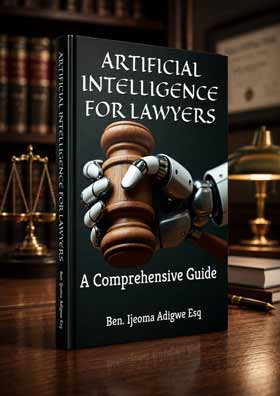 The book also examines Nigeria's legal ecosystem, focusing on the LPELR and NBA AI Guidelines. As a bonus, every purchase comes with a FREE eBook titled: How to Use the AI Features in LegalPedia and LawPavilion.
Ohio Books Ltd praises the publication, stating:
"....this is the only Nigerian book I know of on the topic."
How to Order:
📞 Call, Text, or WhatsApp: 08034917063 | 07055285878
📧 Email: benadigwe1@gmail.com
🌎 Website: www.benadigwe.com
Ebook Version: Access it directly online at https://selar.com/prv626
Authored by Ben Ijeoma Adigwe Esq., ACIarb (UK), LL.M, Dip. in Artificial Intelligence, Director at the Delta State Ministry of Justice, Asaba, Nigeria.
______________________________________________________________________
The book also examines Nigeria's legal ecosystem, focusing on the LPELR and NBA AI Guidelines. As a bonus, every purchase comes with a FREE eBook titled: How to Use the AI Features in LegalPedia and LawPavilion.
Ohio Books Ltd praises the publication, stating:
"....this is the only Nigerian book I know of on the topic."
How to Order:
📞 Call, Text, or WhatsApp: 08034917063 | 07055285878
📧 Email: benadigwe1@gmail.com
🌎 Website: www.benadigwe.com
Ebook Version: Access it directly online at https://selar.com/prv626
Authored by Ben Ijeoma Adigwe Esq., ACIarb (UK), LL.M, Dip. in Artificial Intelligence, Director at the Delta State Ministry of Justice, Asaba, Nigeria.
______________________________________________________________________