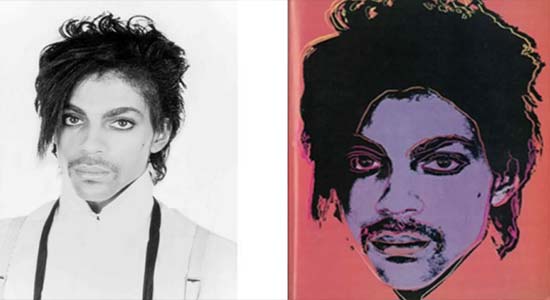
(Reuters) – Andy Warhol’s estate lost its U.S. Supreme Court copyright fight with celebrity photographer Lynn Goldsmith on Thursday as the justices faulted the famed pop artist’s use of her photo of singer Prince in a silkscreen series depicting the charismatic rock star.


The justices, in a 7-2 ruling authored by liberal Justice Sonia Sotomayor, upheld a lower court’s ruling that Warhol’s works based on Goldsmith’s 1981 photo were not immune from her copyright infringement lawsuit.
The case has been watched closely in the art world and entertainment industry for its implications regarding the legal doctrine called fair use, which promotes freedom of expression by allowing the use of copyright-protected works under certain circumstances without the owner’s permission.
Warhol, who died in 1987, was a foremost participant in the pop art movement that germinated in the 1950s. He created silkscreen print paintings and other revered and financially valuable works inspired by photos of celebrities including actress Marilyn Monroe, singer Elvis Presley, Britain’s Queen Elizabeth, Chinese leader Mao Zedong and boxer Muhammad Ali.
At issue in the litigation involving Goldsmith was Warhol’s “Orange Prince” series.
Vanity Fair magazine had commissioned Warhol to make an image of Prince to be published accompanying a story about the rocker, giving credit to Goldsmith for the source photograph. Warhol created 14 silkscreens and two pencil illustrations based on the photo that Goldsmith had taken of Prince for Newsweek magazine in 1981, most of which were not authorized by the photographer.
Goldsmith, 75, has said she learned of the unauthorized works only after Prince’s 2016 death. She countersued the Andy Warhol Foundation in 2017 after it asked a court to find that the works did not violate her copyright.
A key factor courts have used to determine fair use is whether the new work has a “transformative” purpose such as parody, education or criticism.
The New York-based 2nd U.S. Circuit Court of Appeals reversed a judge’s ruling that Warhol had made fair use of Goldsmith’s photo by transforming her depiction of a “vulnerable” musician into a “larger-than-life” figure.
The 2nd Circuit decided that judges should not “assume the role of art critic” by considering its meaning, but instead decide whether the new work has a different artistic purpose and character from the old one. Under that standard, the circuit court said Warhol’s paintings were closer to adapting Goldsmith’s photo in a different medium than transforming it.
Echoing a recommendation from President Joe Biden’s administration, the Supreme Court focused on the specific use that allegedly infringed Goldsmith’s copyright – a license of Warhol’s work to Conde Nast – and said it was not transformative because it served the same commercial purpose as Goldsmith’s photo: to depict Prince in a magazine.
Sotomayor distinguished that use from Warhol’s pop art, like his famed prints of Campbell Soup cans.
“The Soup Cans series uses Campbell’s copyrighted work for an artistic commentary on consumerism, a purpose that is orthogonal to advertising soup,” Sotomayor wrote.
Liberal Justice Elena Kagan wrote a dissent joined by conservative Chief Justice John Roberts, arguing for the artistic value of appropriation with nods to artists ranging from author William Shakespeare to painter Eduoard Manet to rock musician Nick Cave.
“All that matters” in the ruling issued by the court’s majority, Kagan wrote, “is that Warhol and the publisher entered into a licensing transaction, similar to one Goldsmith might have done. Because the artist had such a commercial purpose, all the creativity in the world could not save him.”
“In declining to acknowledge the importance of transformative copying, the court today, and for the first time, turns its back on how creativity works,” Kagan said.
Sotomayor wrote that dissent written by Kagan “misses the forest for a tree,” and that its “single-minded focus on the value of copying ignores the value of original works.”
The last time the Supreme Court ruled on fair use in art was in 1994, when it decided that rap group 2 Live Crew’s parody of singer Roy Orbison’s “Oh, Pretty Woman” made fair use of the popular 1960s song. The justices ruled in a software copyright dispute in 2021 that Google LLC’s Android mobile operating system made fair use of Oracle Corp software code.
 Interested buyers are encouraged to place their orders and enquiries via:
0704 444 4777, 0704 444 4999, 0818 199 9888
Website: www.alexandernigeria.com
Interested buyers are encouraged to place their orders and enquiries via:
0704 444 4777, 0704 444 4999, 0818 199 9888
Website: www.alexandernigeria.com

“Order Justice Omolaye-Ajileye’s Electronic Evidence Books Now” — Essential Guides On Evidence Act, Case Law And Digital Proof
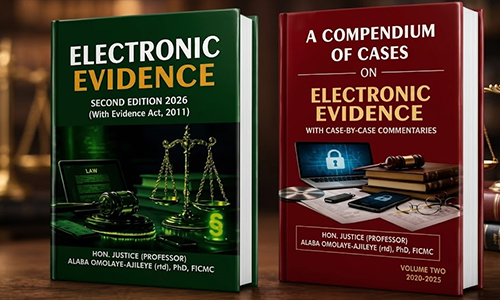
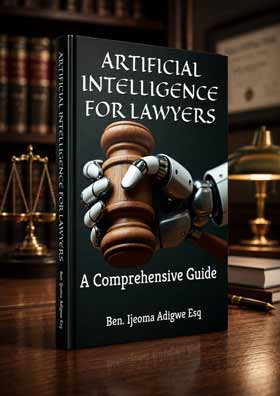 The book also examines Nigeria's legal ecosystem, focusing on the LPELR and NBA AI Guidelines. As a bonus, every purchase comes with a FREE eBook titled: How to Use the AI Features in LegalPedia and LawPavilion.
Ohio Books Ltd praises the publication, stating:
"....this is the only Nigerian book I know of on the topic."
How to Order:
📞 Call, Text, or WhatsApp: 08034917063 | 07055285878
📧 Email: benadigwe1@gmail.com
🌎 Website: www.benadigwe.com
Ebook Version: Access it directly online at https://selar.com/prv626
Authored by Ben Ijeoma Adigwe Esq., ACIarb (UK), LL.M, Dip. in Artificial Intelligence, Director at the Delta State Ministry of Justice, Asaba, Nigeria.
_______________________________________________________________________
The book also examines Nigeria's legal ecosystem, focusing on the LPELR and NBA AI Guidelines. As a bonus, every purchase comes with a FREE eBook titled: How to Use the AI Features in LegalPedia and LawPavilion.
Ohio Books Ltd praises the publication, stating:
"....this is the only Nigerian book I know of on the topic."
How to Order:
📞 Call, Text, or WhatsApp: 08034917063 | 07055285878
📧 Email: benadigwe1@gmail.com
🌎 Website: www.benadigwe.com
Ebook Version: Access it directly online at https://selar.com/prv626
Authored by Ben Ijeoma Adigwe Esq., ACIarb (UK), LL.M, Dip. in Artificial Intelligence, Director at the Delta State Ministry of Justice, Asaba, Nigeria.
_______________________________________________________________________