A federal jury found on Thursday that the pop singer Ed Sheeran did not copy Marvin Gaye’s classic “Let’s Get It On” for his 2014 hit “Thinking Out Loud,” in the music industry’s highest-profile copyright case in years.


Over two weeks in a downtown Manhattan courtroom, Mr. Sheeran, one of music’s biggest global hitmakers, testified — often with a guitar in hand — that “Thinking Out Loud” had been created independently one evening with his friend and longtime collaborator Amy Wadge. The song was inspired, he said, by the decades-long loves that he and Ms. Wadge observed among elders in their families.
The two tracks share a similar syncopated chord pattern that the family of Ed Townsend, Gaye’s co-writer, which filed the suit, called the “heart” of “Let’s Get It On.” Mr. Sheeran and his lawyers never denied that the chords in the two songs are similar, but called them commonplace musical building blocks that have turned up in dozens of other songs.
The jury, which deliberated for around three hours, found that Mr. Sheeran had created his song independently.
“I am obviously very happy with the outcome of the case,” Mr. Sheeran said in a statement that he read outside the courthouse. “At the same time, I am unbelievably frustrated that baseless claims like this are allowed to go to court at all.”
“We have spent the last eight years talking about two songs with dramatically different lyrics, melodies and four chords which are also different and used by songwriters every day, all over the world,” Mr. Sheeran continued. “These chords are common building blocks which were used to create music long before ‘Let’s Get It On’ was written and will be used to make music long after we are all gone.”
“I am just a guy with a guitar who loves writing music for people to enjoy,” he added. “I am not and will never allow myself to be a piggy bank for anyone to shake.”
After the verdict was read shortly after 1 p.m., Mr. Sheeran rose and hugged members of his legal team. He then walked over to Kathryn Griffin Townsend, Mr. Townsend’s daughter, and embraced her too. The two spoke briefly.
After that, Ms. Townsend said that she respected the jury’s decision and that she had defended her father’s legacy.
“I stood up for my father’s intellectual properties,” she said. “I was up against an army.”
“Thinking Out Loud”
Ed Sheeran
“Let’s Get It On”
Marvin Gaye
The case, which was filed in 2017 and had been delayed in part by the coronavirus pandemic, involved questions of originality in pop music that have been tested in a series of recent cases, stoking fears among musicians that the line between inspiration and plagiarism was being muddied.
In a 2015 decision that shook the business, Robin Thicke and Pharrell Williams’s song “Blurred Lines” was found to have infringed Gaye’s “Got to Give It Up.” Five years later, the tide turned: Led Zeppelin won an appeals court victory over its megahit “Stairway to Heaven,” and the judges provided guidance about how copyright applies to works involving “commonplace elements.”
In Mr. Sheeran’s case, the plaintiffs argued that even if elements like chords may not be under copyright individually, their “selection and arrangement” on “Let’s Get It On” was original and distinctive enough to warrant protection. Mr. Sheeran’s side responded that the plaintiffs’ case did not pass the high legal bar required for such protection.
At times, Mr. Sheeran, who has faced litigation stemming from accusations of copying twice before, grew vexed and combative at the stand.
“To have someone come in and say, ‘We don’t believe you, you must have stolen it,’” Mr. Sheeran said, “I find that really insulting.”
He insisted that he did not borrow from “Let’s Get It On,” and, playing an acoustic guitar in the witness box, he showed that the chord progression at the core of both tunes, while similar, was not identical.
In “Thinking Out Loud,” he testified, the second of the four chords in the progression was major, rejecting a suggestion by Alexander Stewart, a musicologist from the University of Vermont hired by the plaintiffs, that it was similar to a minor one in “Let’s Get It On.”
“I know what I’m playing on guitar,” Mr. Sheeran said. “It’s me playing the chords.”
Mr. Sheeran also derided Mr. Stewart’s analysis of his vocal melodies — which included an example with some notes changed — as “criminal.”
A quirk of copyright law governed how the jury could hear the two songs. The case involved only the compositions underlying both tracks — the lyrics, melodies and chords that can be notated on paper — and not their recordings. For older songs like “Let’s Get It On,” copyright is limited to the sheet music, or “deposit copy,” that was originally submitted to the United States Copyright Office. On “Let’s Get It On,” that notation was skeletal.
That meant that the jury never heard Gaye’s original recording, which went to No. 1 in 1973. Instead, the defendants supplied a computer-generated re-creation of what appears on the deposit copy, complete with a robotic voice rendering lyrics like “If you feel like I feel, baby, then come on, let’s get it on.” The studio recording of Mr. Sheeran’s song was heard multiple times.
One of the jurors, Sophia Neis, 23, said after the trial that “the song as we’re allowed to hear it” and the “deposit copy” were key pieces of evidence in the jury’s decision making.
“We ultimately came to what we thought was the right interpretation of the law,” she said.
“It’s obviously cool to have anyone play music in front of you live,” she added, of Mr. Sheeran’s decision to play on the stand. “That was an interesting surprise.”
Ms. Townsend, who often wore a tan-colored coat with the word “integrity” emblazoned on the back to court, said she had filed her suit to protect her father’s legacy. On Day 3 of the trial, the proceedings were interrupted when she collapsed and was taken to a hospital.
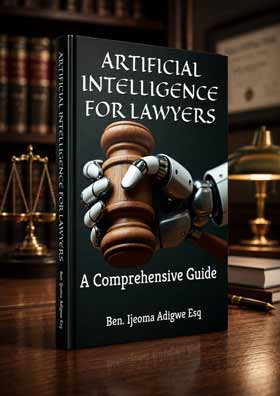 The book also examines Nigeria's legal ecosystem, focusing on the LPELR and NBA AI Guidelines. As a bonus, every purchase comes with a FREE eBook titled: How to Use the AI Features in LegalPedia and LawPavilion.
Ohio Books Ltd praises the publication, stating:
"....this is the only Nigerian book I know of on the topic."
How to Order:
📞 Call, Text, or WhatsApp: 08034917063 | 07055285878
📧 Email: benadigwe1@gmail.com
🌎 Website: www.benadigwe.com
Ebook Version: Access it directly online at https://selar.com/prv626
Authored by Ben Ijeoma Adigwe Esq., ACIarb (UK), LL.M, Dip. in Artificial Intelligence, Director at the Delta State Ministry of Justice, Asaba, Nigeria.
_______________________________________________________________________
The book also examines Nigeria's legal ecosystem, focusing on the LPELR and NBA AI Guidelines. As a bonus, every purchase comes with a FREE eBook titled: How to Use the AI Features in LegalPedia and LawPavilion.
Ohio Books Ltd praises the publication, stating:
"....this is the only Nigerian book I know of on the topic."
How to Order:
📞 Call, Text, or WhatsApp: 08034917063 | 07055285878
📧 Email: benadigwe1@gmail.com
🌎 Website: www.benadigwe.com
Ebook Version: Access it directly online at https://selar.com/prv626
Authored by Ben Ijeoma Adigwe Esq., ACIarb (UK), LL.M, Dip. in Artificial Intelligence, Director at the Delta State Ministry of Justice, Asaba, Nigeria.
_______________________________________________________________________
“Order Justice Omolaye-Ajileye’s Electronic Evidence Books Now” — Essential Guides On Evidence Act, Case Law And Digital Proof
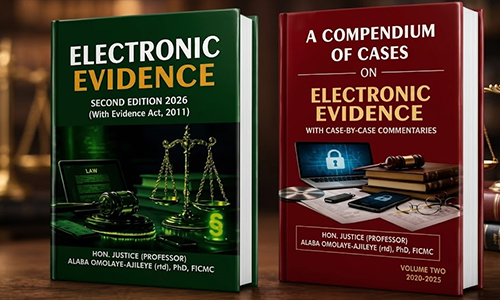

 Interested buyers are encouraged to place their orders and enquiries via:
0704 444 4777, 0704 444 4999, 0818 199 9888
Website: www.alexandernigeria.com
Interested buyers are encouraged to place their orders and enquiries via:
0704 444 4777, 0704 444 4999, 0818 199 9888
Website: www.alexandernigeria.com