Iran has announced the first arrests connected to a spate of suspected poisonings of schoolgirls that has gripped the country.

“Based on the intelligence and research measures of the intelligence agencies, a number of people have been arrested in five provinces and the relevant agencies are conducting a full investigation,” the deputy interior minister, Majid Mirahmadi, told state television. Mirahmadi did not provide details on the detained individuals.
The arrests come as Tehran cracks down on criticism of its response to the suspected attacks. On Monday, three journalists and three dissidents, including a retired academic, were called in for questioning after challenging the government’s handling of the incidents.
More girls were taken from their schools in ambulances on Tuesday, as protests were held outside the ministry of education in Tehran. Teaching union leaders were reportedly arrested during clashes with security forces.
Iranian human rights groups have said at least 7,068 students have been affected in a minimum of 103 schools. Attacks have been recorded in at least 99 cities out of 28 provinces of the country. The highest number of recorded attacks on one day was 81 attacks.
Medical organisations have called on authorities to do more to protect schoolchildren and opponents of the regime, and have said that the security services may have turned a blind eye to religious extremists allegedly punishing girls for taking part in the nationwide protest movement sparked by the death in police custody of Mahsa Amini last September.
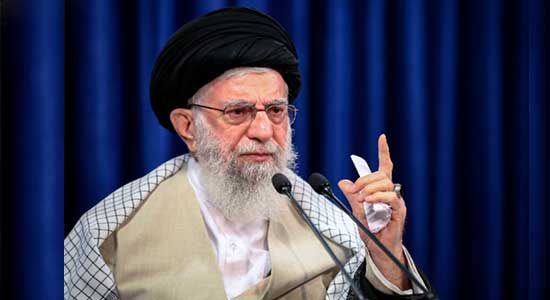
Messages from the government remained contradictory after the supreme leader Ayatollah Ali Khamenei said on Monday that anyone found guilty of poisoning children should be “severely punished”.
Officials from the education department have claimed that at least some of the girls who have fallen ill have a form of “mass hysteria”.
The education minister, Yousef Nouri, said 95% of the girls going to hospitals or medical centres had no medical problem – only fear and worry – while a few had underlying diseases. He urged parents only to pay attention to information transmitted by reliable official media, adding that “it was natural for our enemy to conspire to close schools and stop students from studying”.
His remarks came soon after the Iranian health ministry published the first report of its scientific committee investigation into the suspected poisonings. The committee announced that “some of the students were exposed to an irritant substance that is mainly inhaled”.
Iranian officials have also claimed individuals involved in the recent protests used their children to carry the poison into the schools and then filmed the poisoned school children before sending the footage to foreign news stations.
The explanation, contorted even by the standards of Iranian officials, implies protestors were willing to endanger their own children in a bid to the damage of the Iranian revolution. No details were provided alongside these claims.
The supreme leader’s intervention was a significant admission that the public was deeply concerned about what was happening, given that the government previously had little to say about the incidents of girls falling sick, which started last November.
The US state department spokesperson, Ned Price, said if poisonings had taken place and were in some way linked to suppressing women’s protests, then it would be legitimate for an already established UN-led inquiry into the protests to examine the issue.
The three journalists called in for questioning by the Tehran prosecutor are from Hamehan, Event 24 and Shargh. Event 24 has interviewed psychiatrists who dismissed suggestions the girls were suffering from some sort of psychological event.
On Monday, it emerged authorities had arrested Ali Portbatabaei, a moderator at the news website Qom News who has reported regularly on the suspected poisonings.
The three other individuals called in for questioning are Azar Mansouri, the secretary general of the reformist Ittehad Mellat party; Sadegh Zibakalam, a reformist Tehran professor; and Reza Kianian, an actor and writer. They have been accused of spreading lies about the suspected poisonings but may face questions about social media posts in support of the wider protests.
In an Instagram post, Kianian challenged state media for failing to cover the scale of the alleged attacks on girls, and asked what the government was doing to find those responsible.
 Interested buyers are encouraged to place their orders and enquiries via:
0704 444 4777, 0704 444 4999, 0818 199 9888
Website: www.alexandernigeria.com
Interested buyers are encouraged to place their orders and enquiries via:
0704 444 4777, 0704 444 4999, 0818 199 9888
Website: www.alexandernigeria.com

“Order Justice Omolaye-Ajileye’s Electronic Evidence Books Now” — Essential Guides On Evidence Act, Case Law And Digital Proof
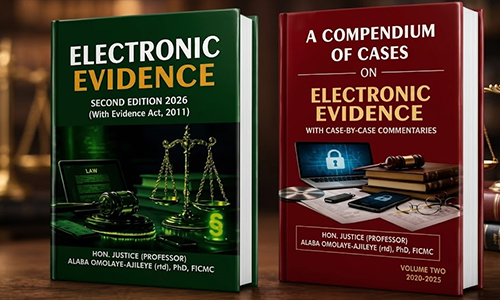
 The book also examines Nigeria's legal ecosystem, focusing on the LPELR and NBA AI Guidelines. As a bonus, every purchase comes with a FREE eBook titled: How to Use the AI Features in LegalPedia and LawPavilion.
Ohio Books Ltd praises the publication, stating:
"....this is the only Nigerian book I know of on the topic."
How to Order:
📞 Call, Text, or WhatsApp: 08034917063 | 07055285878
📧 Email: benadigwe1@gmail.com
🌎 Website: www.benadigwe.com
Ebook Version: Access it directly online at https://selar.com/prv626
Authored by Ben Ijeoma Adigwe Esq., ACIarb (UK), LL.M, Dip. in Artificial Intelligence, Director at the Delta State Ministry of Justice, Asaba, Nigeria.
_______________________________________________________________________
The book also examines Nigeria's legal ecosystem, focusing on the LPELR and NBA AI Guidelines. As a bonus, every purchase comes with a FREE eBook titled: How to Use the AI Features in LegalPedia and LawPavilion.
Ohio Books Ltd praises the publication, stating:
"....this is the only Nigerian book I know of on the topic."
How to Order:
📞 Call, Text, or WhatsApp: 08034917063 | 07055285878
📧 Email: benadigwe1@gmail.com
🌎 Website: www.benadigwe.com
Ebook Version: Access it directly online at https://selar.com/prv626
Authored by Ben Ijeoma Adigwe Esq., ACIarb (UK), LL.M, Dip. in Artificial Intelligence, Director at the Delta State Ministry of Justice, Asaba, Nigeria.
_______________________________________________________________________