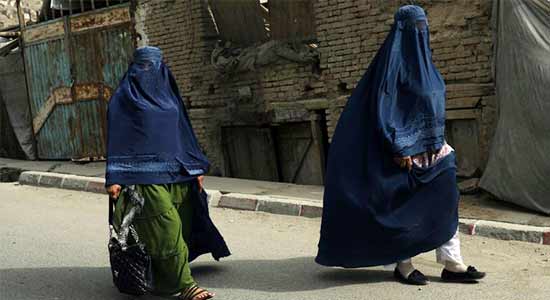
Muslim women in Afghanistan must cover from head to toe in public, according to a Taliban ruling announced Saturday, its latest move to constrain the lives of women since taking control of the country last year.


“This is not a restriction on women but an order of the Quran,” said Akif Muhajir, a spokesman for the Ministry of Virtue and Prevention of Vice, referring to the Taliban’s strict interpretation of Islamic law. “It is the order of Allah and the prophet Muhammad.”
The Taliban’s treatment of women has been a key point of contention as the group has pushed for formal international recognition and increased aid money to address the country’s spiraling economic crisis. When asked for greater engagement with the Taliban, the international community has repeatedly requested a demonstration of greater respect for women’s rights, among other things.
Women may choose to wear the head-to-toe covering called a burqa, or a cloth veil covering the face paired with a headscarf and long robe called an abaya, Muhajir said.
Women who appear in public in violation of the new guidelines on dress will first be issued warnings, the ministry’s announcement stated. Those who continue to disregard the ruling will have their homes identified and their male relatives summoned for punishment that could include prison time, the Taliban said at a news conference Saturday.
The ministry called on the media and mosques to encourage women to comply. “Muslim women are not worried” about the new ruling on dress, Muhajir said. Taliban leaders have traveled the country in recent months trying to convince Afghans at the local level that such a law is in line with Islamic teachings.
Several Afghan women and activists spoke out against the order.
“Believe me, we lost our way,” said Benazir Baktash, a 26-year-old local television presenter in Kabul, who said she felt personally “hurt” by the news and would prefer that the Taliban focus on some of the more serious issues facing Afghanistan.
“They are busy with very small issues, and there is a lot of other things to be done for the country. They should issue rulings to decrease poverty and help people find jobs,” she said.
While not legally required to do so under the previous government, most Afghan women have traditionally covered their hair in public. When the Taliban controlled Afghanistan in the 1990s, all women were required to wear head-to-toe coverings. But after the group was ousted, face coverings became less common in urban parts of the country.
Since the Taliban takeover in August, the group has imprisoned dozens of women’s rights activists, restricted access to education for women and girls, and blocked women from international travel without a male guardian. Many women have also been barred from the workplace under Taliban rule because of guidelines forbidding men and women to work in proximity to one another.
“This decision contradicts numerous assurances regarding respect for and protection of all Afghans’ human rights, including those of women and girls,” the United Nations mission in Afghanistan said in a statement, expressing deep concern about the ruling.
The statement also warned that the Taliban’s action may “further strain engagement with the international community,” and said the mission would “immediately request meetings with the Taliban de facto authorities to seek clarification on the status of this decision.”
“Order Justice Omolaye-Ajileye’s Electronic Evidence Books Now” — Essential Guides On Evidence Act, Case Law And Digital Proof
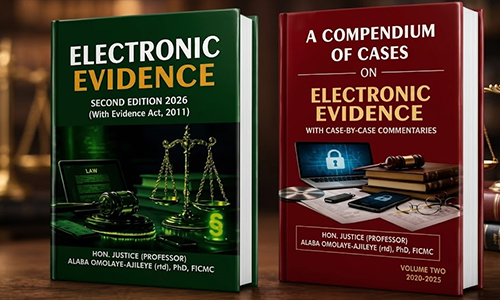
[A MUST HAVE] Evidence Act Demystified With Recent And Contemporary Cases And Materials

Available now for NGN 40,000 at ASC Publications, 10, Boyle Street, Onikan, Lagos. Beside High Court, TBS. Email publications@ayindesanni.com or WhatsApp +2347056667384. Purchase Link: https://paystack.com/buy/evidence-act-complete-annotation
______________________________________________________________________ “Enhance Legal Practice With Authoritative Reports” — Alexander Payne Offers Comprehensive Law Reports, Spanning Over A Century Of Nigerian Jurisprudence Interested buyers are encouraged to place their orders and enquiries via:
0704 444 4777, 0704 444 4999, 0818 199 9888
Website: www.alexandernigeria.com
Interested buyers are encouraged to place their orders and enquiries via:
0704 444 4777, 0704 444 4999, 0818 199 9888
Website: www.alexandernigeria.com
 The book also examines Nigeria's legal ecosystem, focusing on the LPELR and NBA AI Guidelines. As a bonus, every purchase comes with a FREE eBook titled: How to Use the AI Features in LegalPedia and LawPavilion.
Ohio Books Ltd praises the publication, stating:
"....this is the only Nigerian book I know of on the topic."
How to Order:
📞 Call, Text, or WhatsApp: 08034917063 | 07055285878
📧 Email: benadigwe1@gmail.com
🌎 Website: www.benadigwe.com
Ebook Version: Access it directly online at https://selar.com/prv626
Authored by Ben Ijeoma Adigwe Esq., ACIarb (UK), LL.M, Dip. in Artificial Intelligence, Director at the Delta State Ministry of Justice, Asaba, Nigeria.
______________________________________________________________________
The book also examines Nigeria's legal ecosystem, focusing on the LPELR and NBA AI Guidelines. As a bonus, every purchase comes with a FREE eBook titled: How to Use the AI Features in LegalPedia and LawPavilion.
Ohio Books Ltd praises the publication, stating:
"....this is the only Nigerian book I know of on the topic."
How to Order:
📞 Call, Text, or WhatsApp: 08034917063 | 07055285878
📧 Email: benadigwe1@gmail.com
🌎 Website: www.benadigwe.com
Ebook Version: Access it directly online at https://selar.com/prv626
Authored by Ben Ijeoma Adigwe Esq., ACIarb (UK), LL.M, Dip. in Artificial Intelligence, Director at the Delta State Ministry of Justice, Asaba, Nigeria.
______________________________________________________________________