
*No expectation of privacy after accepting friend request


The Supreme Judicial Court has ruled that Suffolk County prosecutors can use as evidence a gun seized from a man outside a Dorchester gym after a gang-unit officer watched him in a Snapchat video displaying the weapon.
Averyk Carrasquillo’s attorney had argued that the way the officer watched and videoed his Snapchat “story” without a warrant was a violation of his constitutional right against improper search and seizure, in particular because he set his Snapchat channel as “private.”
Carrasquillo’s request stems from his 2017 arrest outside a gym on Ellsworth Street in Dorchester – about a month after a gang-unit officer had sent him a Snapchat friend request, which he accepted. In May of that year, the officer watched two videos Carrasquillo, a Roxbury resident posted, one showing him apparently holding a gun while wearing distinctive pants, the other showing the interior of a gym on Ellsworth Street in Dorchester.
Other gang-unit officers went down to the gym, spotted Carrasquillo wearing those pants and then frisked him, finding a loaded gun in one of his pockets. He was then arrested on various gun charges, including possession of a gun after a prior conviction.
In its ruling, the state’s highest court agreed that social-media users have certain privacy rights, and that users of Snapchat in particular have some expectation of privacy given the way postings on the platform are designed to disappear, either immediately after a single viewing or after 24 hours, depending on the settings. Carrisquillo, they continued might have expected a further level of privacy because he had set his account to be “private.”
But, the court continued, he basically threw that right away when he accepted a friend request from a user he did not know with a made-up name and the default Snapchat user icon – the gang-unit officer (in a footnote, the court said the situation might be different had the officer assumed the name or something close to the name, of a person Carrisquillo knew).
“[T]he defendant’s privacy interest in this case was substantially diminished because, despite his asserted policy of restricting such access, he did not adequately “control[] access” to his Snapchat account. … Rather, he appears to have permitted unknown individuals to gain access to his content. For instance, Connolly [the officer] was granted access to the defendant’s content using a nondescript username that the defendant did not recognize and a default image that evidently was not Connolly’s photograph. By accepting Connolly’s friend request in those circumstances, the defendant demonstrated that he did not make “reasonable efforts to corroborate the claims of” those seeking access to his account. …
“The nature of the government intrusion in this case further counsels against a determination that the defendant retained an objectively reasonable expectation of privacy in his video recordings, because the asserted government intrusion took place with the defendant’s permission.
“Connolly was able to view the defendant’s stories precisely because the defendant gave him the necessary permissions to do so. That the defendant not only did not exercise control to exclude a user whose name he did not recognize, but also affirmatively gave Connolly the required permissions to view posted content, weighs against a conclusion that the defendant retained a reasonable expectation of privacy in his Snapchat stories.”
The court started its decision by saying it was rejecting the requests by both defense and prosecution to take absolute or “bright line” stances on the issue of social-media privacy – that police need a warrant at all times or that they don’t need any at all, saying each case needs to be decided on its merits.
As they have with other digital privacy issues, the justices struggled with adapting legal concepts written in an age of physical objects with the digital age. In this case, they began by considering the importance of privacy in the US in general and in Massachusetts in particular, and the implications for that related to the Fourth Amendment and the equivalent section of the Massachusetts constitution. And they concluded that even social-media users have privacy rights.
“Government surveillance of social media, for instance, implicates conversational and associational privacy because of the increasingly important role that social media plays in human connection and interaction in the Commonwealth and around the world. For many, social media is an indispensable feature of social life through which they develop and nourish deeply personal and meaningful relationships. For better or worse, the momentous joys, profound sorrows, and minutiae of everyday life that previously would have been discussed with friends in the privacy of each others’ homes now generally are shared electronically using social media connections. Government surveillance of this activity therefore risks chilling the conversational and associational privacy rights that the Fourth Amendment and art. 14 seek to protect. … Accordingly, the constitutional solicitude for conversational and associational privacy extends to the realm of social media.”
Because of the way it works, they continued, Snapchat might have to be considered differently than other social-media networks, where messages don’t simply disappear:
“Thus, if a text message is akin to a letter, a Snapchat story is akin to a letter written in disappearing ink. In this way, too, the defendant retained a level of control over his stories. In sum, the defendant’s relative level of control over the video recordings, combined with his other protective measures, weighs in favor of his argument that he had a reasonable expectation of privacy in the posted stories.”
But then they returned to the specifics of Carrasquillo’s case and concluded he had no case, at least as far as privacy goes.
“Order Justice Omolaye-Ajileye’s Electronic Evidence Books Now” — Essential Guides On Evidence Act, Case Law And Digital Proof
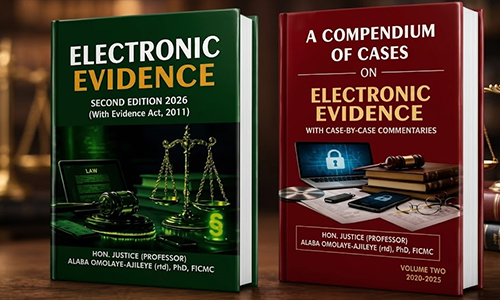
[A MUST HAVE] Evidence Act Demystified With Recent And Contemporary Cases And Materials

Available now for NGN 40,000 at ASC Publications, 10, Boyle Street, Onikan, Lagos. Beside High Court, TBS. Email publications@ayindesanni.com or WhatsApp +2347056667384. Purchase Link: https://paystack.com/buy/evidence-act-complete-annotation
______________________________________________________________________ “Enhance Legal Practice With Authoritative Reports” — Alexander Payne Offers Comprehensive Law Reports, Spanning Over A Century Of Nigerian Jurisprudence Interested buyers are encouraged to place their orders and enquiries via:
0704 444 4777, 0704 444 4999, 0818 199 9888
Website: www.alexandernigeria.com
Interested buyers are encouraged to place their orders and enquiries via:
0704 444 4777, 0704 444 4999, 0818 199 9888
Website: www.alexandernigeria.com
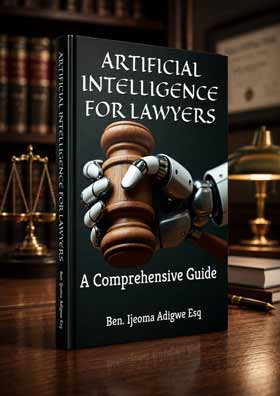 The book also examines Nigeria's legal ecosystem, focusing on the LPELR and NBA AI Guidelines. As a bonus, every purchase comes with a FREE eBook titled: How to Use the AI Features in LegalPedia and LawPavilion.
Ohio Books Ltd praises the publication, stating:
"....this is the only Nigerian book I know of on the topic."
How to Order:
📞 Call, Text, or WhatsApp: 08034917063 | 07055285878
📧 Email: benadigwe1@gmail.com
🌎 Website: www.benadigwe.com
Ebook Version: Access it directly online at https://selar.com/prv626
Authored by Ben Ijeoma Adigwe Esq., ACIarb (UK), LL.M, Dip. in Artificial Intelligence, Director at the Delta State Ministry of Justice, Asaba, Nigeria.
______________________________________________________________________
The book also examines Nigeria's legal ecosystem, focusing on the LPELR and NBA AI Guidelines. As a bonus, every purchase comes with a FREE eBook titled: How to Use the AI Features in LegalPedia and LawPavilion.
Ohio Books Ltd praises the publication, stating:
"....this is the only Nigerian book I know of on the topic."
How to Order:
📞 Call, Text, or WhatsApp: 08034917063 | 07055285878
📧 Email: benadigwe1@gmail.com
🌎 Website: www.benadigwe.com
Ebook Version: Access it directly online at https://selar.com/prv626
Authored by Ben Ijeoma Adigwe Esq., ACIarb (UK), LL.M, Dip. in Artificial Intelligence, Director at the Delta State Ministry of Justice, Asaba, Nigeria.
______________________________________________________________________