By Deborah Iniye Warrie Esq.

When any man hears the word Alimony, the first impression that comes to his mind is,” Chai!!! so this woman has succeeded in draining this hardworking man out of his hard-earned money, Women are wicked, crafty and cunning”. This absurd assumption without any knowledge is quite laughable because the concept of Alimony is way beyond the Court robbing Peter to pay Paul which is unfortunately how the layman has misconstrued the rationale behind Alimony.
- But is that really the case?
- Is Alimony a secret weapon women use to milk money from men(cash out as we say in pidgin) when a marriage ends?
- Is the principle of Alimony strictly stereotyped to only the female folk?
- Is it a manipulative wimp used by women to punish their ex-husbands after a divorce?
Well, ladies and gentlemen, this article seeks to uncloak the aforementioned issues and more so relax and read with a clear, unbiased, objective mind.
First, What is Alimony?
Alimony (also called aliment (Scotland), maintenance (England, Ireland, Northern Ireland, Wales, Canada, New Zealand), spousal support (U.SCanada), and spouse maintenance (Australia) (Nigeria)is a legal obligation on a person to provide financial support to his or her spouse before or after marital separation or divorce. The obligation arises from the divorce law or family law of each country.
Origin & History of Alimony
- The term alimony comes from the Latin word alimōnia (“nourishment, sustenance”, from alere, “to nourish”), from which the terms alimentary (of, or relating to food, nutrition, or digestion), and aliment (a Scots Law rule regarding sustenance to assure the wife’s lodging, food, clothing, and other necessities after divorce) are also derived. The Code of Hammurabi (1754 BC) (The Code of Hammurabi is a Babylonian legal text composed c. 1755–1750 BC. It is the longest, best-organized, and best-preserved legal text from the ancient Near East. It is written in the Old Babylonian dialect of Akkadian,) declares that a man must provide sustenance to a woman who has borne him children so that she can raise them:
- If a man wishes to separate from a woman who has borne him children, or from his wife who has borne him children: then he shall give that wife her dowry, and a part of the usufruct of field, garden, and property, so that she can rear her children. When she has brought up her children, a portion of all that is given to the children, equal as that of one son, shall be given to her. She may then marry the man of her heart.
- The above law applies only to women who had children with their husbands. This fits more closely with the definition of child support in some jurisdictions. Alimony is also discussed in the Code of Justinian (Code of Justinian, Latin Codex Justinianus, formally Corpus Juris Civilis (“Body of Civil Law”), collections of laws and legal interpretations developed under the sponsorship of the Byzantine emperor Justinian I from 529 to 565 ce.)
- The modern concept of alimony is derived from English ecclesiastical courts that awarded alimony in cases of separation and divorce. Alimony pendente lite (Alimony “pending the litigation.”)was given until the divorce decree, based on the husband’s duty to support the wife during a marriage that still continued. Post-divorce or permanent alimony was also based on the notion that the marriage continued, as ecclesiastical courts could only award a divorce a mensa et thoro, (a separation of the parties by an act of law). As divorce did not end the marriage, the husband’s duty to support his wife remained intact.
- Liberalization of divorce laws occurred in the 19th century, but divorce was only possible in cases of marital misconduct. As a result, the requirement to pay alimony became linked to the concept of fault in the divorce. Alimony to wives was paid because it was assumed that the marriage, and the wife’s right to support, would have continued but for the misbehavior of the husband. Ending alimony on divorce would have permitted a guilty husband to profit from his own misconduct. In contrast, if the wife committed the misconduct, she was considered to have forfeited any claim to ongoing support. However, during the period, parties could rarely afford alimony, and so it was rarely awarded by courts.
- In the 1970s, the United States Supreme Court ruled against gender bias in alimony awards and, according to the U.S. Census Bureau, the percentage of alimony recipients who are male rose from 2.4% in 2001 to 3.6% in 2006. In states like Massachusetts and Louisiana, the salaries of new spouses may be used in determining the alimony paid to the previous partners.
Types of Alimony
- Temporary alimony: Support is ordered when the parties are separated prior to divorce. Also called alimony pendente lite, which is Latin, meaning, “pending the suit”.
- Rehabilitative alimony: Support given to a lesser-earning spouse for a period of time necessary to acquire work outside the home and become self-sufficient.
- Permanent alimony: Support paid to the lesser-earning spouse until the death of the payor, the death of the recipient, or the remarriage of the recipient.
- Reimbursement alimony: Support given as a reimbursement for expenses incurred by a spouse during the marriage (such as educational expenses).
ALIMONY IN THE FOREIGN SCENE
Canada
- In Canada, spousal support may be awarded upon divorce, under the federal Divorce Act, or upon separation without divorce under provincial statutes. There are generally three different forms of spousal support awarded: Compensatory support, Non-compensatory support, Contractual support (divorce agreement).
Czech Republic
- The laws of the Czech Republic provide for spousal maintenance both during marriage and after divorce. As the main principle, both spouses have the right to a generally equal standard of living during the marriage.
England
- English courts award spousal maintenance, either in a lump sum or in installments, when one party cannot support themselves without payments from the other party.
- Under traditional English common law, a female gave up her personal property rights on marriage. Upon separation from marriage, the husband retained the right to the wife’s property, but, in exchange, had an ongoing responsibility to support the wife after the dissolution of the marriage.
- English law was amended by legislation including the Married Women’s Property Act 1870 and Married Women’s Property Act 1882 which reformed females’ property rights relating to marriage, by, for example, permitting divorced females to regain the property they owned before marriage.
Japan
- Under the Japanese Civil Code, spousal support is available while the parties are married, but terminates upon divorce. Japanese courts typically award a one-time payment of isha-ryo, or consolation money, to the “wronged” spouse in the divorce, a type of compensation that does not exist in some other jurisdictions such as most U.S. states.
United States
- The U.S. state law establishes requirements regarding alimony (and child support) payments, recovery, and penalties. A spouse trying to recover back alimony sometimes may use only the collection procedures that are available to all other creditors, such as reporting the amount due to a collection agency. One who allows his or her alimony obligations to go into arrears, where there is an ability to pay, may be found in contempt of court and be sent to jail.
- Alimony obligations are not discharged as a result of the obligee’s filing bankruptcy. Ex-spouses who allow child-support obligations to go into arrears may have certain licenses seized, be found in contempt of court, and/or be sent to jail. The determination of alimony varies greatly from state to state within the U.S.
India
- The Hindu Marriage Act, 1955 is about maintenance pendente lite and expenses of proceedings. It is stated thus
- Where in any proceeding under this Act it appears to the court that either the wife or the husband, as the case may be, has no independent income sufficient for his or her support and the necessary expenses of the proceedings, it may, on the application of either party order the other party to pay the expenses of the proceedings, and monthly expenses during the proceeding, having regard to the petitioner’s own income and the income of the respondent, as the court may deem fit.
- The law on alimony and maintenance varies from religion to religion as governed by their personal laws. For example, under the Hindu Marriage Act, of 1955, both the husband and wife are legally entitled to claim permanent alimony and maintenance. However, if the couple weds under the Special Marriage Act, 1954, only the wife is entitled to claim permanent alimony and maintenance.
ALIMONY IN NIGERIA
In Nigeria alimony is also known as maintenance. And our Courts have held the following:
- OLU-IBUKUN & ANOR v. OLU-IBUKUN (1974) LPELR-2606(SC)
“The provisions with respect to maintenance are in Section 70 of the Decree Not only have the above provisions done away with the confusing terminologies of “alimony” and “maintenance” by using the word “maintenance” even when alimony in the conventional sense is intended, they have also presumably done away with the rule concerning one-fifth of the joint income for the wife (which, in any case, had its origin in the practice of the ecclesiastical courts), and have substituted a more reasonable yardstick.” Per ATANDA FATAI-WILLIAMS, JSC (Pp 13 – 14 Paras A – B)
- IGWEMOH v. IGWEMOH (2014) LPELR-46807(CA) Principles governing the grant of maintenance order in matrimonial causes
- Order for maintenance, like all judicial orders, must not be arbitrary. Rather, it should be made judicially and judiciously. It must be based on empirical evidence and established rules or principles of law. From cases decided on Section 70(1) of the Matrimonial Causes Act (MCA), there are clear templates for the exercise of a Court’s discretion in assessment and award of maintenance. By these templates, the Court must always have regards to the means, earning capacity of the parties in marriage, and their conduct.
- The discretion vested in divorce Court to make a maintenance order under Section 70(1) of the Matrimonial Causes Act is not a discretion empowering the divorce Court to award compensation or damages upon dissolution of marriage nor is it as a mark of disapproval of the conduct of one of the parties to the marriage. Quite unlike in tort, in divorce proceedings, the Court does not award damages.
- A maintenance order is neither a reward for a party’s good conduct nor is it awarded as a punishment for improper conduct of a party in marriage or for the audacity of a party to sue for divorce. As the Supreme Court puts it in Hayes v. Hayes (2000) 3 NWLR (Pt. 648) 276 at 293, paragraph G: maintenance is only intended to provide for the needs of the wife and not as a mark of disapproval of the husband’s conduct.” Per EJEMBI EKO, JCA (Pp 5 – 12 Paras D – C)
- Personal relief and relief for children, dependants (As amended by the Personal Income Tax (Amendment) Act 2011 also made provision for payment of alimony under Section 33 (4) thus
4) The deduction allowed under subsection (2) of this section shall be-
(a) a deduction of the amount of any alimony not exceeding N300 paid to a former spouse under an order of a court of competent jurisdiction in the case of an individual whose marriage has been dissolved;
This now brings us to the burning question “Is Alimony secret weapon women use to milk money from men when a marriage ends?” To answer this, we have to ask how the amount of Alimony is Determined?
Depending on the circumstance surrounding the divorce/separation, courts consider the following factors in making decisions about alimony awards:
- The age, physical condition, emotional state, and financial condition of the former spouses;
- The length of time the recipient would need for education or training to become self-sufficient;
- The couple’s standard of living during the marriage;
- The length of the marriage; and
- The ability of the payer spouse to support the recipient and still support himself or herself.
How Long Must Alimony Be Paid?
- Alimony is often deemed “rehabilitative,” that is, it’s ordered for only so long as is necessary for the recipient spouse to receive training and become self-supporting. If the divorce decree doesn’t specify a spousal support termination date, the payments must continue until the court orders otherwise.
- Some awards end if the recipient remarries. Termination upon the payer’s death isn’t necessarily automatic; in cases where the recipient spouse is unlikely to obtain gainful employment, due perhaps to age or health considerations, the court may order that further support be provided from the payer’s estate or life insurance proceeds.
Is the principle of Alimony strictly stereotyped to only the female folk? NO these days, men can also be paid Alimony.
- The present society treats both men and women equally, subsequently, the weight of divorce settlement can fall on either side of the gathering relying on the money-related circumstances of the life partners. In spite of the fact that in the present period both men and women are currently equivalent according to law, still, men are more at risk to give maintenance to their life partner at the time of the prosecution.
- In India, the dowry system refers to the durable goods, cash, and real or movable property that the bride’s family gives to the groom, his parents, and his relatives as a condition of the marriage. Even Though the payment of dowry has long been prohibited under specific Indian laws including the Dowry Prohibition Act 1961 and subsequently by Sections 304B and 498A of the Indian Penal Code, it is still in practice in some areas.
- There was a bit of cheer in a husband’s camp lately when Gandhinagar family court magistrate DT Soni directed Rajvinder Kaur to pay her husband Dalbir Singh alimony.
Gandhinagar, Gujarat held that a husband is entitled to claim alimony from his wife if he is incapable of maintaining himself. In this case, the husband filed a petition in family court for claiming maintenance from his wife. The husband was a former cricketer and played with Sachin Tendulkar in the Under 17 team. He accused his wife of causing mental and physical torture. Here the court held that the wife is liable to maintain her husband as he is physically disabled due to a road accident. The husband was awarded alimony of Rs 10,000 per month. But, was this decision valid?
- By Hindu Law; the husband also has the right to claim maintenance which is subject to certain conditions. In the event of the husband becoming incapable due to some disease or accident, and thereby, is rendered unequipped for acquiring employment, he then has the right to claim alimony. At the same time, one should keep in mind that if the husband is capable enough to earn on his own, and yet does nothing for a living; he cannot be entitled to any maintenance. I.e to say no food for lazy men in the name of Alimony.
We now arrive at our concluding question? Is Alimony a manipulative wimp used by women to punish their ex-husbands after a divorce?
- Absolutely not with the recent Alimony Trends, same (alimony) cannot be used as a decoy, to extort an ex-spouse.
- In the past, most alimony awards were provided for payments to former wives by breadwinning former husbands.
- In this day and age, the culture has changed, as most marriages include two-wage earners, women are viewed as less dependent, and men are more apt to be primary parents, the courts and spousal support awards have kept pace.
- For this reason, the tradition of men paying and women receiving spousal support is being eroded, and orders of alimony payments from ex-wife to ex-husband are on the rise.
- In several high-profile divorces, women such as Britney Spears, Victoria Principal, and Jessica Simpson have paid multimillion-dollar settlements in lieu of alimony to ex-husbands. Aggressive pursuit of spousal support by men is becoming more common, as the stigma associated with asking for alimony gradually fades away.
REFERENCES
- https://en.wikipedia.org/wiki/Alimony
- https://primsol.lawpavilion.com/analytics?ratio=ojjhkcc&court=supreme
- https://primsol.lawpavilion.com/analytics?ratio=ljbnjmh&court=appeal
- https://www.womenslaw.org/laws/de/divorce/information-alimony/can-i-get-alimony-how-many-years-would-i-get-payments
- https://www.findlaw.com/family/divorce/spousal-support-alimony-basics.html
- https://en.wikipedia.org/wiki/Dowry_system_in_India
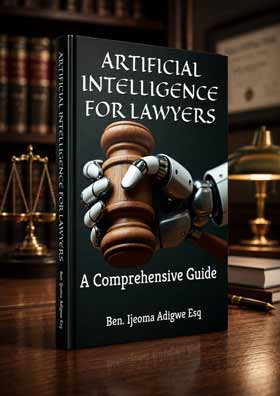 The book also examines Nigeria's legal ecosystem, focusing on the LPELR and NBA AI Guidelines. As a bonus, every purchase comes with a FREE eBook titled: How to Use the AI Features in LegalPedia and LawPavilion.
Ohio Books Ltd praises the publication, stating:
"....this is the only Nigerian book I know of on the topic."
How to Order:
📞 Call, Text, or WhatsApp: 08034917063 | 07055285878
📧 Email: benadigwe1@gmail.com
🌎 Website: www.benadigwe.com
Ebook Version: Access it directly online at https://selar.com/prv626
Authored by Ben Ijeoma Adigwe Esq., ACIarb (UK), LL.M, Dip. in Artificial Intelligence, Director at the Delta State Ministry of Justice, Asaba, Nigeria.
______________________________________________________________________
[A MUST HAVE] Evidence Act Demystified With Recent And Contemporary Cases And Materials
The book also examines Nigeria's legal ecosystem, focusing on the LPELR and NBA AI Guidelines. As a bonus, every purchase comes with a FREE eBook titled: How to Use the AI Features in LegalPedia and LawPavilion.
Ohio Books Ltd praises the publication, stating:
"....this is the only Nigerian book I know of on the topic."
How to Order:
📞 Call, Text, or WhatsApp: 08034917063 | 07055285878
📧 Email: benadigwe1@gmail.com
🌎 Website: www.benadigwe.com
Ebook Version: Access it directly online at https://selar.com/prv626
Authored by Ben Ijeoma Adigwe Esq., ACIarb (UK), LL.M, Dip. in Artificial Intelligence, Director at the Delta State Ministry of Justice, Asaba, Nigeria.
______________________________________________________________________
[A MUST HAVE] Evidence Act Demystified With Recent And Contemporary Cases And Materials

 Interested buyers are encouraged to place their orders and enquiries via:
0704 444 4777, 0704 444 4999, 0818 199 9888
Website: www.alexandernigeria.com
Interested buyers are encouraged to place their orders and enquiries via:
0704 444 4777, 0704 444 4999, 0818 199 9888
Website: www.alexandernigeria.com