

The Federal Government says it has signed a Memorandum of Understanding (MoU) with a UK-based Developing Africa Group, to create Africa’s first Intellectual Property Rights (IPR) Commercialisation Project in Nigeria.

This is contained in a statement by Ibrahim Haruna, Head, Press and Public Relations of the Federal Ministry of Industry, Trade and Investment on Saturday in Abuja.
The statement said the Minister of Industry, Trade and Investment, Otunba Richard Adebayo, disclosed this during the signing ceremony held recently in Abuja.
It said that the minister was represented at the occasion by the Registrar, Trademarks, Shafiu Adamu-Yauri.
Adeniyi was quoted as saying that the MoU would allow the group to use IPR as a means of resolving some of the issues and challenges facing Nigeria as well as creating jobs and trade services.
The minister said the pilot project was structured for three Years, adding that “it is designed to place IPR directly into some of the key issues and challenges in Nigeria.
“This is to address some of the issues surrounding unemployment and allow rural communities in Nigeria to start attracting commercial interests.
“Since trademarks are crucial to the promotion of trade and economic development, and Nigeria happens to be one of the strong regional hubs of trade in Africa being the continent’s biggest economy.
“It is no surprise that it has attracted the world’s IP governing body in Abuja, as Nigeria hosted one of the only two World Intellectual Property Office’s (WIPO) External Offices in Africa.”
According to the statement, the project will assist the registry of trademarks in the effective administration and enforcement of trademark rights in Nigeria.
“Africa in general and Nigeria, in particular, faces an enormous challenge of industrialisation and unemployment generation given the significant population growth.
“The African Development Bank estimates that youth unemployment is twice as high as that of adults “and that young people account for approximately 60 per cent of the continent’s jobless population.
“The problem is only set to become more acute given estimates that some 12 million young people on the continent enter the job market each year,” Adeniyi was quoted as saying.
The minister urged the group to work closely with the WIPO Office in Nigeria to achieve the goals.
The statement also quoted the Chairperson of the group, Hajiya Jamila Ahmadu-Suka, as assuring that the use of the IPR would create a series of technology-based projects in Nigeria.
This, she said, included a project to make Nigeria become a zero tolerant nation for trademarks abuse through the application of a Gig-economy mobile social media app.
“It will create up to 15,000 jobs across Nigeria for the detection of fake labels and abuse of trademark rights and other IPR violations in Nigeria,” she said.
(NAN)
[A MUST HAVE] Evidence Act Demystified With Recent And Contemporary Cases And Materials
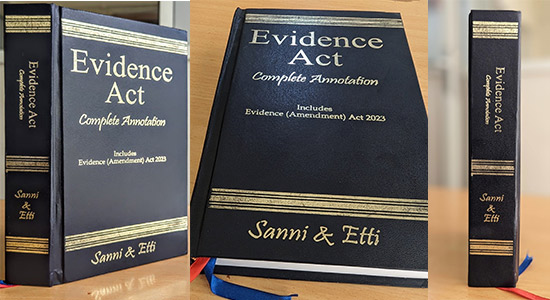
Available now for NGN 40,000 at ASC Publications, 10, Boyle Street, Onikan, Lagos. Beside High Court, TBS. Email publications@ayindesanni.com or WhatsApp +2347056667384. Purchase Link: https://paystack.com/buy/evidence-act-complete-annotation
______________________________________________________________________ “Enhance Legal Practice With Authoritative Reports” — Alexander Payne Offers Comprehensive Law Reports, Spanning Over A Century Of Nigerian Jurisprudence Interested buyers are encouraged to place their orders and enquiries via:
0704 444 4777, 0704 444 4999, 0818 199 9888
Website: www.alexandernigeria.com
“A Comprehensive Guide To Evidence Law” — Releases Second Edition In Three Volumes, Covering 4,051 Cases
For enquiries and orders, contact: 08035526491 Email: jerryamadisilk@gmail.com
 Prof. Jerry Amadi’s Evidence Law, Second Edition (2026), contains 3,314 pages in three volumes, covering the Evidence Act 2011, its 2023 amendment, and 4,051 Nigerian and English cases.