The Economic Community of West African States, ECOWAS, says it is contemplating imposing sanctions, including suspension of member countries that flout rulings of the Community Court of Justice.


The move the regional body says stems from the fact that flouting the community court’s ruling was against the dictates of the “Community Texts’’ and which also equates to disruption of democratic processes.
A judge of the court, Justice Dupe Atoki told the News Agency of Nigeria in Lome, Republic of Togo, on Thursday, that the need for sanctions had become necessary in view of the impunity of disobedience by states.
Mrs Atoki, who moderated a session on sanctions for dissident member states at the International Conference to mark the 20th anniversary of the court, explained that the actions of some member states were capable of undermining the court’s authority.
She noted that although the provision for sanction for violation of the court’s order was still vague, the fact that it was in itself a violation of the community texts makes the sanctions on the texts applicable.
“The sanctions are vague and that is where the problem is because the protocol has not really come up to be precise about what sanctions can be meted to member states that do not respect the decisions of the court.
“But there is a general provision for sanctions to be given against members who do not fulfill their obligations as indicated in the community texts.
“To that purpose, we believe that implementation of the judgment of the court is within that context.
“The first obligation of member states is respect and promotion of human rights.
“So when the court was set up to promote this right, then it follows that if you fail to comply with the decision of the court, you have failed in your obligation to fulfill the provisions of the community texts and there are sanctions to that effect,” she said.
Mrs Atoki further explained that also among the obligations of member states was compliance with democratic process.
“That is why you find that any attempt to derail the democratic process is met with sanctions.
“This has led to the situation in Mali and in Guinea. That is one of the obligations listed together with the protection of human rights.
“So, we can from our own deduce that failure to implement the decision of the court is also a violation of the fulfillment of the obligation of the texts which attract sanctions which can include suspension,” she said.
The judge, however, clarified that the regional body had yet to get to the point where member states take non-compliance with court rulings as a non-fulfillment of the obligations of the Texts of the Community.
She went on to explain that it was not the role of the court to implement sanctions but that the onus lied with member states to do so.
According to her, the role of the court ends when it has reached a verdict on a particular matter.
“There is no doubt that the court has challenges in implementing its decisions, but it is not the making of the court.
“The court is established to hear cases of complaints of violation of human rights and give a decision; that is where its job ends.
“The other arm of implementation rests with the member states,” Atoke said.
NAN reports that other speakers during the conferences agreed that there was need for an agreeable sanction to compel member states to obey the ruling of the court.
Since the establishment of the court 20 years ago, less than 50 per cent of its judgments have been implemented by member states with Nigeria and Ghana among the defaulting countries. NAN
 The book also examines Nigeria's legal ecosystem, focusing on the LPELR and NBA AI Guidelines. As a bonus, every purchase comes with a FREE eBook titled: How to Use the AI Features in LegalPedia and LawPavilion.
Ohio Books Ltd praises the publication, stating:
"....this is the only Nigerian book I know of on the topic."
How to Order:
📞 Call, Text, or WhatsApp: 08034917063 | 07055285878
📧 Email: benadigwe1@gmail.com
🌎 Website: www.benadigwe.com
Ebook Version: Access it directly online at https://selar.com/prv626
Authored by Ben Ijeoma Adigwe Esq., ACIarb (UK), LL.M, Dip. in Artificial Intelligence, Director at the Delta State Ministry of Justice, Asaba, Nigeria.
_______________________________________________________________________
The book also examines Nigeria's legal ecosystem, focusing on the LPELR and NBA AI Guidelines. As a bonus, every purchase comes with a FREE eBook titled: How to Use the AI Features in LegalPedia and LawPavilion.
Ohio Books Ltd praises the publication, stating:
"....this is the only Nigerian book I know of on the topic."
How to Order:
📞 Call, Text, or WhatsApp: 08034917063 | 07055285878
📧 Email: benadigwe1@gmail.com
🌎 Website: www.benadigwe.com
Ebook Version: Access it directly online at https://selar.com/prv626
Authored by Ben Ijeoma Adigwe Esq., ACIarb (UK), LL.M, Dip. in Artificial Intelligence, Director at the Delta State Ministry of Justice, Asaba, Nigeria.
_______________________________________________________________________
“Order Justice Omolaye-Ajileye’s Electronic Evidence Books Now” — Essential Guides On Evidence Act, Case Law And Digital Proof
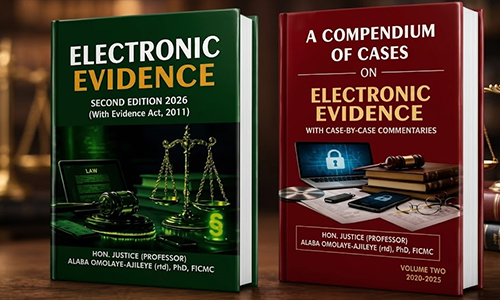
 Interested buyers are encouraged to place their orders and enquiries via:
0704 444 4777, 0704 444 4999, 0818 199 9888
Website: www.alexandernigeria.com
Interested buyers are encouraged to place their orders and enquiries via:
0704 444 4777, 0704 444 4999, 0818 199 9888
Website: www.alexandernigeria.com