By Legalpedia

MR. ADAMS ABURIME & ORS VS DR G. OLUSOJI & ANOR
suit no: CA/B/348/2013
Legalpedia Electronic Citation: (2021) Legalpedia (CA) 15161
Areas Of Law:
Appeal, Company Law, Court, Fair Hearing, Jurisdiction Tribunal, Practice And Procedure, Words And Phrases
Summary Of Facts
This is an Appeal against the Ruling of the Benin High Court, wherein the court held that it had powers and debarred G. E. Oaikhena, Esq. from appearing in a court of law since he was a lecturer.
The 6th Defendant in the lower court had filed a motion to bar G. E. Oaikhena from conducting the suit as well as the Claimants’ counsel contending G. E. Oaikhena Esq. is a law-lecturer at the University of Benin, which is a breach of the code of conduct of public officers under the provision of the 5th schedule of the 1999 constitution of Nigeria.
The Appellants dissatisfied with the judgement filed a notice of appeal against the Ruling.
HELD:
Appeal Allowed
ISSUES FOR DETERMINATION
Ø Was the learned trial judge right when he assumed jurisdiction to pronounce on whether a public officer violates the provision of the code of conduct of public officers under the 1999 constitution
Ø Was the trial judge right when he held that the Respondent had the locus standi to raise the issue of the violation of the provision of the code of conduct of public officers?
Ø Whether the trial judge was right when he held that G. E. Oaikhena Esq is prohibited by the rules of professional Ethics.
Ø Whether the trial judge was right in law when he held that G. E. Oaikhena was the person principally running G. E. Oaikehena & Co. (the legal firm).
RATIONES
“CLAIMANT” – DEFINITION OF “CLAIMANT” UNDER THE EDO STATE HIGH COURT UNIFORM PROCEDURE RULES
“The interpretation section of the Edo state High court uniform procedure Rules provides a definition thus;
“Claimant” is a person who institutes all actions in Court and shall include a claimant in a counter-claim
“Court” means the High Court of Edo State”
The name changed to Claimant instead of Plaintiff and Defendant retains its name and since on appeal it describes the parties as in the capacity of the appeal; Claimant/Respondent and Defendant/Appellants does not mislead anybody as to whom the parties are. Much as the Court of Appeal rules in Order 1 rule 5 of the Court of Appeal, 2011 which is same as 20 16 defines an Appellant as the one who appeals the decision of the lower court while Respondent is the person who is defending the decision of the lower court, the Appellant here has described the parties in the Notice of appeal in dual capacity of both the Claimant in the lower court and the Appellants here in and same goes for the Respondent and the Defendant. Much as it appears strange this court cannot discountenance the process or hold it as defective, the attitude of courts have changed and dwells more on fairness and not technicalities. The Respondent has objected on the form and not the content and it’s trite that the application of the rules of court in and attainment of justice is generally no longer allowed or tolerated to be controlled by strict adherence to technicalities but rather to substances. See; Odonigi v Oyeleke (2001) 5 NSCQ VOL. 5 342“. PER A.O.OBASEKI-ADEJUMO, J.C.A
CODE OF CONDUCT BUREAU TRIBUNAL- JURISDICTION OF CODE OF CONDUCT BUREAU TRIBUNAL
“In Ahmed v Ahmed (SUPRA), the apex court held on the Interpretation of Paragraph 12 of the 5th Schedule of the 1999 Constitution (as amended) as regards jurisdiction of Code of Conduct Bureau Tribunal thus;
“….the said paragraph 12 provides as follows: “Any allegation that a public officer has committed a breach of or has not complied with the provisions of this Code shall be made to the Code of Conduct Bureau.” The foregoing provisions are clearly unambiguous and so construed literally mean that any breaches of any provisions of the said 5th schedule or matters of noncompliance with any provisions of the Code shall, (meaning that it is mandatory i.e. must) be made to the Code of Conduct Bureau that has established its Tribunal with the exclusive jurisdiction to deal with any violations of any provisions under the Code. If I may emphasize, any violations shall be made to Code of Conduct Bureau. The provisions have made it mandatory to 1 ‘• ke any matters so covered by the 5th schedule (supra) to the Code of Conduct Bureau and not to any ordinary regular Courts as has been done in this instance. If I may repeat, the Code of Conduct Tribunal has been established with the exclusive jurisdiction to deal with all violations contravening any of the provisions of the Code as per paragraph 15(1). This provision has expressly ousted the powers of ordinary regular Courts in respect of such violations. The Tribunal to the exclusion of other Courts is also empowered to impose any punishments as specified under sub-paragraphs (2) (a), (b) & (c) of paragraph 18 as provided in sub-paragraphs 3 and 4 of paragraph 18 while appeals shall lie as of right from such decisions to the Court of Appeal. Simply put, to tackle any violation of the Code starts before the Code of Conduct Bureau Tribunal to the Court below on appeal and on a further appeal there from to this Court. As can be seen, the lower Court exercises appellate jurisdiction over the Code of Conduct Tribunal and no more.”
per CHUKWUMA – ENEH, J.S.C (PP. 47 – 49, PARAS. E -B)
– PER A.O.OBASEKI-ADEJUMO, J.C.A
CODE OF CONDUCT BUREAU TRIBUNAL- DUTY OF A HIGH COURT WHERE THE CODE OF CONDUCT BUREAU TRIBUNAL HAS JURISDICTION OVER A MATTER BEFORE IT
“From the above decision, it is clear that the code of conduct bureau is exclusively vested with breaches of the act and other courts such as the High court have been excluded. Therefore, the high court was wrong, once she found that the Code of conduct bureau had jurisdiction and the Appellants was allegedly a public officer, the high court should have referred the matter to the code of conduct bureau. It was an issue within the suit before her and occurred in liminie. PER A.O.OBASEKI-ADEJUMO, J.C.A
COURT – DUTY OF THE COURT TO TAKE COGNIZANCE OF ILLEGALITY DISCLOSED IN PROCEEDINGS BEFORE IT
“Once he had been identified as a public servant then it became a public domain. The issue herein is not apparent on the face of the pleading; it was raised by the plaintiff. Therefore, in Ibrahim v Osim (1988) LPELR – 1403(SC);
“This Court has declared repeatedly in many of its decisions that where illegality is apparent on the face of the plaintiffs pleadings it will not hesitate to strike out the pleadings and dismiss the action. Similarly, if the statement of defence discloses illegality, it will not hesitate to investigate the C’A.B. 172.2014 allegation and if established, give the proper judgment.”
ne, OBASEKI, J.S.C (PP. 24 – 25, PARAS. G – A)
Also in; Sherrif & Anor v PDP & Ors (2017) LPELR – 41805 (CA); where it held on the duty of the Court to take cognizance of illegality disclosed in proceedings before it thus:
In Agip Nig Ltd -V- Agip Petroli Int’l (2010) 5 NWLR (Pt. 1187) 254 at 412 the apex Court per ADEKEYE JSC held:-
“It is also settled and the principle is still evergreen in that illegality once brought to the attention of the Court overrides all other questions and the Court will not close its eye against such illegality, neither will the Court lend its aid to the perpetrators of any illegality.” per SANGA, J.C.A (P. 80, PARAS. B – D).
See also; Okoya v Santilli (SUPRA) COURT;
“Where a Court of law, in the course of trial of a matter finds an illegality punishable under the law, even if not triable in that Court but in another tribunal, without prejudice to its referring the matter to that Tribunal, must take cognizance of the illegality.
Once a transaction is illegal, it is void and all things emanating from that transaction is a nullity.”
per BELGORE, J.S.C (P. 52, PARAS. D – E)
In the light of the above, the Respondents’ Counsel properly raised it to draw the Court’s attention and once it is noted it, it is the duty of the court to direct same for appropriate attention and also the duty of the Respondents’ Counsel to complain to the employers of the public officer and to make a complain at the Code of Conduct Bureau. It is like when a Counsel misconducts himself in the face of the court, the matter is referred to the disciplinary committee of the Nigeria Bar Association for investigation and necessary action not for the court to take summary action. PER A.O.OBASEKI-ADEJUMO, J.C.A
ISSUES RAISED SUO MOTU – EFFECT OF RAISING AN ISSUE SUO MOTU WITHOUT CALLING PARTIES TO ADDRESS THE COURT ON THE ISSUE
“This issue appears to have been raised suo moto as neither parties raised same, they were not called upon to address on the issue, therefore, for the lower court to find it contrary amounts to a miscarriage of justice and a breach of fair hearing. PER A.O.OBASEKI-ADEJUMO, J.C.A
ISSUES RAISED SUO MOTU – INSTANCES WHERE A COURT CAN AND CANNOT RAISE AN ISSUE SUO MOTO
“The instance where a court can and cannot raise an issue suo moto was enumerated in;
Moses – Obiekwe v Ojogbede (2019) LPELR -47290;
“Deciding specifically on raising an issue of jurisdiction suo motu by the Court and deciding on it without affording the parties the opportunity to be heard the Supreme Court held in the case of Alims Nigeria Limited v. United Bank for Africa (2013) 6 NWLR (pt.1351) 613 at 626 per the judgment prepared by his lordship, Fabiyi, J.S.C., inter alia that – “It is now clear that the issue of jurisdiction is a threshold one which can be taken at any stage of the proceedings; even before the apex Court for the first time. It can be raised by any of the parties or by the Court suo motu. Where there are sufficient facts ex facie on the record establishing a want of competence or jurisdiction, the judex has the duty to raise it suo motu, if the parties fail to draw the attention of the Court to it. In such a situation where the judex raises it suo motu, it is proper to invite the address of both counsel before deciding one way or the other. However, failure of the Court to so invite the address of counsel, does not, ipso facto, render such a decision a nullity unless it is shown that the decision is incorrect or occasioned a miscarriage of justice. See: Olutola v. University of Ilorin (supra); Katto v. CBN. (supra); Ima v. Okobe (supra); Ejowhomu v. Edok-Eter Mandilas Ltd. (1986) 5 NWLR (Pt. 39) 1. ‘ The lead judgment (supra) was concurred in by their lordships of the Apex Court (Muhammad, Peter-Odili, Ariwoola and Aka’ahs, JJ.S.C). The Supreme Court also held in the case of Gbagbarigha v. Toruemi and Anor. (2013) 6 NWLR (pt.1350) 289 at 310 -311 per the lead judgment prepared by his lordship, Rhodes-Vivour, J.S.C., inter alia that – “When a judge raises an issue on his own motion, or raises an issue not in the contemplation of the parties; or an issue not before the Court, the judge is said to have raised the issue suo motu. The well laid down position of the law is that when an issue is raised suo motu the parties should be heard before a decision is reached on the issue. This is what procedural fairness entails. See Kuti v. Balogun (1978) 1 SC p. 53; Ogiamien v. Ogiamien (1967) NMLR p. 246, (1967) SCNLR 311; Adeniji v. Adeniji (1972) 4 SC p. 10; Iriri v. Erhurhobara (1991) 2 NWLR (Pt. 173) p. 252 but there is an exception to this procedure. There would be no need to call on counsel to address the Court on an issue raised suo motu by the judge – 1. When the issue relates to the Courts own jurisdiction; 2. When both parties are not aware or ignored a statute which may have bearing on the case; or 3. When on the face of the record serious questions of the fairness of the proceedings is evident. See Comptoir Commercial & Ind S.PR. Ltd. v. O.G.S.W.C. (2002) FWLR (Pt. 105) p. 839, (2002) 9 NWLR (Pt. 773) 629; MD. Kolawole & ors v. A .-G., Oyo & 3 ors (2006) 3 NWLR (Pt. 966) p. 50
Finally, since the issue of jurisdiction raised suo motu by the judge without affording counsel a hearing has not led to miscarriage of justice, the decision will not be set aside. The Court of Appeal was right to uphold the issue of jurisdiction raised suo motu by the learned appellate High Court Judge.” (My emphasis). The lead judgment (supra) of the Apex Court was concurred in by their lordship (Onnoghen, Chukwuma-Eneh, Muhammad and Ogunbiyi, JJ.S.C). Since the trial learned chief magistrate raised the issue of jurisdiction of the magistrate Court itself in the matter without affording the parties the opportunity to be heard and having regard to the fact that the Appellants did not establish a miscarriage of justice, the Court below should not have reversed the decision of the learned Chief Magistrate to take and decide the issue of the jurisdiction of the Magistrate Court in the matter suo motu without affording the parties the opportunity to be heard.”
Per IKYEGH, J.C.A (PP. 9 – 12, PARAS. C – E)”. PER A.O.OBASEKI-ADEJUMO, J.C.A
BUSINESS NAME -LEGAL IMPLICATION OF REGISTERING A BUSINESS NAME
“Finally, the holding that G. E Oaikhena Esq is a separate legal entity different from G. E. OAIKHENA & CO, 1 find solace in the CAMA (Companies and Allied Matters Act) wherein the law firm is registered as a business name and not an incorporated company of a charitable organization. It is either registered as a partnership or associates but the name as it is, is clearly a sole business name with the name of the main legal practitioner.
The legal implication is that there is no separate entity, the name is the same as the law7 firm, and they have no separate identity in law as enjoyed by the incorporated registered company/business under part A of the CAMA. The liabilities differ; the business name is solely liable for all liabilities while the company is responsible for liabilities of the companies with the exclusion of the Directors or shareholders
In Adamu v FRN (2018) LPELR – 46029 (CA); on the effect of registering a business name, this Court held that;
“The Cross Appellants as DW2 admitted under cross examination on page 411 of the record that he is the sole proprietor of MJIE Enterprises. He further confirmed that, it was registered as a business name in 2009 not a company. The legal implication of a registered business name, unlike a company is that the registered business name and its proprietor are regarded one and the same person. Hence the management of the business name can never be transferred to another person because the business name has no legal personality of its own independent of the proprietor. See F.C.D.A Vs Unique Future Leaders International Ltd (2014) 17 NWLR (part 1436) 213.”
per JAURO, J.C.A (PP. 24 – 25, PARAS. E – B)
– PER A.O.OBASEKI-ADEJUMO, J.C.A
CODE OF CONDUCT BUREAU TRIBUNAL –WHETHER COURTS HAVE JURISDICTION TO ENTERTAIN AN ALLEGATION OF BREACH OF THE CODE OF CONDUCT FOR PUBLIC OFFICERS
The motion to disqualify G. E. Oaikhena from conducting the case was premised the allegation that the said counsel was in breach of the Code of Conduct for Public Officers as set out in the 5th Schedule to the Constitution of the Federal Republic of Nigeria, 1999 (as amended). Paragraph 12 of the said Schedule provides:
” Any allegation that a public officer has committed a breach of or has not complied with the provisions of this code shall be made to the Code of Conduct Bureau.”
In Ahmed v Ahmed (2013) 15 NWLR (Pt. 1377) 274,329 Chukwuma-Eneh JSC, interpreted the foregoing provisions thus:
” The foregoing provisions are clearly unambiguous and so construed literary mean that any breaches of any provisions of the said 5th Schedule or matters of non¬ compliance with any provisions of the Code shall(meaning that it is mandatory i.e. must) be made to the Code of Conduct Bureau that has established its Tribunal with the exclusive jurisdiction to deal with any violations of any provisions under the Code, if I may emphasise any violations shall be made to the Code of Conduct Bureau. The provisions have made it mandatory to take any matters so covered by the 5th Schedule (supra) to the Code of Conduct Bureau and not to any ordinary regular courts as has been done in this instance. If I may repeat, the Code of Conduct Tribunal has been established with the exclusive jurisdiction to deal with all violations contravening any of the provisions of the Code as per paragraph 15(1). This provision has expressly ousted the powers of the ordinary regular courts in respect of such violations.”
– PER J.E. EKANEM, J.C.A
Statutes Referred To:
Companies and Allied Matters Act
Constitution of the Federal Republic of Nigeria, 1999 (as amended)
Regulated and other Professions (Private Practice Prohibition) Law Lecturers Exemption (No 2) Order
Rules Professional Conduct for Legal Practitioners, 2007
 Interested buyers are encouraged to place their orders and enquiries via:
0704 444 4777, 0704 444 4999, 0818 199 9888
Website: www.alexandernigeria.com
Interested buyers are encouraged to place their orders and enquiries via:
0704 444 4777, 0704 444 4999, 0818 199 9888
Website: www.alexandernigeria.com

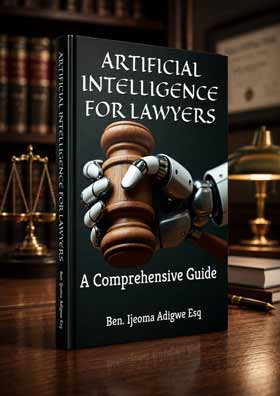 The book also examines Nigeria's legal ecosystem, focusing on the LPELR and NBA AI Guidelines. As a bonus, every purchase comes with a FREE eBook titled: How to Use the AI Features in LegalPedia and LawPavilion.
Ohio Books Ltd praises the publication, stating:
"....this is the only Nigerian book I know of on the topic."
How to Order:
📞 Call, Text, or WhatsApp: 08034917063 | 07055285878
📧 Email: benadigwe1@gmail.com
🌎 Website: www.benadigwe.com
Ebook Version: Access it directly online at https://selar.com/prv626
Authored by Ben Ijeoma Adigwe Esq., ACIarb (UK), LL.M, Dip. in Artificial Intelligence, Director at the Delta State Ministry of Justice, Asaba, Nigeria.
_______________________________________________________________________
The book also examines Nigeria's legal ecosystem, focusing on the LPELR and NBA AI Guidelines. As a bonus, every purchase comes with a FREE eBook titled: How to Use the AI Features in LegalPedia and LawPavilion.
Ohio Books Ltd praises the publication, stating:
"....this is the only Nigerian book I know of on the topic."
How to Order:
📞 Call, Text, or WhatsApp: 08034917063 | 07055285878
📧 Email: benadigwe1@gmail.com
🌎 Website: www.benadigwe.com
Ebook Version: Access it directly online at https://selar.com/prv626
Authored by Ben Ijeoma Adigwe Esq., ACIarb (UK), LL.M, Dip. in Artificial Intelligence, Director at the Delta State Ministry of Justice, Asaba, Nigeria.
_______________________________________________________________________