By Commercial Intermediates
Oscar Wilde said “Always borrow money from a pessimist. He won’t expect it back”. An ancient Albanian proverb says “If you lend your money, you either lose your money or gain an enemy.”
Moneylending is probably as old as money. Human civilizations have been lending and borrowing since the emergence of money as a unit of account in ancient Egypt and Mesopotamia.
Moneylending is the act or occupation of lending money at an interest. The profession of Moneylending can be traced to ancient Rome, where the economy was driven by trade. Moneylending can be carried out by an individual or corporate body.
In colonial Western Nigeria, money lenders charged exorbitant interest rates and often insisted on repayment at a fixed date. Debt recovery was generally painful to defaulters; who were humiliated, harassed, and forced to lose their property.
The Moneylenders Ordinance, 1938, (No. 45 of 1938), one of the most significant Ordinances of 1938, was passed by the Colonial Administration to provide more comprehensively for the regulation of the business of money-lending. The Ordinance created a compulsory licensing scheme.
In both ancient and modern times, the judicial system has proved to be a cog in the wheel of moneylenders due to the long delays and the shelter a defaulting Borrower would enjoy from the Court.
Some moneylenders insert ‘Penalty or Default’ Clauses in Loan Agreements to deter default. These clauses often do not fare very well. In Shakespeare’s the Merchant of Venice, Shylock the moneylender who demanded a pound of Antonio’s flesh as per the Loan Agreement. The Court held that Shylock shall have “nothing but the penalty” — “just a pound of flesh” — no more, no less. And if he takes even “in the estimation of a hair” more than a pound of flesh, he will die and all his goods will be confiscated.
Money-lending disputes include non-payment, payment default, and failure to comply with terms generally.
Navigating the tumultuous sea of money-lending disputes does not have to be as rigorous, expensive or time-consuming- a zero sum game. Mediation allows the Lender and the Borrower to avoid the cost, delay and potential reputational damage associated with protracted litigation.
The Mediation process involves a neutral third party whose intervention facilitates communication and negotiation between the disputing parties to foster a mutually agreed settlement between them. It is a voluntary private dispute resolution process in which an impartial third party assists parties to reach a negotiated settlement. Additional benefits include
Confidentiality:
Mediation proceedings are confidential, which ensures that the outcome of the mediation is not subject to public scrutiny. The Parties can walk away from the transaction without negative exposure in the media or with 3rd parties.
Flexibility and Procedural Simplicity:
Mediation is designed to be flexible and simple and also easily adaptable to various types of dispute. Parties are empowered to conduct such a proceedings in such a manner as it considers appropriate so as to ensure fair hearing.
Quicker Decision Making:
Mediation procedures save time, as going through traditional court of law to resolve cases involves procedures that are time consuming.
Here are some practical steps Moneylenders and Borrowers can adopt to insulate themselves from the harsh disputes.
- Obtain a Money Lenders License
- Deploy Mediation in the Dispute Resolution Clause of the Loan/Lending Agreement
- Employ the use of Default clauses instead of penalty clauses because Penalty Clauses are generally unenforceable.
- Avoid resorting to self-help
Commercial Intermediates is an independent dispute resolution provider based in Lagos State and the Federal Capital Territory
Written By Commercial Intermediates, Commercial.intermediates@gmail.com, info@commercial-intermediates.com.ng, 09086576262
[A MUST HAVE] Evidence Act Demystified With Recent And Contemporary Cases And Materials

Available now for NGN 40,000 at ASC Publications, 10, Boyle Street, Onikan, Lagos. Beside High Court, TBS. Email publications@ayindesanni.com or WhatsApp +2347056667384. Purchase Link: https://paystack.com/buy/evidence-act-complete-annotation
______________________________________________________________________ “Enhance Legal Practice With Authoritative Reports” — Alexander Payne Offers Comprehensive Law Reports, Spanning Over A Century Of Nigerian Jurisprudence Interested buyers are encouraged to place their orders and enquiries via:
0704 444 4777, 0704 444 4999, 0818 199 9888
Website: www.alexandernigeria.com
Interested buyers are encouraged to place their orders and enquiries via:
0704 444 4777, 0704 444 4999, 0818 199 9888
Website: www.alexandernigeria.com
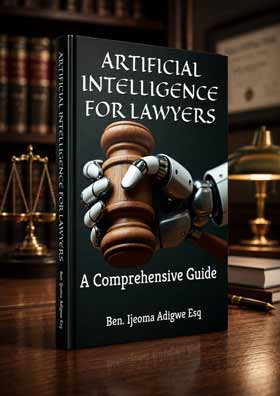 The book also examines Nigeria's legal ecosystem, focusing on the LPELR and NBA AI Guidelines. As a bonus, every purchase comes with a FREE eBook titled: How to Use the AI Features in LegalPedia and LawPavilion.
Ohio Books Ltd praises the publication, stating:
"....this is the only Nigerian book I know of on the topic."
How to Order:
📞 Call, Text, or WhatsApp: 08034917063 | 07055285878
📧 Email: benadigwe1@gmail.com
🌎 Website: www.benadigwe.com
Ebook Version: Access it directly online at https://selar.com/prv626
Authored by Ben Ijeoma Adigwe Esq., ACIarb (UK), LL.M, Dip. in Artificial Intelligence, Director at the Delta State Ministry of Justice, Asaba, Nigeria.
______________________________________________________________________
The book also examines Nigeria's legal ecosystem, focusing on the LPELR and NBA AI Guidelines. As a bonus, every purchase comes with a FREE eBook titled: How to Use the AI Features in LegalPedia and LawPavilion.
Ohio Books Ltd praises the publication, stating:
"....this is the only Nigerian book I know of on the topic."
How to Order:
📞 Call, Text, or WhatsApp: 08034917063 | 07055285878
📧 Email: benadigwe1@gmail.com
🌎 Website: www.benadigwe.com
Ebook Version: Access it directly online at https://selar.com/prv626
Authored by Ben Ijeoma Adigwe Esq., ACIarb (UK), LL.M, Dip. in Artificial Intelligence, Director at the Delta State Ministry of Justice, Asaba, Nigeria.
______________________________________________________________________