The value of Nigeria’s total merchandise trade declined to N8.30 trillion in the first quarter of the year (Q1 2020), representing a contraction of 17.94 per cent compared to N10.12 trillion recorded in Q4 of 2019.

However, trade was 0.80 per cent higher than the N8.24 trillion posted in Q1 2019, according to the National Bureau of Statistics (NBS).
It noted that the drop in trade occurred against the backdrop of a global slowdown in economic activity as a result of the COVID-19 pandemic.
NBS said: “The global health crisis resulted in several countries implementing varying degrees of restrictions with respect to international trade, travel and tourism.”
According to the Foreign Trade Statistics – Q1, 2020, which was released yesterday, the decline in Q1 was tied to the drop in both imports and exports as the former surpassed the latter.
Total imports stood at N4.22 trillion, representing 50.8 per cent of trade, while the export component totalled N4.08 trillion or 49.2 per cent of total trade.
Nigeria recorded a trade deficit of N138.98 billion in the quarter under review, marking two consecutive quarters of negative balance of trade.
Compared with the preceding quarter, Q1 deficit represented an improvement by 76 per cent, but lower by 116.71 per cent year-on-year, NBS stated.
Crude oil export accounted for N2.94 trillion or 72.12 per cent of total exports in Q1, but 18.86 per cent less than the value recorded in Q4 2019 and 12.8 per cent lower than Q1 2019 result.
However, non-crude oil exports stood at N1.13 billion, representing 27.9 per cent of total exports in Q1.
While total export value decreased by 14.42 per cent in Q1 compared to the value recorded in Q4 2019, imports also decreased by 21.08 per cent in the period under review compared to Q4 2019; but it was 13.99 per cent higher when compared to Q1 2019.
NBS explained that the drop in the value of imports in Q1 could be attributed to decreases in the value of machinery and transport equipment, which accounted for N1.74 trillion in Q1, representing 35.5 per cent less than N2.70 trillion recorded in Q4 2019.
Nonetheless, the value of raw material exports increased 60.17 per cent in Q1 relative to last quarter. But it decreased by 7.08 per cent year-on-year, while value of solid minerals exports was 16.31 per cent lower in Q1 compared to Q4 2019 and 82.17 per cent less than Q1 2019 records.
Manufactured goods exports decreased by 12.72 per cent in the review period compared to Q4 2019 and 3.86 per cent compared to Q1 2019, NBS added.
During the quarter, total trade in agricultural goods stood at N387.7 billion or 4.67 per cent of the overall trade of which exported agricultural goods accounted for N126.3 billion.
Meanwhile, India remained the country’s major trading partner for export goods, accounting for N637.5 billion or 15.61 per cent of total exports trade, while Spain accounted for N402.9 billion or 9.87 per cent, followed by The Netherlands, N396.9 billion or 9.72 per cent, South Africa N319.5 billion or 7.82 per cent and Cameroon N301.8 billion or 7.39 per cent.
Analysis of trade by region revealed that Nigeria exported most products to Europe, which accounted for N1.56 trillion or 38.43 per cent of total exports, followed by Asia, N1.27 trillion or 31.28 per cent, Africa N978.21 billion or 23.96 per cent, America N214.12 billion or 5.24 per cent and Oceania N44.14 billion or 1.08 per cent. Also, goods worth N296.3 billion was exported to ECOWAS member-states.
The country’s imported goods were mainly from Asia, which accounted for N1.96 trillion or 46.58 per cent; Europe N1.53 trillion or 36.35 per cent, while imports from America and Africa amounted to N580.2 billion or 13.74 per cent and N118.95 billion or 2.82 per cent respectively.
Imports from Oceania stood at N21.6 billion or 0.51 per cent, while goods valued at N28.3 billion originated from ECOWAS member-states.
In Q1, Nigeria imported goods mainly from China (N1.10 trillion or 26.28 per cent of total imports; The Netherlands, N470.11 billion or 11.14 per cent; the United States, N441.06 billion or 10.45 per cent; India, N334.53 or 7.92 per cent and Belgium N257.89 or 6.11 per cent.
[A MUST HAVE] Evidence Act Demystified With Recent And Contemporary Cases And Materials

Available now for NGN 40,000 at ASC Publications, 10, Boyle Street, Onikan, Lagos. Beside High Court, TBS. Email publications@ayindesanni.com or WhatsApp +2347056667384. Purchase Link: https://paystack.com/buy/evidence-act-complete-annotation
______________________________________________________________________ “Enhance Legal Practice With Authoritative Reports” — Alexander Payne Offers Comprehensive Law Reports, Spanning Over A Century Of Nigerian Jurisprudence Interested buyers are encouraged to place their orders and enquiries via:
0704 444 4777, 0704 444 4999, 0818 199 9888
Website: www.alexandernigeria.com
Interested buyers are encouraged to place their orders and enquiries via:
0704 444 4777, 0704 444 4999, 0818 199 9888
Website: www.alexandernigeria.com
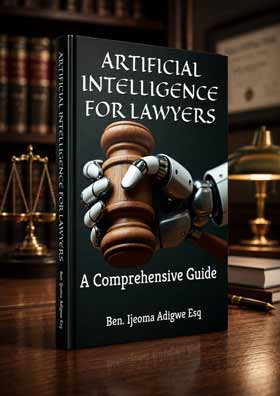 The book also examines Nigeria's legal ecosystem, focusing on the LPELR and NBA AI Guidelines. As a bonus, every purchase comes with a FREE eBook titled: How to Use the AI Features in LegalPedia and LawPavilion.
Ohio Books Ltd praises the publication, stating:
"....this is the only Nigerian book I know of on the topic."
How to Order:
📞 Call, Text, or WhatsApp: 08034917063 | 07055285878
📧 Email: benadigwe1@gmail.com
🌎 Website: www.benadigwe.com
Ebook Version: Access it directly online at https://selar.com/prv626
Authored by Ben Ijeoma Adigwe Esq., ACIarb (UK), LL.M, Dip. in Artificial Intelligence, Director at the Delta State Ministry of Justice, Asaba, Nigeria.
______________________________________________________________________
The book also examines Nigeria's legal ecosystem, focusing on the LPELR and NBA AI Guidelines. As a bonus, every purchase comes with a FREE eBook titled: How to Use the AI Features in LegalPedia and LawPavilion.
Ohio Books Ltd praises the publication, stating:
"....this is the only Nigerian book I know of on the topic."
How to Order:
📞 Call, Text, or WhatsApp: 08034917063 | 07055285878
📧 Email: benadigwe1@gmail.com
🌎 Website: www.benadigwe.com
Ebook Version: Access it directly online at https://selar.com/prv626
Authored by Ben Ijeoma Adigwe Esq., ACIarb (UK), LL.M, Dip. in Artificial Intelligence, Director at the Delta State Ministry of Justice, Asaba, Nigeria.
______________________________________________________________________