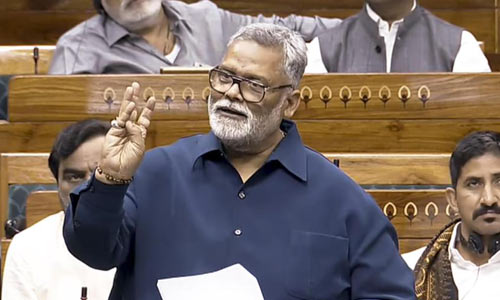
Indian Independent Member of Parliament Rajesh Ranjan, popularly known as Pappu Yadav, has sparked fresh controversy by claiming that 70 to 80 per cent of Indian politicians watch pornography and demanding that their phones be checked, including his own, in a combative response to a notice served on him by the Bihar State Women’s Commission over earlier remarks about the sexual exploitation of women in politics.

The MP from Purnea, backed by the Indian National Congress, had earlier triggered nationwide outrage by claiming during a parliamentary debate on the Women’s Reservation Bill that “90 per cent of women cannot start in politics without going to a male leader’s room,” a statement the Women’s Commission described as sexist and anti-women but which Yadav insists is a defence of women’s rights and an exposure of exploitation by male politicians.
Rather than retreating from the controversy, Yadav has escalated it at every turn, threatening to release photographs of a Women’s Commission member with former ministers, accusing the political establishment of systemic exploitation of women, and demanding accountability from the very institutions that are seeking to hold him accountable.
The controversy began when Yadav spoke on the Women’s Reservation Bill on Tuesday, making remarks that combined advocacy for women’s political participation with graphic descriptions of the obstacles women face in Indian politics.
“In India, women are called goddesses, but they will never be respected here. System and society are responsible for this,” Yadav stated on the floor of the House.
He then made the claim that triggered the backlash: “Who is indulging in domestic violence? Who preys on women, from America to India? It is politicians! 90 per cent of women cannot start in politics without going to a male leader’s room.”
“A culture of exploiting women has become ingrained,” he added, painting a picture of systemic abuse across Indian society.
“Go to school, and your daughter faces exploitation. Go to college, and exploitation in the name of ragging. Go to the office, exploitation is there as well. Leaders behave like vultures toward women,” Yadav stated.
The remarks drew immediate condemnation from political leaders across party lines, with many accusing Yadav of making sweeping generalisations that were themselves demeaning to women by suggesting they cannot succeed in politics without submitting to male exploitation.
The Bihar State Women’s Commission responded by serving a formal notice on Yadav, demanding an explanation for what it described as sexist and anti-women remarks.
The Commission took the position that Yadav’s characterisation of women in politics as victims who must submit to exploitation before they can participate was itself a form of stereotyping that undermines women’s agency and dignity.
Rather than apologising or moderating his position, Yadav responded to the Commission’s notice with a fresh set of incendiary claims.
“I have said this on the floor of the House too, that 70 to 80 per cent of politicians watch porn. So, get everyone checked. If there is porn on my phone, check me too,” Yadav stated.
He then turned his fire on the Commission itself, questioning the credibility and independence of the members who served the notice.
#WATCH | Purnea, Bihar: Independent MP Pappu Yadav says, “…In India, women are called goddesses, but they will never be respected here. System and society are responsible for this…90% of women cannot do politics without entering the room of politicians…”
(20.04.2026) pic.twitter.com/WyHY4ZitUJ
— ANI (@ANI) April 21, 2026
“Who are these people who have served me a notice? Who are they with?” Yadav asked.
He specifically named Sajal Jha, a member of the Women’s Commission, claiming he possessed photographs of her with several political leaders and former ministers.
“There are several photos of former ministers. People who live in glass houses should not throw stones,” Yadav stated, implying that Commission members themselves have compromising political associations that undermine their moral authority to censure him.
He threatened to make the photographs public, a warning that escalated the confrontation from a policy disagreement to a personal standoff between the MP and the Commission.
Yadav framed his entire position as advocacy for women’s rights rather than disparagement of women, insisting the controversy had been manufactured by male politicians who benefit from the exploitation he described.
“I had said that male politicians do not let women enter politics without exploiting them. Is that incorrect? I am fighting a women’s fight. They exploit women,” Yadav stated.
He cited statistics to support his claims, asserting that there are sexual exploitation charges against 755 male politicians and chargesheets against 155, though he did not provide the source of these figures.
“The whole of India is tainted. If I speak of male politicians, why are they troubled?” Yadav asked, suggesting the backlash against him was orchestrated by the very politicians whose conduct he was exposing.
He then connected his remarks to the Women’s Reservation Bill debate: “These politicians exploit women and then they speak of Women’s Reservation Bill,” implying that the same male political class that benefits from systemic exploitation of women is now posturing as champions of women’s political representation through reservation legislation.
Regardless of the merits of Yadav’s delivery, his remarks have triggered a substantive debate about the intersection of gender, power, and exploitation in Indian politics.
On one side, critics argue that his sweeping generalisations, particularly the claim that 90 per cent of women cannot enter politics without going to a male leader’s room, reduce women to helpless victims, erase the agency and achievements of women who have succeeded in politics through merit and determination, and reinforce the very stereotypes that keep women out of public life.
On the other side, supporters argue that Yadav is articulating a truth that many women in Indian politics acknowledge privately but few public figures are willing to state openly, that the gatekeeping function exercised by male political leaders creates conditions where women seeking to enter politics are vulnerable to exploitation, and that the discomfort his remarks cause is itself evidence of how deeply the problem is embedded.
The tension between these positions reflects a broader global debate about how to discuss systemic gender-based exploitation in politics without either minimising its reality or reducing women to passive objects.
Yadav has a well-documented history of provocative public statements that generate controversy and, on occasion, legal consequences.
During the 2025 Maha Kumbh stampede, he stated that politicians and wealthy individuals should take a dip in the Sangam and “die at Maha Kumbh” to achieve “moksha,” quoting a religious leader who had said those who died in the stampede had attained salvation.
“I want that most babas, politicians and those with big money should also take a dip and die there to attain moksha. I am saying such babas should get moksha,” Yadav stated at the time, a remark that drew widespread condemnation for its insensitivity toward the stampede victims and their families.
The pattern suggests a political figure who deliberately courts controversy through provocative statements, using the resulting media attention to position himself as a fearless truth-teller willing to say what others will not, regardless of the personal and political consequences.
The Bihar State Women’s Commission is expected to pursue its inquiry into Yadav’s remarks, potentially calling him for a formal hearing or recommending further action.
Yadav’s threat to release photographs of Commission members with political leaders adds a volatile dimension to the confrontation, raising the possibility that the dispute could escalate further before any resolution.
The Women’s Reservation Bill debate, which provided the context for Yadav’s original remarks, continues in Parliament, with the substantive question of women’s political representation now competing for attention with the controversy over how one MP chose to frame the issue.
For Indian politics, the episode highlights the persistent tension between the reality of gender-based exploitation in political institutions and the challenge of discussing that reality in ways that empower women rather than reinforce the structures of victimhood.
[A MUST HAVE] Evidence Act Demystified With Recent And Contemporary Cases And Materials

Available now for NGN 40,000 at ASC Publications, 10, Boyle Street, Onikan, Lagos. Beside High Court, TBS. Email publications@ayindesanni.com or WhatsApp +2347056667384. Purchase Link: https://paystack.com/buy/evidence-act-complete-annotation
______________________________________________________________________ “Enhance Legal Practice With Authoritative Reports” — Alexander Payne Offers Comprehensive Law Reports, Spanning Over A Century Of Nigerian Jurisprudence Interested buyers are encouraged to place their orders and enquiries via:
0704 444 4777, 0704 444 4999, 0818 199 9888
Website: www.alexandernigeria.com
Interested buyers are encouraged to place their orders and enquiries via:
0704 444 4777, 0704 444 4999, 0818 199 9888
Website: www.alexandernigeria.com