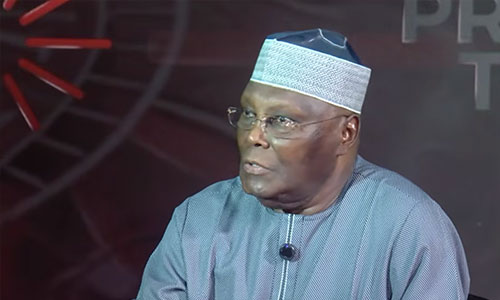
Former Vice President Atiku Abubakar has linked his possible final attempt at the 2027 presidential election to broader concerns over Nigeria’s governance, warning that worsening economic conditions and weak fiscal accountability continue to undermine national development.

Atiku, who spoke during an interview on Arise Television on Wednesday, said the 2027 race may mark the end of his long-running presidential ambitions, citing age and the weight of repeated contests over the years.
“Certainly yes, because the stakes are higher and I believe that will be my last outing,” he said when asked whether turning 80 by 2027 would influence his decision.
Responding to concerns about his age and repeated bids for office, Atiku said Nigeria’s challenge lies in leadership, adding that he embodies both experience and vision for the country’s future. He also called for structured leadership training for young Nigerians, stressing the need to prepare a new generation of leaders.
The declaration came a few hours after Chief Dele Momodu, a chieftain of the African Democratic Congress (ADC), said he backed a possible joint presidential ticket between Atiku and Peter Obi ahead of the 2027 general election.
Speaking earlier on Channels Television’s Politics Today, Momodu said pairing Atiku with Obi could strengthen the opposition, citing their previous collaboration during the 2019 election.
“I’d pair him (Atiku) with Peter Obi because they worked together in 2019, so they already share a similar temperament. Peter Obi came third in the last election, so you don’t have to work too hard to maintain and attract the same group of people who love him,” he said.
The former Vice President has contested the presidency multiple times since 2003 under different political platforms, including 2007, 2011, 2019, and 2023. He said his latest reflection comes at a time when Nigeria is facing deepening economic strain.
In one of the most direct exchanges of the interview, Atiku was asked point-blank whether he would step aside if Peter Obi proved more popular within the coalition. His response was unequivocal.
“I will step aside for any winner,” he said. When pressed specifically about Obi, he added: “Of course, if he is a contender, why not?” He noted that the coalition’s first option would always be to reach a consensus candidate, and that if consensus failed, an internal electoral process would determine the ticket.
“What I would say in the coalition is that we will at first work out a consensus. If that doesn’t of course emerge, then we go for direct [election]. I mean I will support anybody who emerges,” he said.
Atiku revealed that he was at the forefront of forming the ADC-led opposition coalition, tracing its origin to a speech he made within the PDP after the 2023 election defeat.
“I am one of the initiators of this coalition, or perhaps the leading initiator,” he said. “I remember when the PDP lost the last election, I addressed the party. I said I don’t see a future for PDP unless there is a broad-based coalition or alliance, and the PDP leadership disagreed with me at that point in time.”
He said the coalition now brings together elements from the APC, PDP, Labour Party, and NNPP, making it broader than any previous opposition alliance. He also dismissed concerns about competing ambitions within the coalition, saying the key figures understood that consensus-building was essential to defeating the incumbent administration.
“I don’t expect we will get to that level [of internal dispute] because you are dealing with really mature and experienced politicians,” he said. “We have all agreed that this is the way to save democracy in this country.”
Responding to critics who argue that power should rotate to the south after a northern presidency, Atiku pushed back strongly, contending that no party outside the PDP has zoning enshrined in its constitution.
“The only political party that has a zoning provision in its constitution is the PDP. All the rest don’t have,” he said. He further argued that, even applying the PDP’s own formula, it is the north that remains in a deficit.
“The south has governed for 18 years and the north for 10. So who is in a deficit if you want to be fair?” he asked.
Atiku went further, revealing that he had in fact opposed a rotational presidency clause during the Abacha-era constitutional conference, a decision he later admitted was a mistake. “In hindsight, when I attended the funeral of late Dr. Alex Ekwueme, I admitted that I made a mistake. I should have supported his amendment and the presidency would have rotated to all the zones in the country,” he said, adding that if he became president, constitutionally entrenching rotation would be a priority.
Asked whether his grip on the northern vote had weakened, Atiku was confident. “The north still remains my major political base,” he said, noting that he won more northern states than any other region in previous contests. He also dismissed suggestions that the north was more fragmented than it was under former President Muhammadu Buhari, arguing instead that the north was “more united now than fragmented.”
He acknowledged the presence of other powerful northern political figures within the coalition, including those with strategic influence in specific states, but maintained that none of them commanded a broader northern block vote than he did.
Addressing long-standing public questions about his credibility and past corruption allegations, Atiku said all accusations against him were unproved and politically motivated.
“My corruption past only arose through allegations which were not proved,” he said. He revealed that President Olusegun Obasanjo, his former principal, had set up a panel under the then Attorney General to investigate him while he was still in office. Atiku said he voluntarily waived his constitutional immunity to allow the probe to proceed.
“They came to my office. They said, ‘We have the instructions of Mr. President to probe you.’ I said, ‘But do you know I have constitutional immunity?’ They said yes. I said I have decided to waive the immunity. Probe me. And they probed me. What did they find? Nothing,” he said, describing the allegations as a “political issue.”
On Nigeria’s worsening insecurity, Atiku said the solution lies in better-trained and better-equipped armed forces, improved welfare for military and police personnel, and a decisive reduction in corruption within the security services.
“We don’t have enough armed forces personnel, well trained and well equipped,” he said. He recalled that during the Obasanjo-Atiku administration, Boko Haram was decisively suppressed: “Boko Haram started in 2002 when we were in office and the president and I met and decided that we should put it down decisively and we did. By the time we left, there was no Boko Haram.”
He argued that the resurgence of militancy and banditry after 2007 was a function of weak and inexperienced leadership, and pledged to reverse course by restoring institutional discipline in the security sector.
Atiku said his commitment to restructuring Nigeria remains intact, but acknowledged that it no longer dominates public conversation the way it once did.
“I have not changed my position on restructuring,” he said. “It appears political issues also have a generational lifespan. Maybe Nigerians don’t now feel that restructuring is important because of the challenges they are facing: insecurity, hunger, unemployment, corruption. All these things have now come to the forefront of what is worrying Nigerians.”
Closing the interview, Atiku delivered a direct appeal to Nigerians ahead of 2027.
“My final message to the Nigerian people is they should vote out APC if they want their future. If they don’t, it’s going to be a disaster. I don’t see the pathway to a brighter future for Nigeria in APC. Certainly not,” he said.
Alongside his political remarks, Atiku renewed criticism of Nigeria’s fiscal management, calling for stronger oversight of public revenue by the National Assembly, in reaction to a recent World Bank report.
He described the country’s revenue structure as opaque, arguing that increased earnings have not translated into improved welfare for citizens.
“What the World Bank has revealed is both alarming and unacceptable. Nigeria is earning more revenue today, yet the Nigerian people are receiving less benefit from it,” he said.
Atiku warned that excessive deductions at source and weak scrutiny of government finances were creating room for inefficiency and possible abuse, calling for all agency revenues to be brought under full budgetary oversight.
“All agency funding must be brought under the formal budgetary process… The National Assembly must exercise full oversight over every naira earned by this country,” he stated.
He further argued that Nigeria risks deepening poverty if transparency and accountability are not improved, stressing that economic reforms must produce visible benefits for citizens.
“We cannot continue on a path where rising revenues coexist with deepening poverty. When the books are full but the people are empty, it raises serious questions about where the money is truly going,” he said.
The remarks come amid renewed debate over Nigeria’s economic direction, following recent reports showing rising poverty levels despite moderating inflation, adding further weight to Atiku’s warning about a widening gap between government revenue and public welfare.
[A MUST HAVE] Evidence Act Demystified With Recent And Contemporary Cases And Materials

Available now for NGN 40,000 at ASC Publications, 10, Boyle Street, Onikan, Lagos. Beside High Court, TBS. Email publications@ayindesanni.com or WhatsApp +2347056667384. Purchase Link: https://paystack.com/buy/evidence-act-complete-annotation
______________________________________________________________________ “Enhance Legal Practice With Authoritative Reports” — Alexander Payne Offers Comprehensive Law Reports, Spanning Over A Century Of Nigerian Jurisprudence Interested buyers are encouraged to place their orders and enquiries via:
0704 444 4777, 0704 444 4999, 0818 199 9888
Website: www.alexandernigeria.com
Interested buyers are encouraged to place their orders and enquiries via:
0704 444 4777, 0704 444 4999, 0818 199 9888
Website: www.alexandernigeria.com