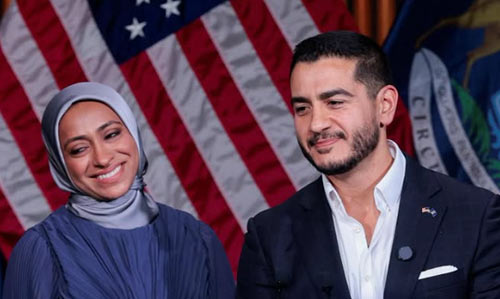
Democrat Abdul El-Sayed has made history by becoming the first Muslim elected to the United States Senate after defeating Republican candidate Mike Rogers in Michigan’s closely contested Senate election, marking a major breakthrough for Muslim representation in American politics.

The 42-year-old physician, epidemiologist and former public health official secured victory in the November 3, 2026, midterm elections, according to projections by the Associated Press and other major American news organisations.
El-Sayed’s victory preserved a crucial Democratic seat following the retirement of Senator Gary Peters, while frustrating Republican efforts to capture Michigan as part of their campaign to retain control of the United States Congress.
The election also represented a political achievement for the progressive wing of the Democratic Party, which had supported El-Sayed despite concerns about whether his policy positions could attract sufficient support in a competitive state.
His emergence is historic because, although Muslim Americans have previously been elected to the United States House of Representatives, no Muslim had been elected to the Senate before his victory.
Speaking to supporters at an election-night gathering in Detroit early on Wednesday, November 4, El-Sayed expressed gratitude to voters who supported his candidacy despite the political and religious attacks directed at him during the campaign.
He described the outcome as a victory for an inclusive political movement that brought together Americans from different religious, ethnic and economic backgrounds.
El-Sayed also criticised his Republican opponent and those who had questioned his religious identity and loyalty to the United States during the campaign.
“You chose hate and Michigan chose hope,” he declared, addressing Rogers.
He maintained that voters had rejected attempts to divide communities along religious lines and had instead demonstrated concern about their economic circumstances and the need for political accountability.
The Democratic candidate said his campaign had reached communities across Michigan, from major cities to smaller towns, during approximately 18 months of political mobilisation.
He thanked voters for welcoming him into their homes and places of worship and for supporting his campaign despite opposition from powerful political interests.
The contest attracted nationwide attention because Michigan was considered an important battleground in the struggle for control of the Senate.
Republicans entered the midterm elections with a 53–47 majority in the upper chamber, meaning Democrats needed a net gain of four seats to regain control.
Michigan was among the states targeted by Republicans, who believed that the retirement of Democratic Senator Gary Peters presented an opportunity to win a seat held by the party for several years.
However, El-Sayed’s victory ensured that the seat remained under Democratic control, contributing to the party’s broader electoral gains.
His Republican opponent, Mike Rogers, 63, is a former member of the House of Representatives and former FBI agent who previously served as Chairman of the House Intelligence Committee.
Rogers received strong political backing from President Donald Trump and senior Republican figures, who viewed the Michigan contest as an important opportunity to strengthen their position in Congress.
During the campaign, Rogers sought to portray El-Sayed as a radical progressive whose political positions were unsuitable for Michigan voters.
The Republican campaign also raised allegations about El-Sayed’s supposed connections to Islamic extremism, including claims of links to the Muslim Brotherhood.
El-Sayed denied the allegations, which were not supported by publicly established evidence.
Democrats criticised the accusations, describing them as attempts to exploit religious prejudice and undermine the candidate because of his Muslim identity.
Trump and other Republican figures also faced criticism over their campaign statements concerning El-Sayed’s religion and political loyalties.
The allegations became a recurring issue in the contest, with El-Sayed maintaining that the focus should remain on the economic challenges facing voters rather than his faith.
He argued that political leaders should be judged by their proposals to address rising living costs, healthcare challenges and other issues affecting families.
The campaign also generated disagreement over United States foreign policy, particularly Washington’s relationship with Israel and the conflict in Gaza.
El-Sayed opposed American military assistance to Israel and described Israel’s actions in Gaza as genocide, positions that drew criticism from some Jewish voters and organisations.
Rogers sought to appeal to voters who disagreed with those positions, arguing that El-Sayed’s foreign policy views were too extreme.
However, the Republican candidate also faced challenges arising from public dissatisfaction with the economy and the performance of the Trump administration.
In the closing weeks of the campaign, Rogers distanced himself from Trump on certain international issues, including the war involving Iran and trade tensions with Canada.
He argued that ending the conflict and resolving the trade dispute were necessary to reduce costs for American businesses and consumers.
Despite those efforts, El-Sayed maintained his focus on economic policies aimed at working families.
His campaign centred on reducing the cost of living, expanding healthcare access and limiting the influence of wealthy corporations and political donors.
One of his principal campaign proposals was Medicare for All, which seeks to establish a government-funded universal healthcare system for Americans.
The proposal has long been associated with progressive Democrats, including Senator Bernie Sanders, who supported El-Sayed’s campaign.
El-Sayed argued that access to healthcare should not depend on personal wealth or employment status and that the government should take greater responsibility for ensuring affordable medical services.
He also criticised the influence of large corporations and wealthy political donors in American elections, calling for reforms that would give ordinary voters greater influence over political decision-making.
His election followed a difficult Democratic primary in which he defeated more moderate candidates, including Congresswoman Haley Stevens.
The primary exposed divisions within the Democratic Party over the direction of its policies and the type of candidates best suited to win competitive elections.
Stevens, who had opposed El-Sayed during the primary, subsequently endorsed Rogers shortly before the general election, reflecting the tensions that emerged during the campaign.
Nevertheless, El-Sayed secured the support of prominent progressive figures, including Sanders and Congresswoman Alexandria Ocasio-Cortez.
Former President Barack Obama and former Vice President Kamala Harris also participated in efforts to mobilise Democratic voters in Michigan.
El-Sayed’s victory has consequently attracted attention as an example of a progressive candidate winning a statewide election despite substantial opposition and disagreements within his own party.
Before entering electoral politics, El-Sayed built his professional career in medicine, epidemiology and public health administration.
He previously served as Executive Director of the Detroit Health Department, where he worked on public health programmes and initiatives addressing inequalities in healthcare access.
His experience in public health became an important part of his political identity, particularly in his advocacy for universal healthcare and improved government support for vulnerable communities.
El-Sayed first attracted national political attention in 2018 when he contested the Democratic governorship primary in Michigan.
He lost the primary to Gretchen Whitmer, who subsequently won the general election and became Governor of Michigan.
Although unsuccessful, the campaign established him as a prominent progressive voice within the party and helped develop the political movement that later supported his Senate ambition.
Eight years after that defeat, his successful Senate campaign has taken him to the national legislative stage.
His election also represents an expansion of Muslim participation in the highest levels of American government.
Muslim Americans have previously served in the House of Representatives, but the Senate had remained without a Muslim member throughout its history.
In 2006, Keith Ellison, a Democrat from Minnesota, became the first Muslim elected to the United States Congress.
Twelve years later, Ilhan Omar of Minnesota and Rashida Tlaib of Michigan became the first Muslim women elected to Congress.
El-Sayed’s election extends that history to the Senate, whose members represent entire states and serve six-year terms.
The development is being viewed as a milestone for religious representation in American politics, particularly following a campaign in which his Muslim identity became a subject of political controversy.
It also comes amid broader Democratic victories in the 2026 midterm elections, which saw the party secure control of Congress after defeating Republican candidates in several competitive and traditionally conservative states.
The outcome presents the Trump administration with a new political environment in which Democrats will exercise greater influence over legislation, federal appointments and congressional oversight.
For El-Sayed, the victory means joining the Senate at a time when debates over healthcare, economic inequality, immigration, campaign financing and foreign policy are expected to remain prominent in Washington.
His election also gives progressive Democrats a stronger presence in the chamber as the party considers its political direction ahead of the 2028 presidential election.
While his campaign attracted support from voters seeking economic reforms, it also revealed deep disagreements over religion, foreign policy and the appropriate role of government in healthcare.
As the first Muslim elected to the United States Senate, El-Sayed is now positioned to represent Michigan in a chamber where his historic victory will be accompanied by the responsibilities of lawmaking, public accountability and representing the interests of his constituents.
His election has therefore become both a milestone in the history of Muslim representation in American politics and an important development in the Democratic Party’s wider electoral success in the 2026 midterm elections.
[A MUST HAVE] Evidence Act Demystified With Recent And Contemporary Cases And Materials

Available now for NGN 40,000 at ASC Publications, 10, Boyle Street, Onikan, Lagos. Beside High Court, TBS. Email publications@ayindesanni.com or WhatsApp +2347056667384. Purchase Link: https://paystack.com/buy/evidence-act-complete-annotation
______________________________________________________________________ “Enhance Legal Practice With Authoritative Reports” — Alexander Payne Offers Comprehensive Law Reports, Spanning Over A Century Of Nigerian Jurisprudence Interested buyers are encouraged to place their orders and enquiries via:
0704 444 4777, 0704 444 4999, 0818 199 9888
Website: www.alexandernigeria.com