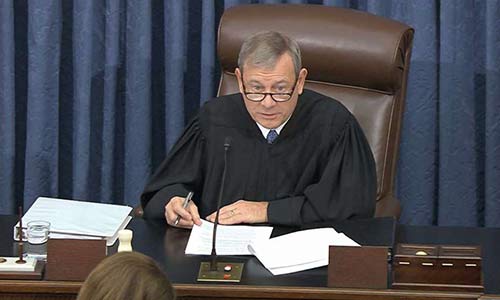
Washington (CNN)In announcing that she would vote against the Senate calling witnesses, Sen. Lisa Murkowski suggested that her decision was made in part to spare Chief Justice John Roberts from having to face a 50-50 tie, allowing him to avoid a legal and political storm.

“It has also become clear some of my colleagues intend to further politicize this process, and drag the Supreme Court into the fray, while attacking the chief justice,” the Alaska Republican said Friday afternoon.
Her statement appeared to be a direct response to Sen. Elizabeth Warren of Massachusetts, a Democratic presidential candidate who had essentially forced Roberts to speculate about his credibility on national television.
Watch the video below:
Lead House manager Rep. Adam Schiff says Chief Justice Roberts “has presided admirably” during the Senate impeachment trial of Pres. Trump https://t.co/NSt9F2Mg3D pic.twitter.com/4miDVZtuqY
— CBS News (@CBSNews) January 30, 2020
Warren had submitted a question for the chief to read:
“At a time when large majorities of Americans have lost faith in government, does the fact that the chief justice is presiding over an impeachment trial in which Republican senators have thus far refused to allow witnesses or evidence contribute to the loss of legitimacy of the chief justice, the Supreme Court and the Constitution?”
Roberts, as part of his prescribed duties, read Warren’s query from the dais. Word for word without expression.
Now it seems Warren’s question was part of the reason Murkowski came to a “no” vote.
Murkowski said, “We have already degraded this institution for partisan political benefit, and I will not enable those who wish to pull down another.”
“I will not stand for nor support that effort,” she said.
Those comments mirror similar sentiments Roberts had made six years ago.
Way back in 2014, before the death of Justice Antonin Scalia and the failed nomination of Merrick Garland, not to mention the fiery confirmation of Brett Kavanaugh, Roberts expressed something similar, worrying about the impact of the political branches on the court.
“They are not getting along very well these days among themselves. It’s a period of real partisan rancor,” he said at the University of Nebraska. “I don’t want it to spill over and affect us.”
Roberts was likely never going to cast the tie-breaking vote. Like his mentor, Chief Justice William Rehnquist, he was likely to have seen himself playing on someone else’s field, seeking to
follow their rules.
Roberts may have seen it as a separation of powers thing. But also something else: He didn’t want his institution drawn into the political circus.
That was apparent during his report on the state of the judiciary issued December 31. Speaking generally, he sent a subtle message to other judges. “We should each resolve to do our best to maintain the public’s trust,” he said. He seemed to suggest: Let the political branches do what they do, and don’t get drawn into it.
After the bitter Kavanaugh hearings, Roberts attempted a reset.
“I will not criticize the political branches,” he said at the University of Minnesota Law School in late 2018. “After all, they speak for the people, and that commands a certain degree of humility from those of us in the judicial branch, who do not.”
But then he continued to talk about the separation of powers. “We are to interpret the laws and Constitution of the United States and ensure that the political branches act within them,” he said.
He was setting the tone. Murkowski’s comments said something out loud that Roberts hadn’t.
Speaking for her own branch of government, and flicking mud at Warren, she said:
“We are, sadly, at a low point of division in this country.”
Culled from CNN
[A MUST HAVE] Evidence Act Demystified With Recent And Contemporary Cases And Materials

Available now for NGN 40,000 at ASC Publications, 10, Boyle Street, Onikan, Lagos. Beside High Court, TBS. Email publications@ayindesanni.com or WhatsApp +2347056667384. Purchase Link: https://paystack.com/buy/evidence-act-complete-annotation
______________________________________________________________________ “Enhance Legal Practice With Authoritative Reports” — Alexander Payne Offers Comprehensive Law Reports, Spanning Over A Century Of Nigerian Jurisprudence Interested buyers are encouraged to place their orders and enquiries via:
0704 444 4777, 0704 444 4999, 0818 199 9888
Website: www.alexandernigeria.com
Interested buyers are encouraged to place their orders and enquiries via:
0704 444 4777, 0704 444 4999, 0818 199 9888
Website: www.alexandernigeria.com