

By Folabi Kuti, SAN

Introduction
An important legal and industrial relations dispute is emerging on the horizon, slowly but surely. It concerns a growing tendency to treat all personnel working within a particular industry as falling within the jurisdiction of that industry’s trade unions, regardless of the legal character of their engagement. In doing so, the distinction between the right to unionise and the jurisdictional competence of a particular union risks being lost entirely. Yet that distinction is both subtle and profoundly important, especially in the context of outsourced and service-contract personnel.
Nowhere is the issue more visible today than in the oil and gas sector, where the Nigeria Union of Petroleum and Natural Gas Workers (NUPENG) and Petroleum and Natural Gas Senior Staff Association of Nigeria (PENGASSAN) increasingly maintain that workers employed by service contractors belong within their fold. Whether that proposition is correct, however, depends not simply on where the work is performed, but on the legal nature of the work performed, the business of the contractor, and the statutory limits of the unions themselves.
Distinguishing Unionism and Co-Employment
It is necessary to state from the outset that this commentary is not primarily concerned with the constitutional right to unionise. That right is guaranteed by section 40 of the Constitution of the Federal Republic of Nigeria 1999 (as amended) and reinforced by section 12 of the Trade Unions Act, subsection (4) of which provides, in unmistakable terms, that membership of a trade union “shall be voluntary and no employee shall be forced to join any trade union or be victimised for refusing to join or remain a member.”
The discussion here concerns a different, though related, question: the developing tension between a worker’s freedom to unionise and the jurisdictional limits within which a particular trade union may lawfully operate. Unfortunately, that tension is often obscured by the tendency to conflate the doctrine of triangular employment with the altogether separate question of which union, if any, has organisational jurisdiction over a worker.
The distinction is important. Service contractors routinely deploy personnel engaged in catering, medical services, transportation, warehouse management, security support, facilities maintenance and janitorial services to clients operating across diverse sectors including banking, manufacturing, construction, technology, telecommunications, maritime operations and petroleum. Where such a contractor assumes responsibility for the service and exercises supervision over its deployed personnel, does a worker so engaged automatically fall within the jurisdiction of a union organised around the client’s industry merely because the service is rendered within that industry? We shall return to the question presently, for the answer is neither as obvious nor as straightforward as current industrial practice appears to suggest. At first glance, the very purpose of many of these arrangements is to avoid the creation of an employment relationship between the client and the contractor’s personnel. Labour jurisprudence, however, has moved beyond formal labels. Influenced by International Labour Organization standards on disguised and triangular employment relationships, the National Industrial Court of Nigeria has consistently held that the existence of an employment relationship is a question of fact rather than contractual form. Accordingly, where the facts disclose sufficient elements of control, integration, supervision or economic dependency, the Court has not hesitated to find the existence of a co-employment relationship notwithstanding the contractual structure adopted by the parties. Indeed, it is in this context that the Court of Appeal’s reintroduction of notions of contractual privity into the discussion in Luck Guard Limited v Felix Adariku & 5 Ors (CA/A/1061/2020) has attracted academic criticism.1 This is particularly so in the face of older/availing appellate authorities. For instance, in Shena Security Co. Ltd v Afropak (Nig.) Ltd & Ors (2008) 18 NWLR (Pt. 1118) 77, the Supreme Court identified control, payment of wages, provision of tools and equipment, and the parties’ intentions as relevant indicators in determining whether a relationship is one of employment or an independent contractual arrangement. Similarly, in Onumalobi v NNPC & Warri Refining & Petrochemical Co. Ltd (2004) 1 NLLR (Pt. 2) 304, the court emphasised the need to examine the factual realities of the relationship rather than merely its description by the parties.
That said, whether an operator may be regarded as a co-employer is a fundamentally different inquiry from the question of trade-union jurisdiction. An operator may, on the facts of a particular case, be found to share employer status, together with the obligations and liabilities that accompany such status. It does not necessarily follow, however, that every worker deployed to that operator’s premises thereby falls within the jurisdictional scope of the industry’s trade union. Co-employment concerns the existence of an employment relationship; unionisation, by contrast, concerns the statutory reach of a particular trade union. The two questions overlap only at the margins and should not be treated as interchangeable.
The Right to Associate and the Jurisdictional Scope of Unions
What is interesting is that the Constitution recognises a freedom to associate and not to associate. However, this is precisely why that freedom must be read in line with whatever law is made to regulate how it is exercised. Just as the right to belong to a political party is regulated by the Electoral Act, and the right of a religious body to associate through incorporated trustees by the Companies and Allied Matters Act, so too must the right to belong to a trade union be read in conjunction with the Trade Unions Act: see Osawe v Registrar of Trade Unions (1985) 1 NWLR (Pt 4) 755. Unions, in other words, bear the sign of jurisdiction; and whatever the Constitution may guarantee the individual worker, the union itself must exist and operate within the four corners of the law that marks out its field.
Now for the avoidance of doubt, let us be clear here – the Act has not left this to guesswork. Section 34 (3) of the TUA mentions the jurisdictional scope of trade unions. Part A of its Third Schedule lists the restructured trade unions, while Part B sets out “the jurisdictional scope of each of the re-structured trade unions”, and Part C lists the senior staff and employers’ associations. For instance, Item 13 of Part B describes the field of NUPENG in the following terms:
“Workers in oil well and natural gas well operations including prospecting, drilling, crude oil and natural gas pipelines. Refining, distribution and marketing of natural gas, extraction oil and natural gas and petroleum products including petrol filling stations, petroleum tanker drivers, but excluding the construction of oil and gas pipelines.”
Applying the ejusdem generis rule (or for that matter simply giving those words their plain meaning), a caterer, a clinic doctor or a cleaner is automatically out. It is also beyond clear that those engaged by service contractors who are not supplying the core work of the sector cannot be compelled to belong to that union. There should not be any argument merely because someone provides a service to an industry, for one might as well say that a man who provides medical services to an oil and gas company must, for that reason alone, belong to PENGASSAN.
Helpfully, the Schedule itself gives an indication of where such workers may go. Item 12 hands the National Union of Hotels and Personal Services Workers “restaurants, cafes, taverns and other drinking and eating places”, along with “shops, offices and cleaning” and “Security services”; so that if Person A does janitorial work at an oil and gas company, he belongs, if at all, in the union of his own trade. In similar vein, Item 16 gives the road transport union all workers in the transportation of passengers and goods by road, “excluding the transportation of petroleum by road”, while Item 13 lays claim to “petroleum tanker drivers”; thus placing the driver of the staff bus and the driver of the tanker in different unions, on the strength of what each actually does. And for good measure, to belong to the maritime workers’ union under Item 3, one must be manning vessels, working the docks or engaged by shipping, clearing and forwarding agencies.
It is true that PENGASSAN does not feature in Part B at all, and appears only by name in Part C as the Petroleum and Natural Gas Senior Staff Association of Nigeria. However, we do not think this gives it a wider licence than NUPENG. Its very name confines it to the same industrial field, and senior staff – on the Court’s own understanding – are in any event deemed not to be members of a union until they opt in. Let us go through some examples to illustrate this point: There is a company that engages medical doctors who have no fixed clinic, but work in the clinics of telecommunications and oil and gas companies. That is a service contract. The reason a telecommunications company would not want to run its own clinic is that it can save money, it being cheaper to engage a company which it pays monthly. When these doctors come to work at that clinic, why should they belong to its sector union? A company whose objects are medical services cannot fall within the industrial field of a union whose objects are limited to petroleum and natural gas. The same goes for those who supply catering to oil and gas companies. They cannot belong to PENGASSAN, as it is the people they feed who belong to the oil and gas companies, and not they themselves.
Nestoil v NUPENG to the rescue?
Here, a similar issue was submitted in Nestoil Plc v NUPENG (2018) LPELR-50094(CA); namely, whether workers of a company involved in specialised support services, outside the core statutory description of an oil and gas union, fall within the jurisdictional scope of that union. At the NICN (Suit No. NIC/LA/08/2010, judgment delivered on 8th March 2012; per Hon. Justice B.B. Kanyip (Presiding Judge, as he then was, now PNICN), Hon. Justice O.A. Obaseki-Osaghae and Hon. Justice J.T. Agbadu-Fishim), the employer’s standing appears to have been raised suo motu, with the Court holding that:
“From these statements of principles, we hold that the claimant has no locus standi, and so is a busy body, regarding the question whether the defendant is the appropriate union to unionize its staff. The locus is with either the staff themselves or some other rival union that lays claim to jurisdictional mandate.”
Suffice it to say that the matter was lost at the gate: lack of standing to sue. It went on appeal. The Court of Appeal was in turn confronted with a preliminary objection that the losing party (the appellant) ought to have sought leave before bringing the appeal, as appeals from the NIC are not automatic, save on fundamental rights issues. That objection was sustained and the appeal failed for want of leave, which should have determined the matter in limine. Not done however, the court went on to do a ‘what if’ of sorts and, just in case it was wrong, gave its view. It agreed that the lower court should not have raised and resolved the issue of locus suo motu, and went on to side with the appellant on the law, holding in relation to Item 13 that:
‘The clear meaning of the words used above will reveal that workers in the Appellant company are not part of the workers statutorily described as members of the Respondent union, in light of the fact that the company is involved in special support services in the area of construction services as evidenced by the permit issued to the Appellant company.’
At this point, a curious paradox emerges. The Court of Appeal recognised that the issue of standing had been raised and determined suo motu, without affording the appellant an opportunity to be heard. Yet such an omission ordinarily raises an obvious question of fair hearing. If the complaint was, in substance, that the appellant had been denied the constitutional right to be heard before an issue determinative of its case was decided against it, was that not itself a complaint grounded in a fundamental right? And if so, was leave required in such an instance? With the utmost respect, the point appears deserving of broader consideration than it received. It may well be that a broader view of the fair-hearing implications of the NICN’s approach could have produced a different result on the question of leave. That said, a detailed examination of the Court of Appeal’s jurisprudence on appeals from the NICN is beyond the scope of this commentary. It is sufficient to note that, having sustained the preliminary objection, the Court nonetheless proceeded to express views on the substantive question of union jurisdiction, thereby providing guidance for future cases notwithstanding the procedural disposition of the appeal.
As it is now, there is no clear final decision. The part where the Court of Appeal agreed on the scope of the union was obiter, not ratio, and in giving an alternative ruling, the court could do no more than guide future decisions. The NICN’s holding on employer standing, for its part, remains a real obstacle, and Nestoil was undoubtedly helped by the express exclusion of pipeline construction in Item 13, which no caterer or doctor can call in aid. Even so, the reasoning is of more than mere passing value. By directing attention away from the fixation on locus and towards what the statute says and what the company in question actually does, as shown by its permit, it offers future courts a surer footing on the question.
Sector-Specific Guidelines
It is also worth noting here that the Federal Ministry of Labour and Employment had at different times issued guidelines to regulate the treatment of contract staffing and labour outsourcing in a few identified sectors. Take, for instance, the 2011 Guidelines on Labour Administration Issues in Contract Staffing/Outsourcing in the Oil and Gas Sector requiring all contract staff under a manpower or labour contract to belong to NUPENG or PENGASSAN as appropriate. Furthermore, it went on to provide that “for all service contracts, trade union membership must be determined by the economic activities of the contractor company”, in line with Part B of the Third Schedule. Yet, even these do not properly address the distinction. They merely define a service contract by the narrow measure of whether the contractor supplies personnel with equipment, all the while offering no reason why those providing third-party services cannot be said to belong to the client’s union. Finally, and unfortunately, they say nothing of a union like PENGASSAN, which has no Part B entry at all.
Conclusion
It is clear that this is not merely a brewing issue. We have actually seen it for a while, and it will not stop at oil and gas. Currently, it is finding its way to other sectors. In the meantime, operators and contractors would do well to characterise their contracts properly from the bid stage and keep evidence of each contractor’s objects and permits. Furthemore, our perpetual advice is that all operators or contractors, regardless of the relationship, steer clear of any interference with a worker’s choice.
All said, it appears increasingly inevitable that future disputes may therefore involve: inter-union jurisdictional conflicts; recognition disputes; bargaining-unit disputes; and challenges to collective agreements. Consequently, as it stands, the pressing question now is whether – when the next case comes – the Court will again be detained by ancilliary (albeit duly important) issues such as leave and locus, or go straight to the Third Schedule. It is hoped that, in no distant future, the appellate courts will have occasion to say in a binding decision, what Nestoil could only suggest.
– Folabi Kuti, SAN, is Lead Partner at Union Attorneys (incorporating KutiLegal).
Footnote
1 Folabi Kuti SAN & Emmanuel Abraye, ‘The Concept of Triangular Employment Suffers a Blow’ https://dnllegalandstyle.com/dnl/the-concept-of-triangular-employment-outsourcing-suffers-a-blow-a-critique-of-recent-court-of-appeal-decisions/
[A MUST HAVE] Evidence Act Demystified With Recent And Contemporary Cases And Materials
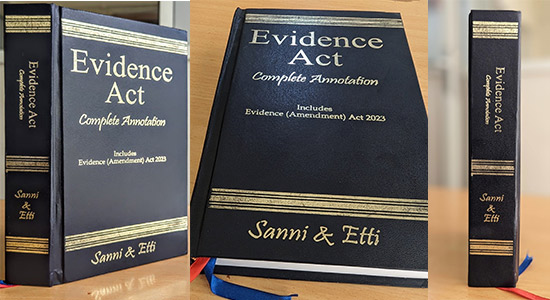
Available now for NGN 40,000 at ASC Publications, 10, Boyle Street, Onikan, Lagos. Beside High Court, TBS. Email publications@ayindesanni.com or WhatsApp +2347056667384. Purchase Link: https://paystack.com/buy/evidence-act-complete-annotation
______________________________________________________________________ “Enhance Legal Practice With Authoritative Reports” — Alexander Payne Offers Comprehensive Law Reports, Spanning Over A Century Of Nigerian Jurisprudence Interested buyers are encouraged to place their orders and enquiries via:
0704 444 4777, 0704 444 4999, 0818 199 9888
Website: www.alexandernigeria.com