*Faults Imo Attorney-General

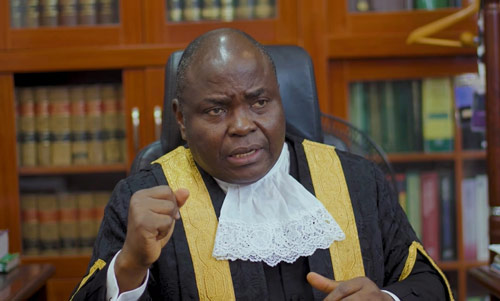
A Senior Advocate of Nigeria, Jibrin Okutepa, SAN, has faulted the objection raised by the Attorney-General of Imo State to the intervention of the National Judicial Council (NJC) in the appointment of a substantive Chief Judge for the state, describing the objection as misconceived and inconsistent with the constitutional framework governing judicial appointments.
Okutepa maintained that the NJC acted within its constitutional responsibilities by requesting the Imo State Judicial Service Commission (IMSJSC) to include the name of Justice Ijeoma Agugua, the state’s most senior High Court judge and Acting Chief Judge, among the candidates to be considered for appointment as substantive Chief Judge.
The senior lawyer argued that excluding the most senior judge from consideration without a reasonable explanation grounded in the applicable legal criteria would undermine the transparency and fairness expected in the appointment process.
He made the observations in a statement published on his verified X account, @sanjsokutepa, titled “Imo Chief Judge Appointment: Why the Attorney-General’s Objection Is Misconceived.”
Reacting to reports that the Imo State Attorney-General had challenged the NJC’s authority to direct the inclusion of Justice Agugua’s name, Okutepa maintained that the appointment of a substantive Chief Judge involved several constitutional institutions, each with clearly defined responsibilities.
“With respect to the Honourable Attorney-General of Imo State, his objection to the National Judicial Council’s intervention in the appointment of a substantive Chief Judge is, in my view, misconceived,” he stated.
According to Okutepa, the NJC’s published decision merely requested that Justice Agugua’s name be included among the candidates to be considered for the position, rather than directing that she must be appointed.
He stressed that including the Acting Chief Judge in the list would allow the relevant authorities to examine her suitability alongside other qualified candidates.
“Inclusion affords her an opportunity to be assessed; it does not predetermine her appointment,” he explained.
The senior lawyer consequently rejected the suggestion that the NJC had exceeded its powers by insisting that the most senior judge should not be excluded from the selection process without proper justification.
Explaining the constitutional framework, Okutepa cited Paragraph 6(a), Part II of the Third Schedule to the 1999 Constitution, which empowers the State Judicial Service Commission to advise the NJC on suitable candidates for judicial appointments.
He also referred to Paragraph 21(c), Part I of the Third Schedule, which empowers the NJC to recommend a candidate from the names submitted for consideration.
According to him, Section 271(1) of the Constitution provides that the Governor appoints the Chief Judge of a state on the recommendation of the NJC, subject to confirmation by the State House of Assembly.
Okutepa argued that the combined effect of these constitutional provisions is that the appointment of a substantive Chief Judge requires cooperation among the State Judicial Service Commission, the NJC, the Governor and the State House of Assembly.
He maintained that none of the institutions involved should exercise its powers in a manner that frustrates the constitutional responsibilities assigned to the others.
“Each institution must exercise its responsibility without frustrating the responsibilities of the others,” he stated.
The senior advocate further addressed the reported reliance by the Imo State Attorney-General on Section 202 of the Constitution, which protects certain state executive bodies from external direction or control in the exercise of specified powers.
Okutepa acknowledged the constitutional independence conferred by the provision but argued that it could not be interpreted as giving the State Judicial Service Commission unlimited authority to exclude candidates from consideration by the NJC.
“That provision deserves respect, but its precise language concerns the exercise of powers to make appointments and exercise disciplinary control,” he said.
According to him, the responsibility of the State Judicial Service Commission to advise the NJC on candidates for appointment as Chief Judge forms part of a wider constitutional process involving several institutions.
He therefore maintained that the independence granted to the Commission under Section 202 should not be used to undermine the NJC’s constitutional responsibility to consider and recommend suitable candidates.
“Advising the NJC on candidates for Chief Judge forms part of a shared constitutional process. In my considered view, section 202 cannot simply be treated as giving the Commission an unrestricted veto over meaningful consideration by the NJC,” Okutepa stated.
The senior lawyer also examined the relevance of seniority in the appointment of judicial officers, particularly where the most senior judge in a state is being considered for elevation to the office of Chief Judge.
He explained that the NJC’s published guidelines for judicial appointments expressly identify seniority at the Bar or Bench as one of the relevant considerations in assessing candidates.
Other factors, according to him, include professional competence, legal knowledge and additional criteria relating to suitability for judicial office.
Okutepa argued that the inclusion of seniority among the prescribed considerations meant that the status of the most senior judge could not be disregarded arbitrarily.
“Seniority therefore deserves serious consideration in an assessment based on merit,” he stated.
He maintained that where the most senior judge was omitted from the list of candidates, the responsible institution should provide a reasoned explanation based on the applicable criteria.
“Where the most senior judge is omitted, the proper response should be a reasoned explanation supported by the applicable criteria. Institutional independence cannot justify arbitrary exclusion,” he said.
Nevertheless, Okutepa cautioned against interpreting the Constitution as conferring an automatic right on the most senior High Court judge to be appointed substantive Chief Judge in every circumstance.
He drew a distinction between the constitutional provisions governing the temporary performance of the functions of Chief Judge and those regulating appointment to the substantive office.
According to him, Section 271(4) of the Constitution expressly requires the most senior judge of the State High Court to perform the functions of Chief Judge when the circumstances stipulated under the Constitution arise.
However, he explained that the constitutional provisions governing the substantive appointment do not confer the same automatic entitlement.
“Legal precision nevertheless matters,” Okutepa stated.
“It would therefore overstate the law to say that the most senior judge can never lawfully be excluded, whatever the circumstances.”
He maintained that the stronger legal argument was that seniority should not be bypassed without a lawful and justifiable basis, particularly where such exclusion would prevent a qualified judicial officer from receiving fair consideration.
“The stronger argument is that no constitutional provision authorises exclusion merely to bypass seniority or prevent fair consideration,” he said.
Okutepa consequently argued that the Attorney-General had not identified any legal provision empowering the Imo State Judicial Service Commission to exclude Justice Agugua merely because it did not wish her name to be considered by the NJC.
According to him, the NJC’s request should therefore be understood as an attempt to safeguard the integrity of the selection process rather than an unlawful interference with the powers of the State Judicial Service Commission.
He maintained that the Commission remained responsible for assessing the suitability of candidates and communicating any legitimate concerns to the NJC.
Similarly, he explained that the NJC must independently evaluate the candidates before exercising its constitutional power to recommend a suitable person for appointment.
The senior lawyer argued that the appropriate approach was to ensure that Justice Agugua’s qualifications, professional competence and judicial record were assessed alongside those of other eligible candidates.
On the published facts, Okutepa described the NJC’s request as “a defensible measure to ensure a credible selection process.”
He stressed that the inclusion of Justice Agugua’s name would not prevent the State Judicial Service Commission from raising genuine objections concerning her suitability, provided such objections were supported by lawful and relevant considerations.
According to him, the Commission “retains its responsibility to assess suitability and communicate any substantiated reservations.”
He added that the NJC “must equally exercise its own judgment before making a recommendation.”
Okutepa therefore urged the Imo State Attorney-General to support a transparent appointment process rather than oppose the inclusion of the Acting Chief Judge among those to be considered.
He maintained that if there were valid grounds for questioning Justice Agugua’s suitability, such grounds should be disclosed and examined fairly by the appropriate authorities.
“If there are lawful grounds against her suitability, let them be presented and fairly examined,” he stated.
The senior advocate stressed that the appointment of a Chief Judge was not merely an administrative matter but an exercise involving the integrity, independence and credibility of the judiciary.
According to him, the process must inspire public confidence and demonstrate that judicial leadership appointments are determined through lawful procedures rather than arbitrary decisions.
“The office of Chief Judge is a public trust, and its occupants must emerge through a process that commands confidence in the independence, integrity and fairness of the judiciary,” Okutepa declared.
He concluded by reaffirming his support for the NJC’s intervention, maintaining that the exclusion of the most senior judge without a proper legal basis could not be justified under the Constitution.
“The whimsical exclusion of her name has no support of law. NJC is right,” he stated.
[A MUST HAVE] Evidence Act Demystified With Recent And Contemporary Cases And Materials

Available now for NGN 40,000 at ASC Publications, 10, Boyle Street, Onikan, Lagos. Beside High Court, TBS. Email publications@ayindesanni.com or WhatsApp +2347056667384. Purchase Link: https://paystack.com/buy/evidence-act-complete-annotation
______________________________________________________________________ “Enhance Legal Practice With Authoritative Reports” — Alexander Payne Offers Comprehensive Law Reports, Spanning Over A Century Of Nigerian Jurisprudence Interested buyers are encouraged to place their orders and enquiries via:
0704 444 4777, 0704 444 4999, 0818 199 9888
Website: www.alexandernigeria.com