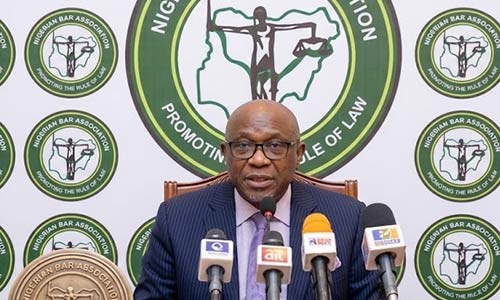
More than two weeks have passed since the 2026 Nigerian Bar Association national officers election, and the question now dominating discussion within the profession is no longer only who won and who lost. It is a simpler and more troubling one.

Where is the Electoral Committee of the Nigerian Bar Association?
Where is its Chairman, Aham Ejelam, SAN? Where is the Secretary, Ibrahim Aliyu Nassarawa, Esq.? Where are the members, Professor Chidi Onyia, Eno-Obong O. Akpan and Mr Mustapha Abubakar?
Five lawyers were entrusted with the conduct of an election in which more than 82,000 members of Africa’s largest bar association were entitled to vote. The election collapsed within minutes of commencement, was attributed to a cyberattack, was moved to a different platform nobody outside the Committee appears to have approved or tested, produced a turnout of 31.86 per cent, and has since been described by a former President of the Association as illegitimate and by senior members as the worst the NBA has ever conducted.
Since then, silence.
The First Question: Was Our Data Attacked?
Of all the unanswered questions, the one that ought to trouble the profession most has attracted the least official attention.
The ECNBA told Nigerian lawyers, by email at 3:01 a.m. on July 18, that the voting system had been subjected to a “deliberate, coordinated and sustained cyberattack.”
That is an extraordinary statement. It is an admission that a system holding the names, Supreme Court enrolment numbers, telephone numbers, email addresses and voting records of over 82,000 Nigerian legal practitioners was targeted by hostile actors.
And yet, more than two weeks later, the profession has not been told:
Who attacked the system. When the attack was first detected. Whether it succeeded. Which components of the system were affected. Whether any personal data of any lawyer was accessed, copied, altered or exfiltrated. Whether any breach notification was made to the Nigeria Data Protection Commission as required where personal data is compromised. Whether affected members have been or will be informed.
Under the Nigeria Data Protection Act 2023, a data controller who becomes aware of a personal data breach is required to notify the Commission, and in cases likely to result in high risk to the rights and freedoms of data subjects, to notify the data subjects themselves.
If the ECNBA’s own account of a coordinated cyberattack is true, that obligation is engaged. If it is not true, the profession is entitled to know that too.
Either way, lawyers are entitled to an answer. Their data is not the Committee’s property. It is theirs.
The Second Question: Who Authorised the Migration?
The advertised voting platform was https://ecnba.org.ng/vote/ecnba-ovs-main/. It went down within ten minutes of voting opening at midnight and stayed down for over seven hours.
At 7:35 a.m., voting resumed on a different website entirely, www.ecnbaovs.org.ng, which had been built, according to the Committee’s own account, within three or four hours.
Nobody outside the Committee has explained who authorised that migration. The National Executive Committee did not ratify it. The candidates did not consent to it. Their IT representatives did not test it. The backend was not independently verified.
The NBA Constitution prescribes safeguards for electronic voting, including integrity testing and stress testing to be conducted before the poll. A platform built in three hours and deployed live at 7:35 a.m. satisfied none of them.
Who took that decision? On what authority? Was any member of the Committee opposed? These are questions with names attached to them, and the five people who can answer them have said nothing.
The Third Question: Why Did the OTPs Fail?
The ECNBA admitted the OTP failure in its own advisory at 5:35 p.m. on election day, signed by the Chairman and Secretary, acknowledging delays and non-receipt and directing voters to log out, wait twenty minutes, and request fresh codes.
But the advisory did not explain the cause, and no explanation has come since.
A presidential candidate, Lateef Omoyemi Akangbe, SAN, has stated publicly that he was unable to vote for himself, and that the Chairman of the ECNBA and the President of the NBA personally sent him links that still did not work.
If the Chairman of the electoral committee could not get a working link to a presidential candidate, what happened to the ordinary member in Yenagoa, Sokoto, Awka or Ikeja?
The Fourth Question: The Ballot Itself
There were also complaints that the presidential ballot displayed the photograph of one candidate while the photographs of others were missing or improperly rendered.
In an electronic election, the ballot interface is the ballot paper. A defect in it is not a cosmetic matter. If that is what members saw when they voted, the profession deserves to know how it passed pre-election testing and why voting was not suspended until it was corrected.
The Fifth Question: 56,107 People
The arithmetic is the plainest fact in the entire controversy and requires no technical expertise to understand.
82,213 lawyers were eligible to vote. 26,106 voted. 56,107 did not.
The winner polled 12,317 votes, which is roughly 14 per cent of the eligible membership.
The ECNBA has published the list of members who voted, describing it as compliance with the NBA Constitution. But publishing a list of those who succeeded in voting is not an explanation of why two-thirds of the Bar did not.
Critics have argued, and the ECNBA has not disputed, that this was not ordinary apathy. It was the consequence of a collapsed platform, a rebuilt portal, and an authentication system that would not deliver codes.
The Integrity Question
The Olanipekun Committee, whose report the Attorney-General of the Federation accepted, found that the reservations expressed about the service providers were “well-founded,” and recorded that Mikrodigital Connect was a mere business name with a single proprietor, no demonstrated track record in election management, and six years of unpaid annual returns which it hurriedly settled between 10:02 p.m. on May 31 and 12:30 p.m. on June 1, 2026, immediately after its appointment.
The Committee also found that the proprietor confirmed he had been part of the 2024 NBA election and remained in possession of the data of over 70,000 lawyers, explaining that he had not been disengaged.
That is a finding about the custody of the personal data of Nigerian lawyers, made by a committee chaired by a former NBA President and accepted by the Chief Law Officer of the Federation. It has not been answered by the ECNBA either.
The Olanipekun Committee expressly respected the personal integrity of the ECNBA Chairman. But integrity in office is demonstrated by conduct in office, and the conduct now in question is the refusal to account.
The Institutional Problem
The NBA’s motto is “Promoting the Rule of Law.” Its members appear before tribunals demanding server logs, BVAS records, result sheets and forensic audits from INEC. Its leaders issue statements when public institutions fail to explain themselves.
An association that does that cannot allow its own electoral body to conduct an election, announce a result, and then decline to explain what happened when the system collapsed.
The NBA President, Mazi Afam Osigwe, SAN, has said the ECNBA would conduct an in-depth analysis of the election and make recommendations on cybersecurity and data protection. That statement makes the silence harder to justify, not easier. If such an analysis is being conducted, the profession should be told who is conducting it, what its terms of reference are, and when it will report.
What Is Actually Being Asked
Nothing in the demands being made of the ECNBA is unreasonable, and nothing requires the Committee to concede that anything was rigged.
Lawyers are asking for: the incident report on the cyberattack; confirmation of whether any personal data was compromised and whether the Data Protection Commission was notified; the identity of the person or body that authorised the platform migration; the integrity and stress test records for both platforms; OTP delivery and failure logs; server and application logs; the audit trail; the record of everyone who held administrative access during the poll; and an independent post-election audit.
These are the ordinary artefacts of any credible electronic election. If the election was properly conducted, producing them vindicates the Committee. If it was not, the profession needs to know that before the next one.
The Silence Is the Story
Five lawyers ran this election. They signed the notices. They issued the guidelines. They announced the cyberattack. They authorised the migration. They admitted the OTP failure. They declared the result.
They are the only people who can explain what happened, and they have chosen not to.
Until Aham Ejelam, SAN, Ibrahim Aliyu Nassarawa, Esq., Professor Chidi Onyia, Eno-Obong O. Akpan and Mr Mustapha Abubakar come forward with a full, calm and technical account, the silence of the ECNBA will continue to speak louder than the results it announced.
[A MUST HAVE] Evidence Act Demystified With Recent And Contemporary Cases And Materials

Available now for NGN 40,000 at ASC Publications, 10, Boyle Street, Onikan, Lagos. Beside High Court, TBS. Email publications@ayindesanni.com or WhatsApp +2347056667384. Purchase Link: https://paystack.com/buy/evidence-act-complete-annotation
______________________________________________________________________ “Enhance Legal Practice With Authoritative Reports” — Alexander Payne Offers Comprehensive Law Reports, Spanning Over A Century Of Nigerian Jurisprudence Interested buyers are encouraged to place their orders and enquiries via:
0704 444 4777, 0704 444 4999, 0818 199 9888
Website: www.alexandernigeria.com
Interested buyers are encouraged to place their orders and enquiries via:
0704 444 4777, 0704 444 4999, 0818 199 9888
Website: www.alexandernigeria.com