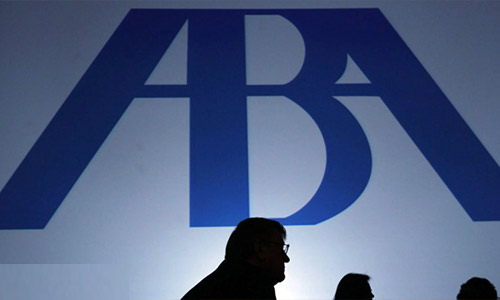
The American Bar Association’s law school accreditation arm has mounted a vigorous defence of its continued federal recognition as the national accreditor of U.S. law schools, rejecting findings by the Department of Education that it is insufficiently independent from the wider lawyers’ organisation and arguing that the record does not justify stripping it of a role it has held since 1952.

The dispute came before the National Advisory Committee on Institutional Quality and Integrity, NACIQI, in Washington on Wednesday, September 23, 2026, as part of the ABA Council of the Section of Legal Education and Admissions to the Bar’s periodic application for renewed recognition.
After about seven hours of debate, committee members failed to reach agreement on whether the Council should retain its recognition. Two proposals failed to secure majority support, leaving the issue unresolved overnight and scheduled for further consideration on Thursday, September 24. Of the committee members participating Wednesday, the vote on one proposal to give the Council another 12 months to address concerns ended 8-8.
The dispute is significant because the Council rather than the larger ABA itself is formally recognised by the U.S. Department of Education as the accreditor of programmes leading to the Juris Doctor degree. It has held federal recognition since 1952 and currently approves 198 institutions and programmes conferring the J.D. degree.
The accreditation system also has consequences extending beyond academic oversight. In most U.S. jurisdictions, graduation from an ABA-approved law school is either necessary or sufficient to satisfy the educational requirement for admission to a state bar examination. Federal recognition also matters for access to federal student aid at certain standalone law schools that do not rely on another recognised institutional accreditor.
The controversy intensified in August when Department of Education staff recommended that the Council’s federal recognition not be renewed.
The Department’s staff report concluded, among other things, that the Council did not satisfy federal rules requiring an accrediting agency associated with a professional organisation to operate “separately and independently” from that parent body.
One central concern was the role of the ABA’s broader policymaking structure, particularly its House of Delegates, in matters relating to accreditation standards. Department officials argued that the arrangement gives the broader association an influence over accreditation policy that members of the public, non-ABA lawyers, law schools and other interested parties do not possess.
The Department also criticised the Council over the timing of changes to its accreditation standards, including its former diversity-related Standard 206.
But the ABA Accreditation Council strongly disputed both the factual and legal foundations of the recommendation.
Appearing before NACIQI on Wednesday, Daniel Thies, immediate past chair of the Accreditation Council, said the Council was sufficiently compliant with federal recognition criteria and asked the committee to reject the Department staff’s recommendation.
“Our position is that the Council is sufficiently in compliance with the criteria to merit re-recognition,” Thies said.
He told the committee that the adverse findings could broadly be divided into three groups: findings based on the Department’s refusal to recognise changes already adopted by the Council; findings the Council considered unfounded or insufficient to justify denial; and issues that, according to the Council, appeared for the first time in the Department’s final staff report.
“My request is that after a careful and fair analysis, you will agree that the record does not justify denial,” he said.
Thies said 19 of the Department’s 26 findings that the Council “did not meet” recognition requirements related to changes the Council said it had already adopted.
According to him, many of those modifications were made in response to questions raised in the Department’s 2025 draft analysis and had become effective by February 2026.
The Council’s position is that the Department wrongly refused to give effect to some of those changes because they had not yet appeared in the annually printed edition of the accreditation standards.
Thies argued that a rule or standard can become legally or administratively effective before it appears in a subsequently printed compilation, comparing the situation to laws taking effect before appearing in a later printed edition of the U.S. Code or federal regulations.
In a September 11 letter to the Department, the Council similarly asked officials to correct what it described as a major factual error underlying many of the non-compliance findings.
The Council said revisions to its standards and procedures had been effective from February 9, 2026, while changes to certain internal operating policies became effective between August and November 2025.
It maintained that the Department had received documentation of those revisions but nevertheless treated them as ineffective because the 2026-2027 printed standards book had not yet been published.
The Council said the new book was eventually published in August 2026 and supplied to accredited law schools and the Department.
A second major point of disagreement concerns the requirement that the accreditation body operate separately and independently from the wider American Bar Association.
Thies told NACIQI that the Council had complied with that requirement for decades.
He said neither the ABA Board nor its chief executive or staff appoints members of the Council; that public members comprise at least one-seventh of the Council; that law-school accreditation fees are separate from ABA membership dues; and that the Council develops its own budget without review or consultation by another ABA body.
He said recent governance changes were intended to strengthen existing structures rather than remedy an admission that the Council had previously lacked independence.
“These were changes in form, not substance,” he said.
Some NACIQI members, however, were not persuaded that the relationship between the Council and the broader ABA satisfied federal independence requirements.
Wednesday’s debate showed substantial concern over the ability of the ABA House of Delegates and other components of the larger organisation to participate in discussions about accreditation standards.
Some members favoured ending recognition, while others believed any shortcomings could be corrected without taking that step.
Committee member Jennifer Blum proposed extending the Council’s recognition for another year while requiring corrective reports and barring it from accrediting new programmes during that period. She said she wanted the Council to become demonstrably separate and independent but questioned whether terminating federal recognition was the appropriate way to achieve that objective.
That proposal failed on an 8-8 vote.
The battle over accreditation also forms part of a wider dispute between the Trump administration and the ABA.
In April 2025, President Donald Trump issued an executive order directing Education Secretary Linda McMahon to examine whether the Council’s federal accrediting status should be suspended or terminated. The administration specifically objected to what it characterised as unlawful diversity, equity and inclusion requirements imposed through accreditation standards.
The ABA and the Trump administration have also clashed on other fronts, including executive actions directed at law firms, criticism of judges, participation by Justice Department lawyers in ABA events and the organisation’s traditional role in evaluating potential judicial nominees.
The Department of Justice has restricted its lawyers’ attendance at certain ABA events, while the administration has reduced the organisation’s longstanding involvement in the judicial nomination process. The White House has also publicly criticised the ABA’s political and institutional positions.
A particularly contentious issue in the accreditation dispute has been Standard 206, which dealt with diversity and access in legal education.
The standard previously required accredited law schools to demonstrate commitments relating to diversity in recruitment, admissions, faculty and educational programming.
The Council suspended enforcement of the standard in February 2025 amid legal and political disputes over race-conscious programmes. It formally repealed Standard 206 on September 8, 2026, shortly before the NACIQI hearing.
Thies told the committee that the Council rejected the Department’s suggestion that it acted too slowly.
According to him, after the U.S. Supreme Court’s 2023 decision restricting race-conscious college admissions, guidance issued by the previous administration led the Council to believe that Standard 206 could still be administered lawfully.
He said different guidance from the Trump administration in early 2025 prompted the Council first to suspend and later repeal the standard.
Thies also complained that the issue was introduced late in the federal recognition process.
He noted that Trump’s executive order had specifically instructed the Education Secretary to assess whether the Council should lose its accreditation status, saying this reinforced the Council’s concern that the outcome of the review might have been predetermined. That is the Council’s contention; the Department’s staff recommendation separately relies on asserted regulatory deficiencies.
The Council also argued that even if NACIQI concluded that technical deficiencies remained, the appropriate response would be a monitoring or compliance report rather than termination of recognition.
Thies said other accrediting agencies had been permitted to retain recognition while correcting shortcomings and argued that the Council should receive equivalent treatment.
He further stressed that the Department’s staff report did not identify concerns about the actual educational quality of the law schools accredited by the Council or the outcomes of their graduates.
“There are no concerns about the educational quality of law schools or the outcomes of graduates of our accredited law schools,” he told the committee.
The Council’s current chair, Melissa Hart, has similarly maintained that the accreditation body has consistently complied with federal requirements and has taken additional steps to reinforce the separation between accreditation functions and the wider ABA.
The broader ABA maintains that eliminating bias and improving access to the legal profession remain organisational priorities even though Standard 206 has been repealed.
Supporters of continued recognition also appeared before NACIQI.
New York City Bar Association President Matthew Diller, a former law dean, urged the committee to preserve the Council’s role, arguing that nationwide standards for legal education are an important public interest and that accreditation provides a national framework for legal education and professional mobility.
The matter, however, will not necessarily be resolved by whatever recommendation NACIQI ultimately adopts.
NACIQI is an advisory body. Under the Department of Education’s recognition process, its recommendation forms part of the record considered by the designated senior Department official, along with the Department staff recommendation, hearing transcript, evidence submitted by the accrediting agency and third-party comments.
The senior Department official ordinarily makes the recognition decision within 90 days of the NACIQI meeting.
The ABA Council can also challenge an adverse administrative decision and potentially seek judicial review. The ABA has publicly acknowledged that the Department ultimately controls federal recognition while emphasising that review and appeal procedures remain available.
[A MUST HAVE] Evidence Act Demystified With Recent And Contemporary Cases And Materials

Available now for NGN 40,000 at ASC Publications, 10, Boyle Street, Onikan, Lagos. Beside High Court, TBS. Email publications@ayindesanni.com or WhatsApp +2347056667384. Purchase Link: https://paystack.com/buy/evidence-act-complete-annotation
______________________________________________________________________ “Enhance Legal Practice With Authoritative Reports” — Alexander Payne Offers Comprehensive Law Reports, Spanning Over A Century Of Nigerian Jurisprudence Interested buyers are encouraged to place their orders and enquiries via:
0704 444 4777, 0704 444 4999, 0818 199 9888
Website: www.alexandernigeria.com
Interested buyers are encouraged to place their orders and enquiries via:
0704 444 4777, 0704 444 4999, 0818 199 9888
Website: www.alexandernigeria.com