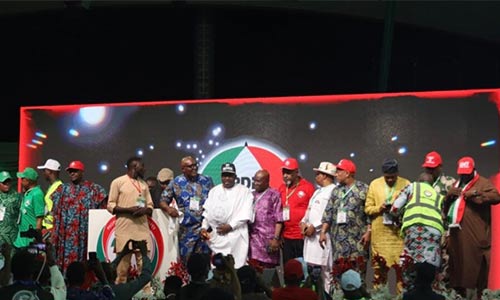
A faction of the Peoples Democratic Party backed by Nyesom Wike, Minister of the Federal Capital Territory, has re-elected Abdulrahman Mohammed and Samuel Anyanwu as National Chairman and National Secretary respectively at a national convention held at the velodrome of the Moshood Abiola National Stadium in Abuja.

Mohammed, Anyanwu and other members of the National Working Committee were re-elected through consensus on Sunday, with about 2,500 delegates endorsing the 19-member NWC and other national officers.
However, the rival faction led by Kabiru Turaki boycotted the exercise, describing it as unconstitutional, and has approached the Supreme Court to challenge its removal — signalling that the struggle for control of party structures is far from over.
The national officers were re-elected after Natasha Akpoti-Uduaghan, Senator representing Kogi Central, moved a motion to dissolve the National Caretaker Committee.
House Minority Leader Kingsley Chinda moved the motion for affirmation of the officers, which was seconded by Usman Adamu.
The affirmed officers include:
- Abdulrahman Mohammed — National Chairman
- Senator Samuel Anyanwu — National Secretary
- Aaron Chukwuemeka — Deputy National Chairman (South)
- Yusufu Nya Akirikwen (SAN) — Deputy National Chairman (North)
- Kolawale Olabisi — Deputy National Secretary
- Odeyemi Mackson Oladiran — National Treasurer
- Lado Dan Marke — Deputy National Treasurer
- Eyim Donatus Henry
- Dr. Grema Kyari
- Umar Mohammed Bature
- Efere Augustine
- Jungudo Haruna Mohammed
- Egwu Goodluck Chidiebere
- Kamaldeen Ajibade (SAN)
- Barr. Aloysius Chinemelu U. Uba
- Osuoha Okechukwu Donatus
- Dr. Adaba Yatu
- Ibrahim Bala Aboki
- Momoh Dejih Eugene Bashir
- Professor Ogunshe Adedayo — National Women Leader
- Hauwa Ahmed Shinge — Deputy National Women Leader
Speaking at the convention, Sule Lamido, former Governor of Jigawa State, appealed to aggrieved members to return to the party.
“We are willing to forgive everyone. Come back, stay focused, and return to the PDP,” he said.
Former Senate President Bukola Saraki declared that the PDP remains vibrant and resilient.
“The PDP is alive, active, and here to stay. It is deeply rooted in this country and firmly in the minds of Nigerians,” he said.
Minority Leader in the House of Representatives, Kingsley Chinda, urged members to unite to reclaim power in 2027.
“We need to recover the power that we have lost. We must come together to recover our country. Every member has a responsibility,” he said.
Senate Minority Leader Abba Moro said members who rejected peace efforts have abandoned the party.
“Those who insisted there would be no peace in the PDP have all negotiated their way out of the party. We now have only two governors,” he said.
He commended Wike for remaining committed to the party.
“Wike has remained steadfast in the PDP. He must be commended,” Moro said.
In his remarks, Wike urged members to commit to rebuilding the party, adding that leadership requires responsibility and dedication.
Wike, who expressed confidence that the party would field candidates in the 2027 elections, said the PDP would reclaim its mandate from those who defected to other parties.
The rival faction led by Kabiru Turaki boycotted the convention, describing it as unconstitutional.
Ini Ememobong, spokesperson for the Turaki faction, told Premium Times that his bloc would not attend.
“Absolutely no. We won’t be present at the convention because it’s an accumulation of events. When you look at the basis on which the convention has been established, it doesn’t align with the constitution of our party, so we won’t be attending,” he said.
However, Ememobong expressed optimism that reconciliation discussions would be fruitful.
“But we’re still hopeful that the reconciliation discussion will go ahead,” he stated.
On Friday, the Turaki-led faction had asked the Supreme Court to restrain the Wike camp from holding the national convention.
The convention, organised by the faction chaired by Abdulrahman Mohammed and backed by Wike, anchors its legitimacy on a judicial pronouncement.
The Court of Appeal had earlier this month invalidated the Turaki-led NWC, which emerged in November 2025 at a convention in Ibadan, Oyo State. The court also asked the Independent National Electoral Commission not to recognise it.
In principle, the removal of Turaki’s executive created a vacuum, necessitating a new convention to elect fresh leaders in line with the Electoral Act 2026.
Political parties are not governed solely by legal frameworks. Their stability depends largely on consensus among critical stakeholders, including governors, members of the Board of Trustees, the National Working Committee, and influential power blocs.
That consensus is clearly lacking. Of the party’s remaining governors — Seyi Makinde of Oyo State and Bala Mohammed of Bauchi State — neither is aligned with the faction organising the convention.
Yet Wike insisted the exercise would proceed, regardless of whether reconciliation was achieved.
A few hours before the convention, there was little evidence of meaningful engagement between the rival camps, despite repeated calls by party leaders.
A few weeks ago, former Senate President Bukola Saraki urged both sides to suspend litigation and prioritise internal reconciliation, warning that prolonged court battles could undermine preparations for the 2027 elections.
That advice appears to have gone unheeded.
Wike’s influence is strongest among former governors and segments of state party structures. As FCT Minister serving in the APC administration, he also commands significant financial and organisational resources — an advantage in mobilising delegates and executing the convention.
He retains influence within parts of the NWC and party bureaucracy, but not across all organs. Crucially, he lacks the backing of the party’s remaining governors, limiting his claim to broad legitimacy.
The Turaki faction, meanwhile, holds a different kind of leverage.
By approaching the Supreme Court, it can seek to invalidate or suspend the convention’s outcome. It is also positioning the exercise as procedurally flawed and exclusionary — an argument that could weaken its acceptance within the party and before INEC.
More importantly, prolonged litigation creates uncertainty, potentially stalling key processes such as candidate nominations.
Two scenarios are likely to emerge from the convention.
In the best-case scenario, it might produce a leadership that is sufficiently inclusive to bridge existing divisions. That outcome would require compromise, back-channel negotiations, and a willingness among rival blocs to prioritise party cohesion over factional advantage.
The more likely outcome, however, is escalation.
If the Turaki faction rejects the outcome and sustains its legal challenge, the PDP — which once boasted of ruling Nigeria for at least 60 years — could slide into parallel conventions, competing leadership structures, and entrenched distrust.
Such fragmentation would push the party into a deeper institutional crisis, one that could even jeopardise its ability to validly nominate candidates for the 2027 elections.
The 28-year-old PDP has been here before.
During the 2013 PDP split, a faction of governors and party leaders broke away from the national convention to form the “New PDP” (nPDP), creating a dual centre of power.
The official leadership under Bamanga Tukur faced a breakaway bloc led by Abubakar Baraje, with key figures including Aminu Tambuwal, Rabiu Kwankwaso, Aliyu Wamakko, Murtala Nyako, and Abdulfatah Ahmed — some of whom were governors.
The fallout weakened the PDP significantly. Many members later defected to the APC, contributing to the party’s historic loss in the 2015 presidential election.
The lesson from this history is clear: conventions can resolve disputes, but they can also trigger deeper fragmentation.
The stakes extend far beyond internal party politics.
As Nigeria’s main opposition platform and a former ruling party, the PDP’s ability to present a credible alternative to the ruling party depends on its internal cohesion.
Failure to reconcile could weaken its electoral competitiveness, erode public confidence, and create space for rival parties or emerging coalitions to occupy the opposition vacuum.
In this sense, the Abuja convention is not merely about leadership selection. It is a test of the party’s survival as a viable national force.
While the exercise may satisfy legal requirements, its true success will be determined politically.
Without broad-based acceptance, the convention risks marking not the resolution of the PDP crisis, but its escalation — transforming internal disagreements into a full-blown struggle for the party’s soul.
 _______________________________________________________________________
[A MUST HAVE] Evidence Act Demystified With Recent And Contemporary Cases And Materials

Available now for NGN 40,000 at ASC Publications, 10, Boyle Street, Onikan, Lagos. Beside High Court, TBS. Email publications@ayindesanni.com or WhatsApp +2347056667384. Purchase Link: https://paystack.com/buy/evidence-act-complete-annotation
______________________________________________________________________ ARTIFICIAL INTELLIGENCE FOR LAWYERS: A COMPREHENSIVE GUIDE
Reimagine your practice with the power of AI “...this is the only Nigerian book I know of on the topic.” — Ohio Books Ltd
Authored by Ben Ijeoma Adigwe, Esq., ACIArb (UK), LL.M, Dip. in Artificial Intelligence, Director, Delta State Ministry of Justice, Asaba, Nigeria.
Bonus:
Get a FREE eBook titled “How to Use the AI in Legalpedia and Law Pavilion” with every purchase.
ARTIFICIAL INTELLIGENCE FOR LAWYERS: A COMPREHENSIVE GUIDE
Reimagine your practice with the power of AI “...this is the only Nigerian book I know of on the topic.” — Ohio Books Ltd
Authored by Ben Ijeoma Adigwe, Esq., ACIArb (UK), LL.M, Dip. in Artificial Intelligence, Director, Delta State Ministry of Justice, Asaba, Nigeria.
Bonus:
Get a FREE eBook titled “How to Use the AI in Legalpedia and Law Pavilion” with every purchase.
How to Order: 📞 Call, Text, or WhatsApp: 08034917063 | 07055285878 📧 Email: benadigwe1@gmail.com 🌐 Website: www.benadigwe.com
Ebook Version: Access directly online at: https://selar.com/prv626
______________________________________________________________________ “Bridging Theory And Courtroom Practice” — Hagler Sunny Okorie, Nathaniel Ngozi Ikeocha Unveil ‘Functional’ Tort Law Book For Nigerian Legal System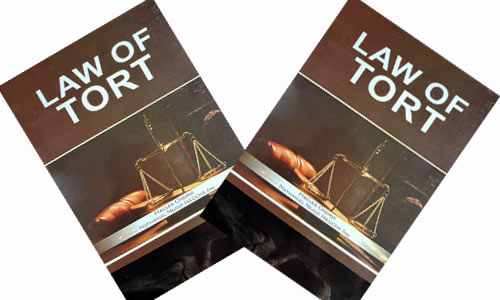 The book, titled The Law of Torts in Nigeria: A Functional Approach, authored by Professor Hagler Sunny Okorie Ph.D and Ikeocha, Nathaniel Ngozi Esq, offers law students, practitioners, and academics a comprehensive guide to understanding and applying tort law in Nigerian courts. Interested buyers can place orders via the following contact numbers: 08028636615, 08037667945, 08032253813, or +234 902 196 2209.