
A United States federal jury in Brooklyn, New York, has convicted Chinese telecommunications giant Huawei Technologies and three of its subsidiaries on 10 of 12 criminal counts involving trade secrets theft, bank fraud, sanctions violations and other offences, prompting strong condemnation from Beijing and a pledge by the company to challenge the verdict.

The verdict was returned on Tuesday, November 24, 2026, following an approximately three-month trial before the United States District Court for the Eastern District of New York.
The jury found one or more of Huawei Technologies and its subsidiaries, Huawei Device Co. Ltd., Futurewei Technologies Inc. and Huawei Device USA Inc., guilty on each of the 10 counts, including conspiracy to steal trade secrets, bank fraud, wire fraud, money laundering conspiracy and offences connected with violations of United States sanctions against Iran.
However, the jury acquitted the defendants of two other charges involving racketeering conspiracy and obstruction of justice.
The conviction marks a significant development in a criminal prosecution arising from allegations that Huawei concealed its business dealings in Iran, misled financial institutions and unlawfully obtained proprietary technological information belonging to American companies.
According to the United States Department of Justice, Huawei and its subsidiaries engaged in conduct designed to secure access to the American financial system while concealing the nature of their commercial activities in countries subject to United States sanctions.
The prosecution alleged that Huawei repeatedly misrepresented its business relationship with Iran, including its dealings through a company known as Skycom, to financial institutions and American authorities.
The Department of Justice maintained that the alleged misrepresentations enabled Huawei to obtain billions of dollars and access United States dollar-clearing services despite restrictions associated with its activities in Iran.
“Huawei repeatedly lied about the nature of its business in Iran, falsely telling banks, journalists, and the US government that it did not assist Iran’s government, military, or intelligence community,” the department stated.
Prosecutors also alleged that Huawei supplied surveillance equipment, including cameras, which Iranian authorities used to monitor protests.
The allegations concerning Huawei’s international business dealings extended to activities involving North Korea, which were also raised in connection with the bank fraud accusations.
Beyond the sanctions-related allegations, the prosecution accused Huawei of engaging in a coordinated effort to obtain confidential technology and intellectual property belonging to competing American telecommunications companies.
According to the prosecution, Huawei sought to recruit employees of rival firms and obtain proprietary information that could assist it in developing products similar to those manufactured by its competitors.
The companies identified in the proceedings as affected by the alleged misconduct included T-Mobile, Cisco and other United States telecommunications businesses.
The Department of Justice said the allegedly misappropriated intellectual property included source codes, technical manuals, internet router technology, antenna technology and robotic testing systems.
Prosecutors further alleged that Huawei operated an internal programme offering financial incentives to employees who obtained commercially valuable information from competitors.
The prosecution maintained that the alleged conduct allowed the company to develop competing telecommunications products while avoiding some of the research and development costs ordinarily associated with technological innovation.
Reacting to the jury’s verdict, United States Attorney General Todd Blanche described the convictions as an affirmation that multinational corporations remain subject to American criminal laws.
“No person or company is above the law,” Blanche declared.
He accused Huawei and three of its subsidiaries of conducting business in the United States through dishonest practices and unlawful acquisition of intellectual property.
“For decades, Huawei and three of its subsidiaries conducted their business in the United States on the basis of lies and theft,” he stated.
Assistant Attorney General A. Tysen Duva also welcomed the verdict, describing it as a demonstration of the United States Government’s determination to protect American businesses, workers and national security interests.
“Today’s verdict sends an unmistakable message: America will defend its businesses, protect its workers, and safeguard its national security against corrupt foreign corporations that lie, cheat, and steal to get ahead,” Duva said.
Despite the convictions, Huawei rejected the jury’s findings, insisting that the verdict was not supported by the applicable law or evidence presented during the proceedings.
In a statement issued on Wednesday, November 25, the company described the decision as “without legal or factual merit.”
Huawei disclosed that it would examine the verdict and pursue available legal measures to protect its interests.
“We will thoroughly review the relevant verdicts and take all necessary legal actions to defend our rights and interests,” the company stated.
The telecommunications manufacturer also welcomed its acquittal on the racketeering conspiracy and obstruction of justice charges, maintaining that the jury’s rejection of those allegations supported its longstanding position.
According to Huawei, the acquittals confirmed that the allegations lacked a factual basis.
The company nevertheless faces convictions on the remaining 10 criminal counts, with the proceedings yet to reach the sentencing stage.
The criminal case has a history dating back to investigations and indictments brought against Huawei between 2018 and 2019.
In February 2020, American prosecutors expanded the case through a superseding indictment that included racketeering conspiracy allegations.
The proceedings also followed the arrest of Huawei’s former Chief Financial Officer, Meng Wanzhou, in Canada in 2018 at the request of United States authorities.
Meng subsequently entered into a deferred prosecution agreement in 2021, during which she acknowledged making misleading statements to HSBC concerning Huawei’s relationship with Skycom.
The criminal charges against her were later dismissed by a United States federal judge in December 2022.
During Huawei’s trial, prosecutors presented her earlier admissions as part of the evidence supporting the government’s case.
The trial lasted approximately 11 weeks, with the jury reportedly deliberating for about four days before returning its verdict.
While the convictions expose Huawei and the affected subsidiaries to potential criminal penalties, including financial sanctions available under United States law, no sentencing date or specific penalty had been announced in the information available as of November 25.
The company may also pursue post-trial applications and appellate remedies in challenging the jury’s verdict.
Meanwhile, the Chinese Government strongly criticised the conviction, accusing Washington of using legal and regulatory measures to suppress Chinese businesses.
Responding on Wednesday, Beijing said it opposed what it described as American efforts to contain the commercial activities of Chinese enterprises.
China said it “firmly opposes the US suppressing and containing Chinese enterprises and firmly supports Chinese enterprises in safeguarding their legitimate rights and interests.”
The reaction highlights continuing tensions between the world’s two largest economies over technology, trade restrictions and national security concerns.
The United States has for years raised allegations that Huawei’s telecommunications infrastructure could be used to facilitate espionage on behalf of the Chinese Government.
Washington had previously urged other countries to exclude Huawei equipment from the development of fifth-generation mobile telecommunications networks over national security concerns.
Huawei has consistently rejected allegations that it poses such a security threat.
The latest verdict comes at a politically sensitive period in relations between Washington and Beijing, particularly following a meeting between United States President Donald Trump and Chinese leaders in Shenzhen the previous week.
Trump had described the relationship between the two countries as “fantastic” following the meeting, although the conviction and China’s subsequent response have brought renewed attention to their differences over technology and international trade.
[A MUST HAVE] Evidence Act Demystified With Recent And Contemporary Cases And Materials
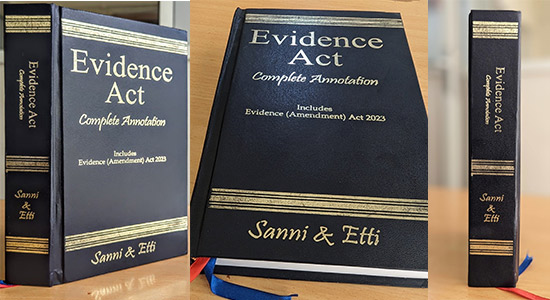
Available now for NGN 40,000 at ASC Publications, 10, Boyle Street, Onikan, Lagos. Beside High Court, TBS. Email publications@ayindesanni.com or WhatsApp +2347056667384. Purchase Link: https://paystack.com/buy/evidence-act-complete-annotation
______________________________________________________________________ “Enhance Legal Practice With Authoritative Reports” — Alexander Payne Offers Comprehensive Law Reports, Spanning Over A Century Of Nigerian Jurisprudence Interested buyers are encouraged to place their orders and enquiries via:
0704 444 4777, 0704 444 4999, 0818 199 9888
Website: www.alexandernigeria.com
“A Comprehensive Guide To Evidence Law” — Releases Second Edition In Three Volumes, Covering 4,051 Cases
For enquiries and orders, contact: 08035526491 Email: jerryamadisilk@gmail.com
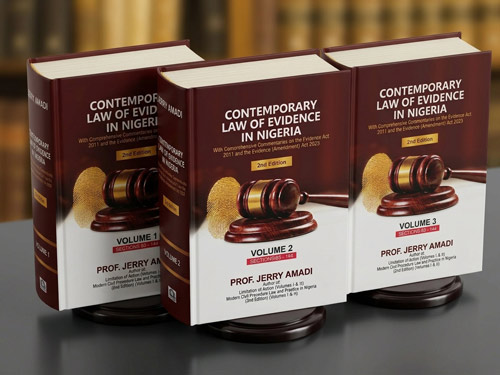 Prof. Jerry Amadi’s Evidence Law, Second Edition (2026), contains 3,314 pages in three volumes, covering the Evidence Act 2011, its 2023 amendment, and 4,051 Nigerian and English cases.