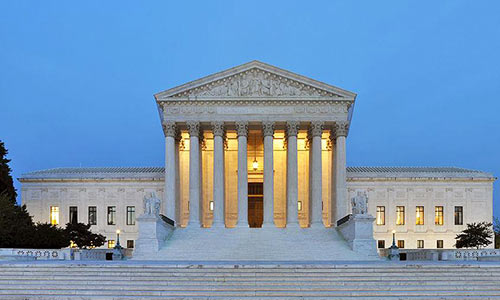
A U.S. Supreme Court spokesperson said Friday the justices are feeling healthy and embracing measures to minimize personal interaction.

The U.S. Supreme Court’s private conference, where the justices meet to discuss pending cases, occurred Friday in a new world, where personal interaction—”judicial” handshakes included—is avoided.
The justices met Friday—some remotely, by telephone—for their private conference in which they comb through petitions and other matters. But this time, the justices had decided to suspend, temporarily, their traditional handshakes with each other.
A court spokesperson said the justices are feeling healthy and embracing measures to minimize personal interaction.
March’s argument session, including the dispute over President Donald Trump’s financial records, has been postponed indefinitely. Still, the court is expected to continue to release orders in pending cases and opinions. New rulings in argued cases could come early next week.
Federal and state authorities have advised against handshakes, as one measure to help stop the spread of the novel coronavirus. More than 15,000 people in the United States have contracted the virus. As a New York Times headline put it recently: “The Handshake Is on Hold.”
The “Judicial Handshake” at the Supreme Court has been a tradition since the days of Chief Justice Melville W. Fuller in the late 19th century, according to the court. When the justices assemble to go on the bench each day and at the beginning of the private conferences, each justice shakes hands with each of the other eight. Fuller instituted the practice as a reminder that differences of opinion on the court did not preclude overall harmony of purpose.
The justices’ handshakes also became a popular math problem for school students: How many handshakes will result if nine Supreme Court justices each shake hands with each other?
“36 of them to be exact,” Justice Ruth Bader Ginsburg once remarked.
“As we enter the robing room or the adjacent conference room, we shake hands, each justice with every other,” Ginsburg said in 2009. “Every day the court hears arguments, and every day we meet to discuss cases, we lunch together in the justices’ dining room. The room is elegant, but the lunch is not haute cuisine. It comes from the court’s public cafeteria, the same fare available to anyone who visits the court.”
And then there was Justice Sandra day O’Connor’s “secret” handshake following her first conference meeting. As Evan Thomas, author of “First”, recounts: “On her first day, O’Connor grasped the meat-hook hand of Justice Byron ‘Whizzer’ White, who had led the National Football League in rushing for the Detroit Lions. ‘It was like I had put my hand in a vise,’ recalled O’Connor. ‘He just kept the pressure on and tears squirted from my eyes.’ After that, O’Connor made sure to shake White’s thumb.”
The handshake has long been a routine part of the proceedings in the U.S. Court of Appeals for the Fourth Circuit, where the judges, after argument, leave the bench and greet the advocates who’d just made their cases. “The Fourth Circuit is one that values still its traditions, its civility, its continuity, and its commitment to equal justice under law,” the court says.
The Richmond, Virginia-based appeals court recently postponed a week’s worth of arguments amid the widening pandemic.
Other trial and appellate courts are adjusting to a new normal, as scheduled proceedings are heard by telephone instead of in person. The D.C. Circuit’s first go-around with telephonic arguments Friday was a “mess.”
Culled from Law
 Interested buyers are encouraged to place their orders and enquiries via:
0704 444 4777, 0704 444 4999, 0818 199 9888
Website: www.alexandernigeria.com
Interested buyers are encouraged to place their orders and enquiries via:
0704 444 4777, 0704 444 4999, 0818 199 9888
Website: www.alexandernigeria.com
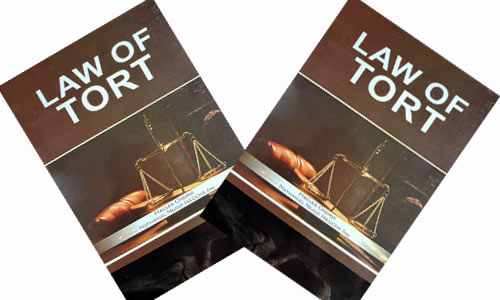 The book, titled The Law of Torts in Nigeria: A Functional Approach, authored by Professor Hagler Sunny Okorie Ph.D and Ikeocha, Nathaniel Ngozi Esq, offers law students, practitioners, and academics a comprehensive guide to understanding and applying tort law in Nigerian courts. Interested buyers can place orders via the following contact numbers: 08028636615, 08037667945, 08032253813, or +234 902 196 2209.
_______________________________________________________________________
The book, titled The Law of Torts in Nigeria: A Functional Approach, authored by Professor Hagler Sunny Okorie Ph.D and Ikeocha, Nathaniel Ngozi Esq, offers law students, practitioners, and academics a comprehensive guide to understanding and applying tort law in Nigerian courts. Interested buyers can place orders via the following contact numbers: 08028636615, 08037667945, 08032253813, or +234 902 196 2209.
_______________________________________________________________________
 ARTIFICIAL INTELLIGENCE FOR LAWYERS: A COMPREHENSIVE GUIDE
Reimagine your practice with the power of AI “...this is the only Nigerian book I know of on the topic.” — Ohio Books Ltd
Authored by Ben Ijeoma Adigwe, Esq., ACIArb (UK), LL.M, Dip. in Artificial Intelligence, Director, Delta State Ministry of Justice, Asaba, Nigeria.
Bonus:
Get a FREE eBook titled “How to Use the AI in Legalpedia and Law Pavilion” with every purchase.
ARTIFICIAL INTELLIGENCE FOR LAWYERS: A COMPREHENSIVE GUIDE
Reimagine your practice with the power of AI “...this is the only Nigerian book I know of on the topic.” — Ohio Books Ltd
Authored by Ben Ijeoma Adigwe, Esq., ACIArb (UK), LL.M, Dip. in Artificial Intelligence, Director, Delta State Ministry of Justice, Asaba, Nigeria.
Bonus:
Get a FREE eBook titled “How to Use the AI in Legalpedia and Law Pavilion” with every purchase.
How to Order: 📞 Call, Text, or WhatsApp: 08034917063 | 07055285878 📧 Email: benadigwe1@gmail.com 🌐 Website: www.benadigwe.com
Ebook Version: Access directly online at: https://selar.com/prv626
________________________________________________________________________ [A MUST HAVE] Evidence Act Demystified With Recent And Contemporary Cases And Materials