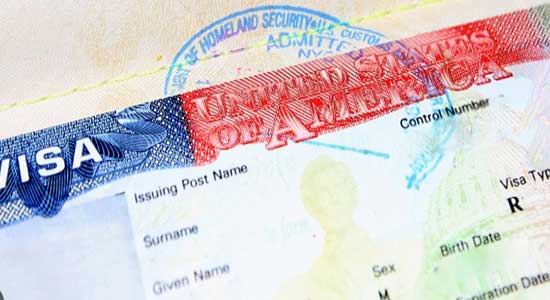
The United States has introduced a new pilot programme requiring certain immigrant visa applicants to post bonds of up to $250,000 before they can be granted immigrant visas.

The new policy applies immediately to some immigrant visa applicants from the Dominican Republic who had been found ineligible on “public charge” grounds, meaning officials considered them likely to become dependent on government-funded welfare programmes.
US officials said the programme could later be expanded to other countries.
The policy was announced in a report by the Washington Free Beacon and shared by the US Department of State on Wednesday.
“Immigrating to the United States is a privilege, not a right. Those who seek to obtain that privilege must be capable of demonstrating that they will be a benefit—rather than a burden—to our nation,” the State Department said while sharing the report.
According to the report, consular officers will have discretion to determine the bond amount on a case-by-case basis after considering the applicant’s particular circumstances.
It added that some of the cases being processed this week involve bonds ranging from $100,000 to $250,000.
A State Department official said the programme was being implemented under a long-standing legal authority in the Immigration and Nationality Act, allowing certain applicants who are otherwise ineligible because they are likely to become a public charge to post a bond as proof that they have access to funds to support themselves.
“As part of this comprehensive initiative, the Department is implementing a long-standing legal authority under the Immigration and Nationality Act to require certain visa applicants—those who are otherwise ineligible for a visa because they are likely to become a public charge—to post a bond as a way to tangibly demonstrate they have access to the funds needed to support themselves,” the official was quoted as saying.
The State Department said the bonds are intended to protect American public benefits programmes from financial pressure arising from foreigners who may arrive with major medical expenses or other needs.
Defending the policy, the department said the Trump administration was restoring what it described as the basic expectation that immigrants should contribute more to the United States than they take from it.
“The Trump Administration is restoring the basic expectation that those who immigrate to the United States should contribute to our society more than they take from it. Under Secretary Rubio’s leadership, the Department of State is putting that principle into action,” the official said.
US officials said the programme will give applicants previously denied visas on public charge grounds an opportunity to prove that they can financially support themselves.
The bond may be cancelled after five years if the immigrant does not receive public cash assistance for income maintenance or long-term government-funded institutional care during that period.
The State Department said the Dominican Republic was selected for the pilot phase because of the “scope and scale” of immigrant visa operations at the US Embassy in Santo Domingo.
According to the department, the bond offers will be presented to certain immigrant visa applicants who had earlier been found ineligible on public charge grounds, while US Citizenship and Immigration Services will determine when a bond can be cancelled or whether its terms have been breached.
The announcement comes days after the United States made permanent a separate visa bond programme requiring certain non-immigrant visa applicants from 50 countries, including Nigeria, to pay refundable bonds of up to $20,000 before obtaining some categories of B1/B2 business and tourist visas.
Under that separate programme, travellers who comply with the conditions of their visas and leave the United States within the authorised period are entitled to a refund, while those who violate immigration rules risk forfeiting the bond.
The permanent non-immigrant visa bond scheme followed a 2025 pilot programme, which initially imposed visa bonds of up to $15,000 on selected applicants as part of efforts to discourage visa overstays.
[A MUST HAVE] Evidence Act Demystified With Recent And Contemporary Cases And Materials

Available now for NGN 40,000 at ASC Publications, 10, Boyle Street, Onikan, Lagos. Beside High Court, TBS. Email publications@ayindesanni.com or WhatsApp +2347056667384. Purchase Link: https://paystack.com/buy/evidence-act-complete-annotation
______________________________________________________________________ “Enhance Legal Practice With Authoritative Reports” — Alexander Payne Offers Comprehensive Law Reports, Spanning Over A Century Of Nigerian Jurisprudence Interested buyers are encouraged to place their orders and enquiries via:
0704 444 4777, 0704 444 4999, 0818 199 9888
Website: www.alexandernigeria.com
Interested buyers are encouraged to place their orders and enquiries via:
0704 444 4777, 0704 444 4999, 0818 199 9888
Website: www.alexandernigeria.com