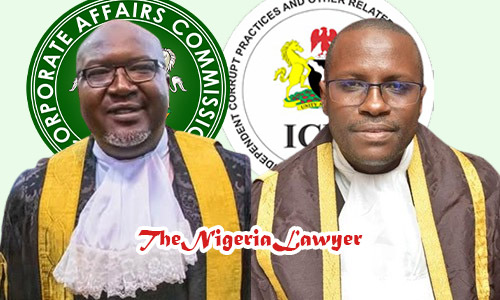
TheNigeriaLawyer Editorial

In Nigeria’s protracted struggle against corruption and bureaucratic paralysis, two institutions occupy positions of singular importance: the Independent Corrupt Practices and Other Related Offences Commission (ICPC) and the Corporate Affairs Commission (CAC). Both are led by Senior Advocates of Nigeria (SANs) the most distinguished rank in the Nigerian legal profession—and are therefore expected to exemplify professionalism, fidelity to the rule of law, and an unwavering commitment to public service.
Recent events, however, tell a starkly different story. The conduct of Dr. Musa Adamu Aliyu, SAN, Chairman of the ICPC, and Hussaini Ishaq Magaji, SAN, Registrar-General of the CAC, reveals a troubling chasm between their mandates and their actions. This editorial argues that their stewardship not only erodes public confidence in the institutions they lead but also brings dishonour upon the legal profession they represent. We begin with the ICPC’s handling of the detention of former Kaduna State Governor Nasir El-Rufai, before turning to the CAC’s operational failures.
- The ICPC’s Unlawful Detention of El-Rufai: A Betrayal of Due Process
The ICPC, under Dr. Musa Adamu Aliyu, SAN sworn in as Chairman on 27 November 2023 has come under sharp and sustained criticism for its handling of the investigation and detention of Nasir El-Rufai. Having invited the former governor for questioning towards the end of last year, the agency conspicuously failed to conduct a thorough preliminary investigation beforehand. This is not merely a procedural lapse; it offends a basic tenet of investigative protocol and a requirement implicit in the Commission’s establishing statute, the Corrupt Practices and Other Related Offences Act 2000, which mandates the investigation of allegations before the preferring of charges.
Instead of building a case through diligent inquiry, the ICPC resorted to arrest and prolonged detention without charges, exceeding the constitutional limits on pre-arraignment detention. Section 35(4)–(5) of the 1999 Constitution (as amended) guarantees that a suspect must be brought before a court within 24 to 48 hours of arrest, extendable only by a court order in prescribed circumstances. These safeguards are reinforced by sections 293–299 of the Administration of Criminal Justice Act (ACJA) 2015, which regulate remand proceedings and require prompt arraignment. Yet the ICPC flouted these provisions with impunity.
The agency’s conduct culminated in a classic case of forum shopping: on 19 February 2026, it obtained a 14-day remand warrant from a Bwari Magistrate Court to justify holding El-Rufai for over two weeks without presenting him before a court of competent jurisdiction for trial and without disclosing the evidence against him. This manoeuvre raises the gravest questions about the agency’s respect for constitutional due process.
The Misuse of Remand Proceedings
A particularly troubling dimension of this affair is the apparent misuse of remand proceedings. Under sections 293–296 of the ACJA, remand is an exceptional mechanism designed to hold a suspect pending the completion of an investigation and the filing of a proper charge. It is not, and was never intended to be, a licence for investigative agencies to warehouse suspects while they “go and look for evidence.” Recent decisions of the Supreme Court of Nigeria have condemned precisely this abuse of the remand process as a backdoor violation of the right to liberty and fair hearing. The ICPC’s conduct in El-Rufai’s case falls squarely within this condemned pattern.
As of 6 March 2026, El-Rufai remained in custody under dubious legal grounds, prompting him to file a ₦15.6 billion suit against the ICPC for unlawful detention, defamation, and abuse of office. The agency’s actions reek of impunity: why detain a suspect without prior investigation, only to retroactively secure a remand warrant to legitimise the fait accompli? This course of conduct violates not only the spirit of sections 7 and 8 of the ACJA which require investigation before arrest and prohibit arrest for civil wrongs but also offends section 34 (the right to dignity of the human person) and section 35 (the right to personal liberty) of the Constitution. It further runs afoul of the emerging jurisprudence of the Supreme Court on arbitrary and proxy detentions.
If a former governor of a state can be treated in this manner, what recourse exists for the ordinary Nigerian citizen who lacks the resources and the public platform to challenge such overreach?
Hypocrisy at the Highest Level
Compounding the irony, Dr. Aliyu himself has been a vocal advocate for expedited justice. At a meeting on 4 March 2026 with the National Judicial Council (NJC), convened as part of the Corruption and Financial Crimes Cases Trial Monitoring Committee (COTRIMCO), the ICPC Chairman called for “time-bound” corruption trials akin to election petition timelines, citing models from Kenya and Zambia. He urged the adoption of mechanisms for consistent prosecution standards and speedier adjudication. Yet, under his watch, the very agency he leads drags its feet on evidence-gathering while prolonging pre-trial detention—a stark hypocrisy that teaches young lawyers the worst possible lessons about ethical practice and the limits of prosecutorial and investigative power.
The Silence of the Gatekeepers
The silence from key stakeholders has been deafening. The Attorney-General of the Federation (AGF), who has publicly championed the principle of “investigate before arrest,” has issued no rebuke, despite his constitutional role as the chief law officer of the Federation under section 150 of the Constitution and his oversight responsibility for federal prosecutorial agencies. The Nigerian Bar Association (NBA) and leading human rights organisations, usually vocal on matters of fundamental rights, have remained conspicuously mute.
Some have cynically dismissed El-Rufai’s predicament as “payback” for his own heavy-handed tactics as governor a dismissal that amounts to a dangerous capitulation to the politics of vengeance. This eye-for-an-eye mentality is the hallmark of a democratic order in retreat. In 2026, with no meaningful institutional improvement, such reasoning regresses our democracy to its infancy, prioritising political scores over legal principle. A democracy that tolerates the abuse of one citizen’s rights because of who that citizen is will soon find that no one’s rights are safe. Nigeria’s hope for fair justice dims with every such act of institutional indifference.
Dr. Aliyu’s conduct raises a legitimate question of professional misconduct under the Rules of Professional Conduct for Legal Practitioners 2023, which demand that a lawyer and, a fortiori, a SAN must not aid or participate in conduct that subverts the course of justice or violates constitutional rights. Does a SAN who presides over the systematic violation of the very principles he publicly champions deserve the distinction of that rank?
- The CAC’s AI Portal Fiasco: A Monument to Incompetence
Turning to the Corporate Affairs Commission, Registrar-General Hussaini Ishaq Magaji, SAN conferred the rank of Senior Advocate in 2021 and appointed to his current position in October 2023 arrived with promises of transformative reform. Heralded as a “reformer at the helm,” he pledged to build upon his predecessor’s digital initiatives and modernise the Commission’s operations. Instead, his tenure has amplified the CAC’s systemic deficiencies, most glaringly through the botched rollout of an AI-driven portal intended to streamline business registrations.
More than five months since the portal’s full deployment, it has drawn a relentless stream of complaints from lawyers, businesses, and members of the public. Users report persistent glitches in TIN generation, missing company details from the public registry, payment processing failures, and an almost entirely unresponsive support infrastructure. These are not mere inconveniences. Under the Companies and Allied Matters Act (CAMA) 2020, the CAC is under a statutory duty to maintain a reliable, up-to-date register of companies and to provide access to that information to the public, investors, regulators, and courts. When the portal cannot retrieve basic company data or process routine filings, it constitutes a breach of statutory duty that undermines legal certainty and jeopardises commercial transactions across the nation.
Scale of the Failure
Reports indicate that the CAC’s support channels handle approximately 5,000 inquiries daily via email and call centres, yet meaningful resolutions remain scarce. The National Assembly has voiced its frustrations, echoing the broader discontent of the professional and business communities. Magaji’s response has been dismissive at best: characterising the failures as “teething problems” and offering vague promises of expanded payment options and a website relaunch none of which have materialised in any effective form. This is not innovation; it is incompetence dressed in the language of reform.
A competent rollout of a system of this scale and consequence demands phased implementation, dedicated post-deployment support including on-site developers to address emerging issues in real time and rigorous pre-testing. This is not merely the view of industry observers; it is consistent with the duty of public bodies to act reasonably, fairly, and in the public interest, principles long recognised by Nigerian courts in judicial review and administrative law proceedings.
Questions of Procurement Integrity
Information technology professionals familiar with government digitalisation projects have offered a more troubling diagnosis. According to several industry experts, a recurring reason for the failure of such initiatives in Nigeria is the award of contracts to incompetent firms, the appointment of personnel without adequate IT expertise to oversee critical systems, or most perniciously the extraction of kickbacks during the procurement process, which leaves the contracted firm with insufficient funds to deliver a functional product or provide post-deployment support.
If these suspicions are substantiated in the case of the CAC’s portal, they raise potential violations of procurement law and may even constitute offences under the Corrupt Practices and Other Related Offences Act. Meanwhile, the system fails to recall even basic registered data, crippling the ease of doing business in Nigeria and frustrating compliance with the statutory timelines for filings under CAMA. The Senate’s recent rejection of the CAC’s 2026 budget proposal coupled with its demand for detailed financial disclosures underscores the growing legislative scrutiny and hints at the possibility of sanctions or structural reorganisation should the Commission continue to fail in its obligations.
As a Senior Advocate of Nigeria, Magaji was expected to elevate the CAC, not compound its failures. His portal which professionals have aptly described as a “show of shame” betrays the trust of lawyers, businesses, and ordinary Nigerians who depend on it, transforming what was meant to be a tool for progress into a barrier to commerce and exposing clients and practitioners to regulatory penalties and transactional risks entirely beyond their control.
III. Conclusion: The Imperative of Accountability and Reform
The actions and inactions of Dr. Aliyu and Mr. Magaji, both Senior Advocates of Nigeria entrusted with the stewardship of critical national institutions, illuminate a broader malaise in our public life: the weaponisation of law for political ends and the neglect of public service in favour of self-serving optics. While preaching swift justice and technological innovation, they deliver detention without due process and a glitch-ridden system without remedies. This hypocrisy not only disappoints; it actively endangers Nigeria’s democratic fabric and constitutes, in varying degrees, violations of constitutional guarantees, statutory mandates, and the ethical obligations of the legal profession.
The Nigerian Bar Association, the Attorney-General of the Federation, and civil society organisations must break their silence and demand thorough investigations and far-reaching reforms. El-Rufai’s case, now adjourned to 23 April 2026 for arraignment, stands as a test of our collective commitment to the rule of law particularly whether the courts will insist on strict compliance with constitutional safeguards, the ACJA’s remand procedures, and the principled limits of investigative detention.
At the CAC, a comprehensive systems audit, an independent procurement review, and if the facts warrant it a leadership overhaul are long overdue in order to restore compliance with CAMA 2020 and Nigeria’s ease-of-doing-business commitments.
Nigeria deserves institutions that serve, not institutions that shame. Until those entrusted with the public’s trust are held accountable for betraying it, our progress will remain stalled and our democracy, imperilled.
 Reimagine your practice with the power of AI “...this is the only Nigerian book I know of on the topic.” — Ohio Books Ltd
Authored by Ben Ijeoma Adigwe, Esq., ACIArb (UK), LL.M, Dip. in Artificial Intelligence, Director, Delta State Ministry of Justice, Asaba, Nigeria.
Bonus:
Get a FREE eBook titled “How to Use the AI in Legalpedia and Law Pavilion” with every purchase.
Reimagine your practice with the power of AI “...this is the only Nigerian book I know of on the topic.” — Ohio Books Ltd
Authored by Ben Ijeoma Adigwe, Esq., ACIArb (UK), LL.M, Dip. in Artificial Intelligence, Director, Delta State Ministry of Justice, Asaba, Nigeria.
Bonus:
Get a FREE eBook titled “How to Use the AI in Legalpedia and Law Pavilion” with every purchase.
How to Order: 📞 Call, Text, or WhatsApp: 08034917063 | 07055285878 📧 Email: benadigwe1@gmail.com 🌐 Website: www.benadigwe.com
Ebook Version: Access directly online at: https://selar.com/prv626
_______________________________________________________________________ [A MUST HAVE] Evidence Act Demystified With Recent And Contemporary Cases And Materials
 ______________________________________________________________________
“Bridging Theory And Courtroom Practice” — Hagler Sunny Okorie, Nathaniel Ngozi Ikeocha Unveil ‘Functional’ Tort Law Book For Nigerian Legal System
______________________________________________________________________
“Bridging Theory And Courtroom Practice” — Hagler Sunny Okorie, Nathaniel Ngozi Ikeocha Unveil ‘Functional’ Tort Law Book For Nigerian Legal System
 The book, titled The Law of Torts in Nigeria: A Functional Approach, authored by Professor Hagler Sunny Okorie Ph.D and Ikeocha, Nathaniel Ngozi Esq, offers law students, practitioners, and academics a comprehensive guide to understanding and applying tort law in Nigerian courts. Interested buyers can place orders via the following contact numbers: 08028636615, 08037667945, 08032253813, or +234 902 196 2209.