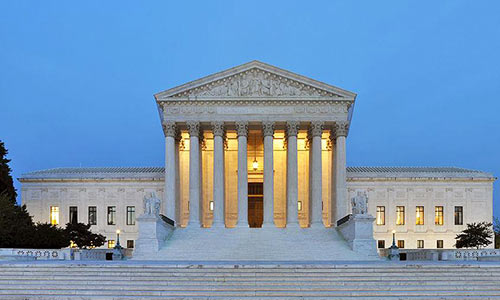
The Supreme Court has strengthened the Trump administration’s ability to deport people seeking asylum without allowing them to make their case to a federal judge

The Supreme Court on Thursday strengthened the Trump administration’s ability to deport people seeking asylum without allowing them to make their case to a federal judge.
Immigration experts suggested the administration would use sweeping language in the majority opinion to bolster broader efforts to restrict asylum.
The court’s 7-2 ruling applies to people who are picked up at or near the border and who fail their initial asylum screenings, making them eligible for quick deportation, or expedited removal.
Justice Samuel Alito wrote the high-court opinion that reversed a lower-court ruling that said asylum-seekers must have access to the federal courts.
Congress acted properly in creating a system “for weeding out patently meritless claims and expeditiously removing the aliens making such claims from the country,” Alito wrote.
He noted that more than three-quarters of people who sought to claim asylum in the past five years passed their initial screening and qualified for full-blown review.
Justices Ruth Bader Ginsburg and Stephen Breyer agreed with the outcome in this case, but did not join Alito’s opinion.
In dissent, Justice Sonia Sotomayor wrote, “Today’s decision handcuffs the Judiciary’s ability to perform its constitutional duty to safeguard individual liberty.” She was joined by Justice Elena Kagan.
Lee Gelernt, the American Civil Liberties Union lawyer who argued the case in the Supreme Court, said the outcome will make it hard to question the actions of immigration officials at the U.S. border. “This decision will impact potentially tens of thousands of people at the border who will not be able to seek review of erroneous denials of asylum,” Gelernt said.
In practical terms, the impact may be limited. Even after the ruling from federal appeals court in San Francisco that the justices threw out Thursday, only about 30 asylum-seekers whose claims were quickly rejected had sought access to the courts, Gelernt told the justices during arguments in February.
But Cornell University law professor Stephen Yale-Loehr, an immigration expert, said the decision lends support to broader administration action on asylum.
“Justice Alito used sweeping language in his majority opinion upholding Congress’s efforts to limit due process for arriving immigrants. While not necessary to the precise holding in the case, the Trump administration is sure to use such language to justify its broader efforts to restrict asylum seekers,” Yale-Loehr said.
The administration has made dismantling the asylum system a centerpiece of its immigration agenda, saying it is rife with abuse and overwhelmed by meritless claims. Changes include making asylum-seekers wait in Mexico while their cases wind through U.S. immigration court, denying asylum to anyone on the Mexican border who passes through another country without first seeking protection there, and flying Hondurans and El Salvadorans to Guatemala with an opportunity to seek asylum there instead of the U.S.
On Monday, the Trump administration published sweeping new procedural and substantive rules that would make it much more difficult to get asylum, triggering a 30-day period for public comment before they can take effect.
The United States became the world’s top destination for asylum-seekers in 2017, according to UN figures, many of them Mexican and Central American families fleeing endemic violence.
The justices ruled in the case of Vijayakumar Thuraissigiam, who said he fled persecution as a member of Sri Lanka’s Tamil minority, but failed to persuade immigration officials that he faced harm if he returned to Sri Lanka. The man was arrested soon after he slipped across the U.S. border from Mexico.
He was placed in expedited removal proceedings that prohibit people who fail initial interviews from asking federal courts for much help.
Since 2004, immigration officials have targeted for quick deportation undocumented immigrants who are picked up within 100 miles of the U.S. border and within 14 days of entering the country. The Trump administration is seeking to expand that authority so that people detained anywhere in the U.S. and up to two years after they got here could be quickly deported.
On Tuesday, a federal appeals court threw out a trial judge’s ruling that had blocked the expanded policy. Other legal issues remain to be resolved in the case.
Associated Press
[A MUST HAVE] Evidence Act Demystified With Recent And Contemporary Cases And Materials

Available now for NGN 40,000 at ASC Publications, 10, Boyle Street, Onikan, Lagos. Beside High Court, TBS. Email publications@ayindesanni.com or WhatsApp +2347056667384. Purchase Link: https://paystack.com/buy/evidence-act-complete-annotation
______________________________________________________________________ “Enhance Legal Practice With Authoritative Reports” — Alexander Payne Offers Comprehensive Law Reports, Spanning Over A Century Of Nigerian Jurisprudence Interested buyers are encouraged to place their orders and enquiries via:
0704 444 4777, 0704 444 4999, 0818 199 9888
Website: www.alexandernigeria.com
Interested buyers are encouraged to place their orders and enquiries via:
0704 444 4777, 0704 444 4999, 0818 199 9888
Website: www.alexandernigeria.com