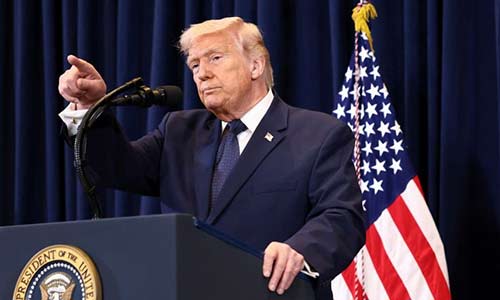
United States President Donald Trump has signed a proclamation designating the Oval Office and adjoining rooms in the White House as a national monument, in a move aimed at preventing future presidents from substantially altering or demolishing the historic spaces without undergoing a formal review process.

Trump signed the proclamation on Thursday, November 5, 2026, two days after the Republican Party suffered major defeats in the United States midterm elections, which saw Democrats secure control of Congress.
The proclamation, titled “Establishment of the Oval Office National Monument,” designates the Oval Office, the Outer Oval Office and the Cabinet Room as protected historic spaces under the Antiquities Act.
Speaking during the signing ceremony at the White House, Trump said the designation was intended to preserve the architectural character and historical importance of the Oval Office.
“We’ve had tremendous victory in this office,” Trump said.
He added that the room would be designated a national monument to prevent its destruction or substantial alteration by future occupants of the White House.
Trump explained that the Oval Office was not merely a presidential workplace but a symbol of the United States and its presidency.
The proclamation specifically covers the Oval Office, identified as Room 110; the Outer Oval Office, comprising Rooms 106 and 108; and the Cabinet Room, identified as Room 105.
According to the official document published by the White House, the designation was made pursuant to Section 320301 of Title 54 of the United States Code, commonly known as the Antiquities Act.
The law empowers the president to designate certain historic landmarks, structures and other objects of historical or scientific interest located on federal land as national monuments.
Trump’s proclamation acknowledges that the White House and its grounds are already recognised as a National Historic Landmark but maintains that the Oval Office deserves specific recognition because of its unique historical and architectural importance.
Under the directive, the Secretary of the Interior, acting through the National Park Service, is required to manage the designated spaces in a manner that protects their historic character, architectural integrity and association with the presidency.
The Secretary is also directed to develop a management plan in consultation with the White House Office of Administration and other relevant government bodies.
The plan must prioritise the preservation of the monument’s structural and important architectural features.
The proclamation further requires documentation, review and consideration of alternatives before any action that would substantially alter or demolish the protected spaces or their essential architectural elements.
It also directs that proposed changes affecting the monument’s historic character be evaluated for consistency with its national importance.
However, the proclamation does not impose an absolute prohibition on future presidents making changes to the Oval Office.
It expressly preserves the president’s authority to redecorate the rooms, select furnishings and undertake ordinary operational or security modifications that do not substantially impair their historic structure or architectural character.
Trump nevertheless suggested during the signing ceremony that major changes to the Oval Office would require congressional approval.
He said any future proposal to fundamentally change the room’s distinctive oval shape should be subjected to congressional consideration.
Although Trump expressed that position publicly, the proclamation itself does not expressly require congressional approval for every major alteration.
Instead, it establishes preservation and review procedures while recognising Congress’s existing constitutional and statutory authority over federal property.
The proclamation also states that it does not alter existing statutory exemptions applicable to the White House under the National Historic Preservation Act.
Legal questions remain about whether the designation could permanently prevent a future administration from making substantial changes, as national monument proclamations can become the subject of subsequent presidential action and legal disputes.
Trump himself has previously taken steps to reverse or modify national monument protections established by earlier administrations.
The new designation comes amid controversy surrounding the president’s extensive renovation and construction projects at the White House.
Since returning to office in January 2025, Trump has made several decorative changes to the Oval Office, including installing gold accents, decorative wall features and additional portraits.
He has also overseen changes to the Cabinet Room, including the installation of chandeliers.
Beyond the Oval Office, his administration demolished the White House East Wing to make way for a new ballroom, a project that has attracted criticism and legal challenges over preservation requirements and the scope of presidential authority.
The ballroom project has remained a prominent focus of Trump’s public activities.
On Wednesday, November 4, the president invited reporters to observe construction progress and the raising of the project’s final structural beam.
The following day, he turned his attention to protecting the Oval Office and Cabinet Room through the national monument designation.
The development came against the backdrop of Republican losses in the November 3 midterm elections, which are expected to increase congressional scrutiny of the administration’s activities.
The Oval Office has served as the principal working office of the United States president in its present location and form since the administration of President Franklin D. Roosevelt.
Its distinctive oval design originated during the presidency of William Howard Taft and was subsequently refined in the early 1930s.
Over the decades, the office has hosted major presidential decisions, meetings with foreign leaders and events central to American political history.
The White House proclamation describes the room as possessing an exceptional combination of historical associations, architectural features and national importance.
While the designation introduces additional preservation requirements, future presidents will retain the ability to redecorate the office and make permissible modifications.
The proclamation therefore represents an attempt to strengthen protections against substantial structural changes rather than an absolute legal prohibition on future alterations to the Oval Office.
[A MUST HAVE] Evidence Act Demystified With Recent And Contemporary Cases And Materials

Available now for NGN 40,000 at ASC Publications, 10, Boyle Street, Onikan, Lagos. Beside High Court, TBS. Email publications@ayindesanni.com or WhatsApp +2347056667384. Purchase Link: https://paystack.com/buy/evidence-act-complete-annotation
______________________________________________________________________ “Enhance Legal Practice With Authoritative Reports” — Alexander Payne Offers Comprehensive Law Reports, Spanning Over A Century Of Nigerian Jurisprudence Interested buyers are encouraged to place their orders and enquiries via:
0704 444 4777, 0704 444 4999, 0818 199 9888
Website: www.alexandernigeria.com