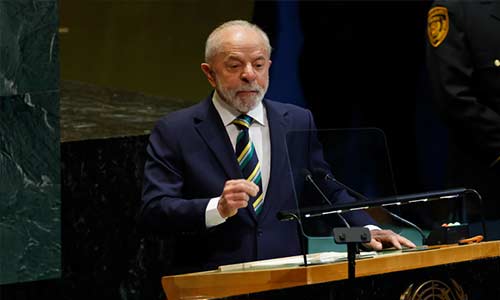
Brazilian President Luiz Inácio Lula da Silva has criticised United States President Donald Trump’s approach to international relations, saying the American leader was elected to govern the United States and has no right to impose his will on other sovereign countries.

Lula made the remarks in an exclusive interview with CNN’s Christiane Amanpour ahead of the high-level meetings of the 81st United Nations General Assembly in New York, where tensions over trade, sovereignty, Venezuela and alleged foreign interference in elections featured prominently in his comments. CNN’s transcript confirms that Lula said Brazil was not seeking confrontation with Washington but wanted its sovereignty and independent interests respected.
“President Trump was elected to be the US president. He has the right to govern the US, but he doesn’t have the right to govern other countries,” Lula said.
He added that Trump did not have the right to impose his will on other nations and should instead be willing to negotiate.
According to Lula, Brazil was not attempting to challenge the United States or create another global power bloc against Washington. Rather, he said the principle at stake was that every country should be free to protect its sovereignty and pursue its interests.
“We don’t want to challenge the U.S.; we just want to say that every country has their own sovereignty,” Lula said, adding that the United States should not impose its rules on other countries.
The Brazilian leader characterised Trump’s governing approach as one that places considerable emphasis on American economic, military and technological strength, a style Lula said he disagreed with.
He argued instead for negotiation, mutual respect and stronger multilateral institutions, maintaining that international relations should not operate solely on the basis of which country possesses the greatest economic or military power.
A major part of the disagreement between Washington and Brasília has centred on trade.
On July 15, 2026, the Office of the United States Trade Representative imposed an additional 25 per cent tariff on certain Brazilian goods following a Section 301 investigation that began a year earlier.
The USTR said its investigation found certain Brazilian policies and practices concerning digital trade and electronic payment services, preferential tariffs, anti-corruption enforcement, intellectual property protection, ethanol market access and illegal deforestation to be unreasonable and burdensome to United States commerce.
Lula rejected the justification for the tariffs, describing them during the CNN interview as being “based on lies.”
He said Brazil had responded not by depending exclusively on the American market but by expanding commercial relationships with other countries.
According to figures cited by Lula during the interview, Brazilian exports to the United States had declined by nine per cent following the tariff measures, while imports from the United States had fallen by 8.5 per cent.
He said trade increased by 20 per cent with China, 18 per cent with Japan, 16 per cent with Germany, eight per cent with Indonesia, 14 per cent with Vietnam and 23 per cent with the European Union. CNN’s transcript records the Germany figure as 16 per cent, rather than the 60 per cent carried in some secondary reports.
Lula said his response was to find alternative trading partners rather than simply complain about reduced commerce with the United States.
He nevertheless stressed that Brazil remained in negotiations with Washington and that he was not seeking a tariff war.
“I don’t want to go to a tariff war with the U.S. and neither with any other country,” he said.
Lula said Brazil had a reciprocity law available should negotiations ultimately fail, but explained that he preferred not to activate retaliatory measures while discussions with Trump’s administration remained underway.
According to him, negotiations between the two countries had reopened following a telephone conversation with Trump about a month and a half earlier. He said Brazil would consider reciprocal measures only if the talks failed to produce an agreement.
The Brazilian president also raised concerns about possible foreign interference in Brazil’s elections, although he expressly acknowledged that he had no concrete evidence that the United States was interfering.
Lula said there were what he termed “clues” that prompted concern, including activity involving artificial intelligence, and referred to United States Secretary of State Marco Rubio’s relationship with the family of former Brazilian President Jair Bolsonaro.
However, he qualified the allegation, stating that it remained a suspicion and that “there’s nothing concrete.”
He said he had directly told Trump that the United States should not interfere in Brazil’s domestic electoral process.
According to Lula, Trump had told others that he would not interfere in the Brazilian elections, a commitment the Brazilian president said he welcomed.
Lula argued that Brazilian elections should be determined by Brazilian voters in the same way that elections in the United States are the responsibility of the American people.
Brazil is heading into an October election, and Lula also used his UN address this week to warn publicly against foreign interference and disinformation in the electoral process.
Lula said he had also presented Trump with four documents during discussions between them, including a proposal concerning cooperation against organised crime, drug trafficking and arms trafficking. He said Brazil was prepared to cooperate internationally on those issues without surrendering its sovereignty.
The Brazilian leader extended his criticism of United States foreign policy to Venezuela, where Washington’s role has expanded dramatically since the capture of former President Nicolás Maduro earlier this year.
United States forces captured Maduro during a military operation in January 2026 and transported him to the United States to face criminal charges. Trump subsequently said Washington would temporarily “run” Venezuela until what he described as a safe and orderly transition could take place.
Maduro’s former vice-president, Delcy Rodríguez, was formally sworn in as Venezuela’s interim president on January 5 following his removal. She has since led the Venezuelan administration while engaging extensively with Washington on energy, financial and political issues.
Lula told CNN that developments since Maduro’s removal had created the impression that the United States was effectively governing Venezuela.
He said documents and agreements emerging from the relationship between Washington and Caracas appeared, in his assessment, to present the United States as the dominant authority.
“The U.S. conveys the idea that they’re governing Venezuela,” Lula said, arguing that such a situation was harmful to Venezuela, the United States and democratic governance.
Lula said Venezuela should be allowed to determine its political future through elections.
He suggested that if he were in Rodríguez’s position, he would call a national election so Venezuelans could decide who should govern the country.
“If I was Delcy, the president, I would call for election, national elections so that people could choose who is going to be the next president of the country,” Lula said.
His remarks come as the Trump administration continues to deepen its involvement in Venezuela.
Trump highlighted the capture of Maduro in his UN General Assembly address this week as part of his administration’s broader security strategy in the Western Hemisphere, while Venezuela under Rodríguez has been negotiating with United States officials and companies on oil, mining, debt restructuring and other economic issues.
Lula’s broader position during the CNN interview was that cooperation between countries should be based on negotiation rather than unilateral pressure.
He said Brazil did not consider itself anti-American and wanted commercial and diplomatic partnerships with American companies as well as businesses from China, France, Germany and other countries.
However, he maintained that such partnerships should not come at the expense of Brazil’s sovereignty.
The interview therefore brought together three major areas of disagreement between Lula and the Trump administration: Washington’s tariff policy towards Brazilian goods, concerns surrounding sovereignty and possible foreign influence in Brazil’s elections, and the scale of United States involvement in post-Maduro Venezuela.
[A MUST HAVE] Evidence Act Demystified With Recent And Contemporary Cases And Materials

Available now for NGN 40,000 at ASC Publications, 10, Boyle Street, Onikan, Lagos. Beside High Court, TBS. Email publications@ayindesanni.com or WhatsApp +2347056667384. Purchase Link: https://paystack.com/buy/evidence-act-complete-annotation
______________________________________________________________________ “Enhance Legal Practice With Authoritative Reports” — Alexander Payne Offers Comprehensive Law Reports, Spanning Over A Century Of Nigerian Jurisprudence Interested buyers are encouraged to place their orders and enquiries via:
0704 444 4777, 0704 444 4999, 0818 199 9888
Website: www.alexandernigeria.com
Interested buyers are encouraged to place their orders and enquiries via:
0704 444 4777, 0704 444 4999, 0818 199 9888
Website: www.alexandernigeria.com