*Faults Coalition’s Takeover, Urges Settlement With Nafiu Bala To Save 2027 Candidacies

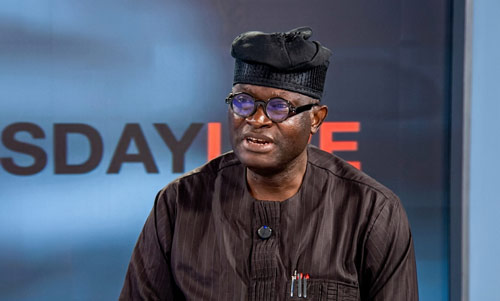
Human rights lawyer and Principal Counsel of Jiti Ogunye Chambers, Jiti Ogunye, has described the emergence of the David Mark-led leadership of the African Democratic Congress (ADC) as a hostile takeover, arguing that the coalition knew the implications of assuming control of a political party already facing questions over its internal constitutional processes.
Ogunye, however, warned that excluding the ADC and its candidates from the 2027 general elections following the Federal High Court judgment nullifying the party’s leadership would undermine the credibility of the electoral process and cast doubt on the legitimacy of the eventual outcome.
Speaking on Arise News’ Sunday programme, This Day Live, the lawyer urged the party and Nafiu Bala Gombe, who obtained the judgment against the David Mark-led leadership, to explore a post-judgment resolution that would preserve the party’s participation in the elections.
His comments followed the judgment of Justice Peter Lifu of the Federal High Court in Abuja, which nullified the David Mark-led national leadership of the ADC and invalidated decisions taken under it, including the presidential primary that produced former Vice-President Atiku Abubakar as the party’s candidate.
Atiku has vowed to remain in the 2027 presidential race, while the ADC has taken the dispute to the Court of Appeal.
Reacting to the controversy, Ogunye maintained that the coalition could not claim to have been completely unaware of the risks associated with the manner in which it assumed control of the party.
“ADC knew what it was doing,” he said.
“ADC didn’t go to inspire a merger. ADC engaged in a hostile takeover of a political party, a political party that was not even abiding by its internal processes.”
He referred to an argument that the party’s former national chairman had remained in office for more than 20 years, allegedly contrary to the provisions of the party’s constitution.
According to Ogunye, the coalition should have conducted adequate due diligence before proceeding with the arrangement.
“If they didn’t do their due diligence and matters have come to a head like this, I think that they should follow through with the process and see how the matter can be resolved,” he stated.
The lawyer also examined the conflicting decisions of two judges of the Federal High Court concerning the ADC leadership dispute.
He noted that Justice Musa Liman had, in a case instituted by Leke Abejide, ruled that the matter concerned the internal affairs of a political party and was not justiciable.
The decision, delivered on July 2, differed from the subsequent judgment of Justice Lifu, which invalidated the emergence of the Mark-led executive and decisions taken under its leadership.
Ogunye explained that although both cases arose from substantially similar facts, they were instituted by different parties, with their reliefs framed differently.
He expressed concern that the cases were allowed to proceed separately despite their similarities.
“One thing to note is that in spite of the fact that the cases were similar, there was no attempt in either case to consolidate,” he said.
“While the lawyers to the ADC were filing their slate of papers, objections, interrogatories, they didn’t make any attempt to consolidate this with this so that we’ll have the same decision. So those two cases were running parallel, pari passu.”
He recalled that Gombe’s case was initially before Justice Emeka Nwite before proceeding through the appellate courts to the Supreme Court.
According to him, the Supreme Court directed that the substantive dispute be heard on its merits, after which the matter returned to the Federal High Court and was reassigned to Justice Lifu.
Addressing the legal controversy, Ogunye explained that Nigerian judicial decisions had historically reflected different approaches to disputes involving the internal affairs of political parties.
He cited decisions in Onuoha v. Okafor, Amaechi v. INEC and Ararume v. INEC while explaining the circumstances in which courts could intervene in party disputes.
“There’s been this jurisprudential ambivalence over time, to the extent that the courts have serially decided that in matters within the domestic domain of a political party, the court should not intervene. It is not justiciable. The courts have also intervened where statutory provisions have been violated in the primaries or where parties do not follow the provisions of their constitution, affecting legal rights and constitutional rights,” he explained.
“If you ask me, the two cases that have been decided are a representation of those two poles,” Ogunye added.
On whether Justice Lifu should have proceeded with the case despite Justice Liman’s earlier ruling, Ogunye said the issue required a careful examination of the arguments presented before the trial court.
He maintained that it would be premature to conclude that Justice Lifu was wrong to proceed merely because another judge had previously determined a related dispute.
“The question is whether that issue of jurisdiction was raised in Justice Lifu’s court, and did Justice Lifu rule on it? A court can be aware that another court has decided a point, but it will still behoove the judge to raise it, because a judge can even raise an issue suo motu,” he stated.
He further noted that the Supreme Court had specifically directed that the case be heard on its merits.
“The Supreme Court rather said, ‘Go back and try it on the merit,’” he said.
Ogunye also addressed allegations of judicial bias arising from petitions filed against Justice Lifu and concerns over the reassignment of the case.
He acknowledged challenges facing the judiciary, including corruption, but cautioned against drawing conclusions about judicial decisions based solely on public sentiment.
“When a decision of a court drops like this, we shouldn’t argue what the crowd is saying. We should not argue public sentiment. We should argue facts, procedure and decisions,” he said.
He questioned whether the petitions against Justice Lifu had resulted in any decision preventing the judge from continuing with the proceedings.
Ogunye maintained that criticism of the judgment should be grounded in legal arguments, evidence and applicable procedures rather than assumptions about institutional collusion.
Turning to the consequences of the judgment, the lawyer warned that the decision could have far-reaching implications for the ADC if it remained undisturbed on appeal.
According to him, the orders granted by the court meant that decisions taken by the David Mark-led leadership, including party primaries, meetings and congresses, had been invalidated.
He cautioned that the consequences could extend beyond Atiku’s presidential candidacy to other candidates seeking elective offices on the party’s platform.
Ogunye argued that removing a major political party from the ballot shortly before an election would be damaging to the democratic process.
“The question is whether that should happen,” he said, explaining that such an outcome would mean that a major political party was being deprived of the opportunity to participate in an election.
He warned that any victory secured in such circumstances could be questioned because the affected political opponent had been eliminated through a legal technicality rather than defeated at the polls.
“Any victory that is secured, if they ever secure a victory, will be attributed to the technical knockout that has been given to the adversary, and so it will cast a doubt on the legitimacy of that election,” Ogunye stated.
The lawyer recalled historical disputes in Nigerian elections, including controversies surrounding Dr. Nnamdi Azikiwe’s tax documentation in 1979 and legal action involving M.K.O. Abiola during the 1993 presidential election.
He said political parties had historically attempted to eliminate opponents through technical legal objections rather than concentrating on defeating them through electoral competition.
Ogunye consequently called for a political settlement that would allow the ADC and its candidates to participate in the 2027 elections.
He suggested that the party could engage Gombe, who secured the judgment, in discussions aimed at resolving the dispute and protecting the wider electoral process.
“They can do that within their party. They can call Bala [Gombe], who got the judgment, and say that, ‘Look, this thing is going to cause a lot of reverberation,’” he stated.
He stressed that although the ADC had the constitutional right to challenge the judgment on appeal, the party should also consider other lawful avenues for resolving the dispute.
Ogunye also condemned threats attributed to some party members that the country would be thrown into crisis if the ADC was excluded from the elections.
“Nobody should burn down the country,” he warned.
He urged the ADC, the ruling All Progressives Congress (APC) and other political parties to embrace the principles of peaceful political engagement.
According to him, the peace process should go beyond merely signing agreements against violence and should include genuine efforts to preserve electoral participation.
He maintained that resolving the controversy was not only in the interest of the ADC but also in the interest of the ruling party and the credibility of Nigeria’s democratic system.
“I’m seriously suggesting that there should be a discussion that will lead to having ADC and its candidates on the ballot so that we can have a free and fair election,” Ogunye said.
He rejected the suggestion that calls for violence or confrontational political statements could resolve the legal difficulties confronting the party.
“That’s not what I’m trying to suggest here. I’m serious, because megalomaniac bombast of ‘we’ll burn down the country’ and all that will not resolve the legal conundrum that has been drawn up,” he stated.
Ogunye concluded by reiterating that the implications of the judgment extended beyond Atiku and the presidency to all candidates nominated under the affected party leadership.
“It is not in the interest of the electoral process, or our democratic process, for a major political party to be knocked off the ballot. People are focusing on former Vice President Atiku, their candidate, but everybody down the ballot will go,” he said.
[A MUST HAVE] Evidence Act Demystified With Recent And Contemporary Cases And Materials

Available now for NGN 40,000 at ASC Publications, 10, Boyle Street, Onikan, Lagos. Beside High Court, TBS. Email publications@ayindesanni.com or WhatsApp +2347056667384. Purchase Link: https://paystack.com/buy/evidence-act-complete-annotation
______________________________________________________________________ “Enhance Legal Practice With Authoritative Reports” — Alexander Payne Offers Comprehensive Law Reports, Spanning Over A Century Of Nigerian Jurisprudence Interested buyers are encouraged to place their orders and enquiries via:
0704 444 4777, 0704 444 4999, 0818 199 9888
Website: www.alexandernigeria.com