By Simon Tabji, Associate at J-K Gadzama LLP.

Introduction
In property law transactions in Nigeria, since the 1989 decision of the Supreme Court in Savanah Bank v Ajilo,¹ it had been impossible for private persons to lawfully transfer or alienate their interests in land without interference by the State, in that such private persons had to first obtain the consent of the relevant State Governor before they could completely alienate their interests in land.
This position in property transactions witnessed a significant shift, following the 2017 decision of the Supreme Court of Nigeria in Engr. Yakubu Ibrahim & Ors v Simon Obaje,² where the Court held that private persons must not acquire Governor’s consent before they can lawfully transfer or alienate their interests in land, as long as there is no conflict between the parties, and in the absence of an overriding public interest.
The concept of Governor’s consent under the Land Use Act
Aside from the 1999 Constitution of the Federal Republic of Nigeria, the 1978 Land Use Act is the most relevant enactment that regulates the use of land in Nigeria. The Act with its much importance, was born out of the need to preserve lands in Nigeria for the good, enjoyment and purposeful use by all Nigerians and by the Government of Nigeria. The Act was also inspired by the need to provide for simplified methods of land administration and to preserve the Nigeria land tenure system. In achieving its objectives, the Act vests in the Governor of the State, all lands in the territory of the State.
In order to give effect to the relevant State Governor’s power over land within the territory of the State, the Act confers power on the Governor of each State to grant statutory right of occupancy; and, where individuals are desirous of transferring their interest in land, they must first obtain the consent of the relevant State Governor before they can lawfully do so.
What used to be the practice – Savanah Bank v. Ajilo
The case of Savanah Bank v Ajilo is significant in that it presented the Supreme Court the first opportunity to interpret section 22 of the Land Use Act. The major issue faced by the Court had been whether a person who was vested with propriety right or interest in land before the commencement of the Act, therefore deemed to be holder of right of occupancy,³ needed to obtain the State Governor’s consent before he could alienate his interest to another person. The Court resolved that the holders of such interests in land, before the commencement of the Act, must obtain the consent of the relevant Governor of the State before any alienation of their interest. The decision then became a landmark precedent in property law transactions in Nigeria and was applied in many other judgments of the Courts in Nigeria.
Paradigm shift – Yakubu v. Simon Obaje
In Yakubu v Simon Obaje, the Supreme Court was presented with yet another opportunity to determine whether an individual can actually alienate his interest in land without the consent of the relevant State Governor.
The facts leading up to the case were that the Respondent who was plaintiff at the trial Court, sought inter-alia: a declaration of title to land covered by customary right of occupancy, based on the claim that he obtained title vide a power of attorney executed between the Respondent and the original title holder of the certificate of occupancy. The Appellant, who was the original Defendant, submitted in his defence that the power of attorney relied upon by the Plaintiff was unlawful and therefore could not transfer a valid title. Specifically, he contended that the power of attorney was not consented to by the Honourable Minister of the Federal Capital Territory (analogous to the State Governor for the purpose of the Land Use Act), whose approval was requisite for a valid alienation of interest under the Act.
The Supreme Court, in resolving the issue, held, per C.B Ogunbiyi, JSC, who delivered the leading judgment as follows:
…I agree with the Respondent’s Counsel that it is not the intendment of the legislature that section 22 of the Land Use Act, on consent would limit and deny parties of their rights to use and enjoy land and the fruits thereto in a non-contentious transaction or alienation. The section cannot be given a literal interpretation as would be seen from the preamble… Following from the foregoing restatement, it is clear that the essence of the Act is to preserve and protect the rights of Nigerians to enjoy and use land, and further enjoy the fruits from the land. Citizens should be allowed to transact on their properties without unnecessary and undue interference by the State. By the phrase the enjoyment of the land and the fruits thereof should be given a simple and ordinary interpretation. In other words, the fruits of the land can be houses, installations in minerals and plants. I agree with the respondent’s counsel that it is not the intendment of the legislature that Section 22 of the Land Use Act, on consent would limit and deny parties of their rights to use and enjoy land and the fruits thereto in a non-contentious transaction or alienation. The Section cannot be given a literal interpretation as would be seen from the preamble. Section 22(1) of the Land Use Act provides that: – “It shall be unlawful for a holder of a right of Occupancy to alienate same or any part thereof by assignment, mortgage, transfer of possession, sublease or otherwise without the consent of the Governor first had and obtained.” The preambles to the Land Use Act, if looked at carefully and relating it to the case at hand, would reveal that the provision for consent of the Governor must not be applied to transfer of title or alienation of rights between private individuals where there is no overriding public interest or conflict between the parties.” (underlined are mine for emphasis)
Conclusion
The Supreme Court has, through its decision in Yakubu & Ors v Simon, played its role as a policy Court by using the law as an instrument of social change, to ease the difficulty faced in property law transactions in Nigeria. It goes without saying that the huge number of financial resources and Government bureaucratic processes which sometimes cause avoidable delays in property transaction in Nigeria, can significantly be reduced by the application of this decision.
END NOTES ¹ (1989) 1 NWLR (Pt 97) 305. ² (2017) LPELLR-43749 (SC). ³ Land Use Act 1978, s 34. ⁴ UBN Plc v Ayodere & Sons Ltd (2007) 13 NWLR (Pt 1159).

 ARTIFICIAL INTELLIGENCE FOR LAWYERS: A COMPREHENSIVE GUIDE
Reimagine your practice with the power of AI “...this is the only Nigerian book I know of on the topic.” — Ohio Books Ltd
Authored by Ben Ijeoma Adigwe, Esq., ACIArb (UK), LL.M, Dip. in Artificial Intelligence, Director, Delta State Ministry of Justice, Asaba, Nigeria.
Bonus:
Get a FREE eBook titled “How to Use the AI in Legalpedia and Law Pavilion” with every purchase.
ARTIFICIAL INTELLIGENCE FOR LAWYERS: A COMPREHENSIVE GUIDE
Reimagine your practice with the power of AI “...this is the only Nigerian book I know of on the topic.” — Ohio Books Ltd
Authored by Ben Ijeoma Adigwe, Esq., ACIArb (UK), LL.M, Dip. in Artificial Intelligence, Director, Delta State Ministry of Justice, Asaba, Nigeria.
Bonus:
Get a FREE eBook titled “How to Use the AI in Legalpedia and Law Pavilion” with every purchase.
How to Order: 📞 Call, Text, or WhatsApp: 08034917063 | 07055285878 📧 Email: benadigwe1@gmail.com 🌐 Website: www.benadigwe.com
Ebook Version: Access directly online at: https://selar.com/prv626
________________________________________________________________________ The Law And Practice Of Redundancy In Nigeria: A Practitioner’s Guide, Authored By A Labour & Employment Law Expert Bimbo Atilola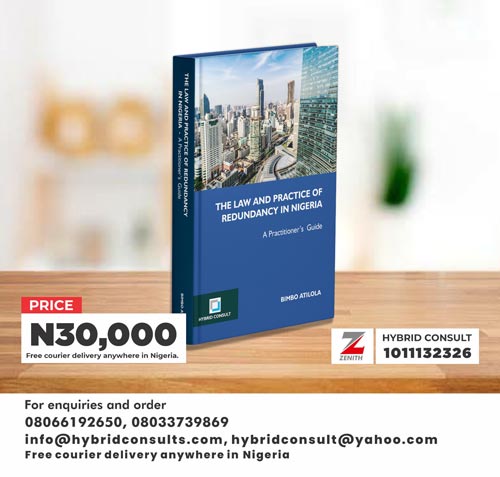 _______________________________________________________________________
"You Don't Need To Be Rich, You Just Need To Start" — Victoria Ezeigwe, Esq Launches Investment Handbook For Nigerians Starting With ₦5,000
_______________________________________________________________________
"You Don't Need To Be Rich, You Just Need To Start" — Victoria Ezeigwe, Esq Launches Investment Handbook For Nigerians Starting With ₦5,000

Get your copy today and take the first step toward financial growth:👉 https://selar.co/4f16676016
_______________________________________________________________________