By Oliver Azi

An erroneous belief that has permeated the Nigerian socio-legal space is that women CANNOT stand as surety or offer bail for anyone in the custody of the police or the court. Sadly, this seemingly authoritative position is founded on Lord Denning’s dictum in the notorious case of UAC v McFOY where he said that: “you cannot place something upon nothing and expect it to stand”. In simple words, it has no legal backing under Nigerian law.
First, the 1999 constitution of the Federal Republic of Nigeria (as amended), the Nigeria Police Act 2020, and the Administration of Criminal Justice Act (ACJA) 2015 are predominantly the laws that deal with criminal liability—bail and surety inclusive—crown at any form of gender discrimination.
Although the 1999 constitution is silent on the specific issue of a woman standing as surety, the provision of section 42 serves as the background that prohibits gender discrimination or any form of social class discrimination. Section 42 (1) states that:
“A citizen of Nigeria of a particular community, ethnic group, place of origin, sex, religion or political opinion shall not, by reason only that he is such a person:
“(a) be subjected either expressly by, or in the practical application of, any law in force in Nigeria or any executive or administrative action of the government, to disabilities or restrictions to which citizens of Nigeria of other communities, ethnic groups, places of origin, sex, religious or political opinions are not made subject.”
“(b) be accorded either expressly by, or in the practical application of, any law in force in Nigeria or any such executive or administrative action, any privilege or advantage that is not accorded to citizens of Based on communities, ethnic groups, places of origin, sex, religious or political opinions.”
Remembering the fact that the Constitution is Supreme and it has been stated that any law that is inconsistent with the Constitution shall be declared null and void. This is why other laws on the subject matter follow suit. The position in the Police Act, of 2020 accentuates this. Section 135 of the Nigeria Police Act 2020 states that:
“The police force or other persons shall not, in the performance of his or its functions under this act, regulations or standing orders made under to this act, discriminate against any person on the basis of gender as provided under section 42 of the constitution of the Federal Republic of Nigeria, 1999.”
In the same vein, section 167 of the Administration of Criminal Justice Act 2015 succinctly establishes the position on surety when it states that surety should not be denied on the “ground only that the person is a woman”. For clarity of that provision, it is trumpeted thus:
“A person shall not be denied, prevented, or restricted from entering into a recognizance or standing as surety for any defendant or applicant on the ground only that the person is a woman.
Hence, the archaic and Hellenistic-driven culture of female discrimination in standing as surety and giving bail, although might appear legal but is not. It is only a garment of discrimination that still permeates the culture of our civilization and is being purged out by sound laws as proposed in Article 5 (a) of the Convention on the Elimination of Discrimination against Women.
Oliver Azi is a penultimate student of law at the University of Jos with a keen interest in legal writing, research, and advocacy. He can be reached at 07088859703 or oliverazi20@gmail.com
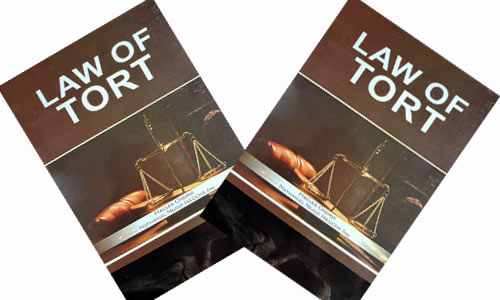 The book, titled The Law of Torts in Nigeria: A Functional Approach, authored by Professor Hagler Sunny Okorie Ph.D and Ikeocha, Nathaniel Ngozi Esq, offers law students, practitioners, and academics a comprehensive guide to understanding and applying tort law in Nigerian courts. Interested buyers can place orders via the following contact numbers: 08028636615, 08037667945, 08032253813, or +234 902 196 2209.
______________________________________________________________________
[A MUST HAVE] Evidence Act Demystified With Recent And Contemporary Cases And Materials
The book, titled The Law of Torts in Nigeria: A Functional Approach, authored by Professor Hagler Sunny Okorie Ph.D and Ikeocha, Nathaniel Ngozi Esq, offers law students, practitioners, and academics a comprehensive guide to understanding and applying tort law in Nigerian courts. Interested buyers can place orders via the following contact numbers: 08028636615, 08037667945, 08032253813, or +234 902 196 2209.
______________________________________________________________________
[A MUST HAVE] Evidence Act Demystified With Recent And Contemporary Cases And Materials

 ARTIFICIAL INTELLIGENCE FOR LAWYERS: A COMPREHENSIVE GUIDE
Reimagine your practice with the power of AI “...this is the only Nigerian book I know of on the topic.” — Ohio Books Ltd
Authored by Ben Ijeoma Adigwe, Esq., ACIArb (UK), LL.M, Dip. in Artificial Intelligence, Director, Delta State Ministry of Justice, Asaba, Nigeria.
Bonus:
Get a FREE eBook titled “How to Use the AI in Legalpedia and Law Pavilion” with every purchase.
ARTIFICIAL INTELLIGENCE FOR LAWYERS: A COMPREHENSIVE GUIDE
Reimagine your practice with the power of AI “...this is the only Nigerian book I know of on the topic.” — Ohio Books Ltd
Authored by Ben Ijeoma Adigwe, Esq., ACIArb (UK), LL.M, Dip. in Artificial Intelligence, Director, Delta State Ministry of Justice, Asaba, Nigeria.
Bonus:
Get a FREE eBook titled “How to Use the AI in Legalpedia and Law Pavilion” with every purchase.
How to Order: 📞 Call, Text, or WhatsApp: 08034917063 | 07055285878 📧 Email: benadigwe1@gmail.com 🌐 Website: www.benadigwe.com
Ebook Version: Access directly online at: https://selar.com/prv626
________________________________________________________________________ The Law And Practice Of Redundancy In Nigeria: A Practitioner’s Guide, Authored By A Labour & Employment Law Expert Bimbo Atilola _______________________________________________________________________
“Enhance Legal Practice With Authoritative Reports” — Alexander Payne Offers Comprehensive Law Reports, Spanning Over A Century Of Nigerian Jurisprudence
_______________________________________________________________________
“Enhance Legal Practice With Authoritative Reports” — Alexander Payne Offers Comprehensive Law Reports, Spanning Over A Century Of Nigerian Jurisprudence
 Interested buyers are encouraged to place their orders and enquiries via:
0704 444 4777, 0704 444 4999, 0818 199 9888
Website: www.alexandernigeria.com
Interested buyers are encouraged to place their orders and enquiries via:
0704 444 4777, 0704 444 4999, 0818 199 9888
Website: www.alexandernigeria.com