By O. G. Ogbom, Ph.D.

Introduction.
Marriage under Nigerian law, particularly statutory marriage, is governed principally by the Marriage Act and the Matrimonial Causes Act (MCA). A fundamental requirement of any valid marriage is capacity, which includes mental capacity. Where one party is described (in older legal terminology) as an “imbecile” now more appropriately referred to as a person of unsound mind or mental defect serious legal consequences arise.
This article examines whether such a marriage is valid, void, or voidable, with reference to statutory provisions and judicial authorities in Nigeria.
The term “imbecile” is largely obsolete in modern law but historically refers to a person with significantly impaired mental functioning. Nigerian law adopts broader terminology such as:
“unsound mind”
“mental defective”
“subject to recurrent attacks of insanity”
Under Nigerian matrimonial law, the key issue is whether such a person understood the nature of marriage and could undertake its responsibilities. It need not amount to total insanity “weakness of understanding” may suffice. The burden of proof lies on the petitioner. The principal statutory provision is Section 5(1)(b) of the MCA, which provides that a marriage is voidable where, at the time of the marriage:
- a party is of unsound mind;
- a party is a mental defective; or
iii. a party is subject to recurrent insanity or epilepsy.
The Act further defines a “mental defective” as a person whose mental development is incomplete or arrested to the extent that they are unfit for the responsibilities of marriage.
A statutory marriage with an “imbecile” is not automatically void, but voidable at the instance of the other party.
A voidable marriage is valid until annulled by a court, can only be challenged by one of the spouses and cannot be challenged after the death of either party.
Thus, a marriage involving a mentally incapacitated person subsists legally unless and until annulled.
Under the MCA (notably Sections 5, 37, and 38), the petitioner must prove:
- Ignorance of the mental condition at the time of marriage.
- Petition filed within a reasonable time (often within 12 months).
- No voluntary marital intercourse after discovering the condition.
A statutory marriage with an “imbecile” (i.e., a person of unsound mind or mental defect) is not illegal per se, but voidable under Section 5 of the Matrimonial Causes Act.
The courts, particularly in Hunponu-Wusu v. Hunponu-Wusu (2006) 6 NWLR (Pt. 972) 228 (SC) has clarified that the decisive factor is the existence of mental disorder at the time of marriage, not total incapacity to consent. In Hinponu’s case, the petitioner sought a decree of nullity on the ground that the respondent was, at the time of the marriage, suffering from recurrent insanity. Evidence was led to show that the respondent had a history of mental illness before and after the marriage. In answering the question whether the respondent’s mental condition at the time of the marriage rendered the marriage voidable under Section 5(1)(b) of the Matrimonial Causes Act.
The Court held that the crucial consideration is whether the party was “subject to recurrent attacks of insanity” at the time of the marriage. It is not necessary to prove total incapacity to understand marriage. Once recurrent insanity is established, the marriage is voidable.
Accordingly, such marriages remain valid until successfully challenged, reinforcing the principle that mental capacity is essential but its absence does not automatically nullify a marriage without judicial intervention.
In Enekebe v. Enekebe (1964) 1 All NLR 102. The petitioner sought nullity alleging that the respondent lacked mental capacity at the time of marriage. The court refused the petition due to insufficient proof of mental incapacity at the time of marriage and reinforced the principle that mental incapacity must be clearly established at the time of marriage, not based on speculation.
The court in Obiekwe v. Obiekwe (1963) 1 All NLR 63 (SC), although primarily on customary marriage, emphasized capacity and consent as essential elements of a valid marriage and went further to hold that absence of real consent due to mental defect undermines the validity of marriage.
Conclusion:
The combined effect of statutory cases and judicial authorities is clear, a statutory marriage with a person described as an “imbecile” (i.e., mentally incapacitated) is voidable, not void. Such marriages remain valid until successfully challenged. Again, mental capacity is essential but its absence does not automatically nullify a marriage without judicial intervention.
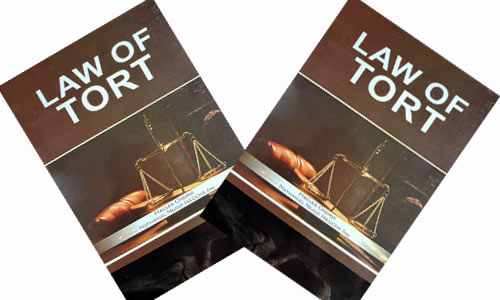 The book, titled The Law of Torts in Nigeria: A Functional Approach, authored by Professor Hagler Sunny Okorie Ph.D and Ikeocha, Nathaniel Ngozi Esq, offers law students, practitioners, and academics a comprehensive guide to understanding and applying tort law in Nigerian courts. Interested buyers can place orders via the following contact numbers: 08028636615, 08037667945, 08032253813, or +234 902 196 2209.
_______________________________________________________________________
The book, titled The Law of Torts in Nigeria: A Functional Approach, authored by Professor Hagler Sunny Okorie Ph.D and Ikeocha, Nathaniel Ngozi Esq, offers law students, practitioners, and academics a comprehensive guide to understanding and applying tort law in Nigerian courts. Interested buyers can place orders via the following contact numbers: 08028636615, 08037667945, 08032253813, or +234 902 196 2209.
_______________________________________________________________________
 ARTIFICIAL INTELLIGENCE FOR LAWYERS: A COMPREHENSIVE GUIDE
Reimagine your practice with the power of AI “...this is the only Nigerian book I know of on the topic.” — Ohio Books Ltd
Authored by Ben Ijeoma Adigwe, Esq., ACIArb (UK), LL.M, Dip. in Artificial Intelligence, Director, Delta State Ministry of Justice, Asaba, Nigeria.
Bonus:
Get a FREE eBook titled “How to Use the AI in Legalpedia and Law Pavilion” with every purchase.
ARTIFICIAL INTELLIGENCE FOR LAWYERS: A COMPREHENSIVE GUIDE
Reimagine your practice with the power of AI “...this is the only Nigerian book I know of on the topic.” — Ohio Books Ltd
Authored by Ben Ijeoma Adigwe, Esq., ACIArb (UK), LL.M, Dip. in Artificial Intelligence, Director, Delta State Ministry of Justice, Asaba, Nigeria.
Bonus:
Get a FREE eBook titled “How to Use the AI in Legalpedia and Law Pavilion” with every purchase.
How to Order: 📞 Call, Text, or WhatsApp: 08034917063 | 07055285878 📧 Email: benadigwe1@gmail.com 🌐 Website: www.benadigwe.com
Ebook Version: Access directly online at: https://selar.com/prv626
________________________________________________________________________ The Law And Practice Of Redundancy In Nigeria: A Practitioner’s Guide, Authored By A Labour & Employment Law Expert Bimbo Atilola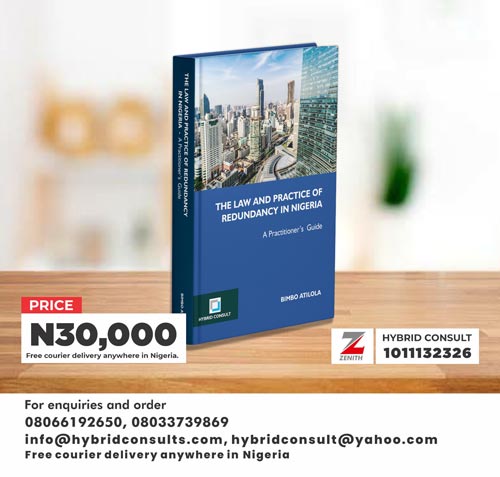 _______________________________________________________________________
[A MUST HAVE] Evidence Act Demystified With Recent And Contemporary Cases And Materials
_______________________________________________________________________
[A MUST HAVE] Evidence Act Demystified With Recent And Contemporary Cases And Materials