By Ben Ijeoma Adigwe.Esq
A lot of sporadic arguments have been featured on the propriety or otherwise of the move to abolish the death penalty in Nigeria. This piece is offered as an expose on the death penalty, zeroing in on its origin, effects and views of its retentionists and abolitionists.


It has been said that all of earth’s creature kill, but only man punishes. At the highest rung on the ladder of punishments which man has evolved for breach of societal laws is the death penalty. The death penalty has a deep root in the mosaic laws where it’s an eye for an eye and a tooth for a tooth. This mosaic position was based on the Hammurabi laws which have in it the principle of retribution and legal revenge. It had a prime place in primitive societies, where punishments were savage and violent. In such societies even death itself was not considered sufficient punishment. Sadistic forms of execution were invented. The Persians practiced burning alive. Others practiced boiling, drowning or burning at stakes. The Roman adopted crucifixion which has been described as one of the cruelest and most painful form of execution whereby the victim dies slowly as was done to the Nazarene.
As society evolved, more refined modes of execution were invented. In France, Dr. Guillotine, the son of a court prosecutor sponsored the idea of an instrument of execution that would be less brutal than methods then used. It was supposedly painless to the victim. The edifice became known as the Guillotine: assuming the name of its patron. The electric chair and the gas chamber were also invented in the United States. The Electric shock execution originated in New York in1888. In executing the convicted person, the society takes over the wreaking of vengeance on behalf of the injured. The angry feeling of the society is thus relieved as the wicked is punished. According to the retentionists of the death penalty, notably James Fitzjames Stephen, it is justified because it provides an orderly and socially accepted outlet for the revenge emotion just as marriage provides a socially accepted outlet for the sexual appetite. The state therefore takes away the right of retaliation from the individual. To the retentinoists of the death penalty the more wicked man should suffer more pain, thus expiating his wickedness.
Another reason why retentionists favour the death penalty is that it serves, as deterrence to other would be criminals. To check other people from committing like crimes.
These retentionists of what Charles Dickens refer to as judicial homicide also advance the argument that it is necessary for society to be protected from such people by disabling them.
Most academic writers including prominent criminologist have through the ages discredited the death penalty. These abolitionists say that the death penalty is a relic of barbarism. That it is a backward looking approach to punishment. They argue that instead of concentrating on the criminal, lawmakers should identify the social causes of crime and eliminate them rather than just punish for the sake of punishment. Even in classical times, moralists and philosophers rejected the death penalty and the theories advanced in its favour. Plato denounced the theory. Thomas Hobbes, in his leviathan decried it. Gandhi, in criticizing the bases of the death penalty said that an eye for an eye would soon make the whole world blind.
The abolitionists argue further that the deterrence capacity of death penalty and indeed all vindictive justice is not provable, that people who take crime as a career are less likely to be deterred and most crimes including murders are not the results of reasoning or of weighing considerations for or against the intended crime and are not apt to be repressed by the force of example.
Lord Ellenborough’s claim that the imaginary terror of the gallows on men’s mind was enough to retain capital punishment was met by the assertion of Mary Wollstonecraft who said that “Executions, far from being useful examples to the survivors have a quite contrary effect by hardening the heart they ought to terrify”. The abolitionists also argue, and I agree that it is improper and immoral to use a human life to show example. Life is so cheapened and by so doing it has been said that society diminishes itself. According to Cesare Beccaria, a criminologist of the abolitionists schools “to me it is absurdity that the law which represents the common will and detest and punishes homicide, should itself commit one and in other to keep citizens from committing murder, order a public one committed”. I am totally in support that the death penalty be abolished in Nigeria. Society evolves with time and most societies in the highest plane of civilization have done away totally with the death penalty. It is a mark of civilization that we treat life with respect. I agree with the sociologists and criminologists who say that no baby is born a criminal. That everybody, except the retard, is born with a promising, innocent, and positive disposition, but social conditions as he grows which leads to a low self-esteem turns him into a criminal/animal. Rather than cutting the stem by vindictive justice, we should examine the root cause of this aberration in order to correct it.
A very thorny case came up in 1976 in the American state of Utah. It involved a certain young man called Gary Gilmore. At 14 years he spent most of his time behind bars. He entered reformatory after breaking a school window. He was later jailed for auto theft, armed robbery and assault. After his release from prison at 35 years he started a new life. He got a job and fell in love with a girl who somewhere along the line left him. She returned back to her former husband. Suddenly, Gary Gilmour snapped. He went to a petrol station and without provocation killed the attendant. The following night he confronted the night manager of a motel and shot him dead. He was sentenced to death by firing squad. Against his wishes, an appeal was filed for him. Gilmore sent a note to the Supreme Court asking that he be allowed to die with dignity. The authorities prevaricated after the sentence was confirmed. Gary Gilmore complained that “to prolong the execution when I don’t ask for it to be prolonged puts me through the stress of cruel unusual punishment”.
At his execution, he was asked if he had anything to say. He looked up for a long time, looked ahead of him and said unrepentantly “let’s do it”. A kinsman of his made a statement which was a classic. “Things might have been different if Gary had not been “caged” in different institutions on and off since the age of 14, going from Juvenile trouble maker to a hardened killer in 22 years”.
Obviously he was one who was a victim of his circumstances and experiences. Perhaps if his decent into crime had been nipped in the bud by reforming or rehabilitating him there would not have been an occasion that called for his cold blooded execution. It is not provable that the death sentence has deterred other would be criminals from committing similar crimes. The upsurge in Armed Robbery cases in Nigerian was attributable to the after-effect of the civil war where many able bodied men were left without any means of livelihood. Perhaps the better approach to meeting the disaster would have been to address the issue of underemployment and unemployment rather than setting up Armed Robbery Tribunals to deal speedily with such cases without the right of Appeal. As statistics showed, the courts kept experiencing an ever increasing deluge of cases that threatened to ground the machinery of justice despite public executions.
The deterrence effect, of such public executions, if ever, were very negligible, thus giving credence to the observation of Justice Burton Roberts, a former Queens District Attorney that between 1891 and 1963 when the electric chair at Sing Song terminated the lives of 584 victims, there was no discernible effect of eliminating crimes.
An eye for an eye never stopped any crime. This vindictive principle has not helped to stop the endless bombing of the Israeli land by Palestinians despite revengeful counter-attacks by Israelis.
In fact, it was postulated by some psychologists in America that the mere thought that they could be executed trigger off a deadly and frenzy behavior from would be criminals. Fear of execution has never proved as a deterrent to crime and like I have said earlier, it has lost place amongst civilized societies. A case that occurred in Warri (Nigeria), which I took part in prosecution at a certain stage of the case, opened me up to appreciate the nobility on abolishing the death penalty. A certain Catholic Nun, Sister Irene Connelly was murdered by her steward and his other conspirators and her car and other properties stolen.
After much investigation, the suspects were arrested and tried at the Robbery and Firearms Tribunal, Effurun. The suspects were found guilty and sentenced to death like our law prescribed.
As soon as death sentence was handed down, the Vatican wrote saying that they do not subscribe to the killing of the convicts and pleaded passionately that the convicts should not be killed. The Irish government also wrote through their embassy (The Nun was an Irish) expressing their desire that the convicts be spared from execution, because they did not believe in taking life for whatever cause. The family members of the fallen Nun also visited from Ireland to see the graveside of their loved one and wasted no time in raising an objection to the convicts being executed. Thus the ball was passed on to our bully-like, obsolete laws, which cried more than the bereaved and needed to keep abreast with the trend of civilization. I wonder the effect it would have on the convicts to learn that their lives were being spared on request from the persons who’s loved one they have sniffed.
As regards the arguments to justify death penalty on the grounds that it is necessary to protect society. I think life imprisonment does offer the community ample protection.
Another troubling fact based on analysis is the unequal application of the death penalty which finds most of its victims among the poor. It is seldom if ever used against the wealthy. This has been proven as a fact in America. Majority of those executed are the poor- not the rich killers. The ones who are arrested at all one way or the other protract the cases and get the smartest lawyers that invariably gets them out based on technicalities.
As to the religious scholars, who say that “an eye for an eye” is a sacrosanct injunction, I humbly submit that the Nazarene was considered superior to Moses the giver of that law and at his execution for an offence he never committed, he prayed that the Creator forgive his killers; the same attitude which the Vatican and the Irish Republic prayed we do in my earlier story. The more humane prophet Ezekiel gives a broader picture of the Creator who said “As I live saith the Lord, I have no pleasure in the death of the wicked, but that the wicked turn from his way and live (Ezekiel 33:11)
No justice would be done to this topic without a consideration of the plight of the Hangman-the doer of the state’s dirty job whose identity is often concealed. Why encourage such an infamous and cold-blooded profession. Most of our law givers and law interpreters who hand out the death sentence can’t even kill a chicken yet we expect someone over there to carry out such monstrous orders. A certain humane and repentant American Hangman by name Clinton T. Duffy, after seeing the flesh torn from the condemned’s face by the rope and his swollen tongue, swinging legs and odors of urine, defecation, sweat and caking blood had this to say: “it would do the people good to know exactly how their mandate was carried out. Every juror who ever voted for the death penalty, every judge who ever pronounced sentence, every legislator who helped pass the law that made it necessary for us to go through this ordeal should have been with me today”. In the final analysis I believe the revenge theory upon which the death penalty was based has lost its place in modern thinking. Rather than be extremely judgmental to those convicts; products of a wild society without the cushioning effects of welfares, most of whom were dragged up rather than being properly brought up, we should consider the prayer of the Sioux Indians who say: “ O Great Spirit, keep me from ever judging and criticizing a man until I have walked in his moccasins for 2 weeks” or as the Nazarene would say: “Love your enemies, bless them that curse you, do good to them that hate you, and pray for them which despitefully use you and persecute you”
Written in commemoration of 2024 World day against the death penalty (October 10th )
By Ben Ijeoma Adigwe.Esq, Adigwe is a Director in the ministry of justice Asaba and long time prosecutor. +2348034917063, Benadigwe1@gmail.com
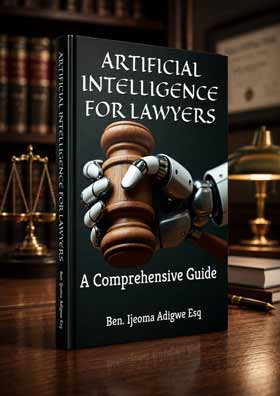 The book also examines Nigeria's legal ecosystem, focusing on the LPELR and NBA AI Guidelines. As a bonus, every purchase comes with a FREE eBook titled: How to Use the AI Features in LegalPedia and LawPavilion.
Ohio Books Ltd praises the publication, stating:
"....this is the only Nigerian book I know of on the topic."
How to Order:
📞 Call, Text, or WhatsApp: 08034917063 | 07055285878
📧 Email: benadigwe1@gmail.com
🌎 Website: www.benadigwe.com
Ebook Version: Access it directly online at https://selar.com/prv626
Authored by Ben Ijeoma Adigwe Esq., ACIarb (UK), LL.M, Dip. in Artificial Intelligence, Director at the Delta State Ministry of Justice, Asaba, Nigeria.
_______________________________________________________________________
“Enhance Legal Practice With Authoritative Reports” — Alexander Payne Offers Comprehensive Law Reports, Spanning Over A Century Of Nigerian Jurisprudence
The book also examines Nigeria's legal ecosystem, focusing on the LPELR and NBA AI Guidelines. As a bonus, every purchase comes with a FREE eBook titled: How to Use the AI Features in LegalPedia and LawPavilion.
Ohio Books Ltd praises the publication, stating:
"....this is the only Nigerian book I know of on the topic."
How to Order:
📞 Call, Text, or WhatsApp: 08034917063 | 07055285878
📧 Email: benadigwe1@gmail.com
🌎 Website: www.benadigwe.com
Ebook Version: Access it directly online at https://selar.com/prv626
Authored by Ben Ijeoma Adigwe Esq., ACIarb (UK), LL.M, Dip. in Artificial Intelligence, Director at the Delta State Ministry of Justice, Asaba, Nigeria.
_______________________________________________________________________
“Enhance Legal Practice With Authoritative Reports” — Alexander Payne Offers Comprehensive Law Reports, Spanning Over A Century Of Nigerian Jurisprudence
 Interested buyers are encouraged to place their orders and enquiries via:
0704 444 4777, 0704 444 4999, 0818 199 9888
Website: www.alexandernigeria.com
Interested buyers are encouraged to place their orders and enquiries via:
0704 444 4777, 0704 444 4999, 0818 199 9888
Website: www.alexandernigeria.com