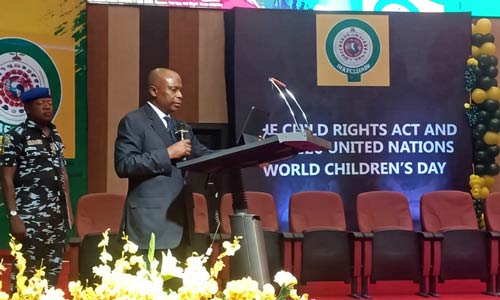
The First Lady, Senator Oluremi Tinubu, the Chief Justice of Nigeria, Justice Kudirat Kekere-Ekun, and the Attorney-General of the Federation and Minister of Justice, Lateef Fagbemi, SAN, have called for stronger commitment to the protection of children’s rights and the creation of an environment in which every child can thrive.

They spoke in Abuja at the inaugural conference of the Nigerian Association of Family Court Judicial Officers, Magistrates and Other Practitioners in commemoration of the United Nations World Children’s Day.
The speakers noted that although Nigeria has a robust legal framework for the protection of children’s rights, more needs to be done to ensure effective implementation and practical protection for children.
Represented by the Director-General and Chief Executive Officer of the Maryam Babangida National Centre for Women Development, Dr. Adedayo Benjamins-Laniyi, the First Lady said Nigeria took an important step by domesticating relevant international provisions on children’s rights through the Child Rights Act of 2003.
She said that although the Act established a legal framework for protecting children and promoting their best interests in decisions affecting them, there was a need to continually assess how effectively those protections were being translated into reality for every Nigerian child.
“The challenges of almajiri and out-of-school children, child labour and teenage pregnancy remain real concerns in our society. These issues deprive children, particularly girls, of education, protection and opportunities to fulfil their potential,” she said.
The First Lady urged stakeholders to recommit themselves to protecting the rights of every child and ensuring access to quality education, proper care and the support needed for a promising future.
“Protecting children’s rights requires more than legislation. It demands effective implementation, strong institutions and collective action. On the part of the Judiciary, you must ensure that the Child Rights Act is upheld and strictly adhered to.
“In this rapidly changing world, the commitment to protect our children must include shielding them from the modern danger of unregulated artificial intelligence technologies and the harmful effects of social media addiction, ensuring that their mental health and digital wellbeing are protected,” she said.
Justice Kekere-Ekun, represented by Justice Jummai Sankey of the Supreme Court, said the existence of legislation, important as it is, cannot by itself guarantee the protection of children.
According to the CJN, the real measure of the nation’s commitment lies in how effectively children’s rights are respected, protected and enforced in their daily lives.
“Across our communities, many children continue to face abuse, neglect, sexual exploitation, trafficking, child labour, early and forced marriage, abandonment and other forms of vulnerability.
“Some are denied access to education and healthcare, while others are exposed to violence within the very environment in which they ought to feel safest.
“The increasing use of digital platforms has also introduced new risks, including cyberbullying, online exploitation and exposure to harmful content. These challenges demand constant attention and a coordinated response,” she said.
Justice Kekere-Ekun said that while the Judiciary has a major responsibility in addressing the challenges, governments at various levels and other relevant stakeholders must also intensify their efforts.
Speaking on the expected conduct of judicial officers handling cases involving children, the CJN said judges must remain conscious that children are not merely subjects of legal procedures but individuals with rights, feelings and vulnerabilities requiring particular care and sensitivity.
“A child appearing before a court, whether as a victim, witness or a child in conflict with the law, must be treated with dignity and understanding.
“Proceedings should, as far as the law permits, be conducted in an environment that protects the child’s privacy, encourages the child’s participation, and takes into account the child’s age, security and emotional circumstances.
“Where a child comes in conflict with the law, the emphasis should, where appropriate, be on rehabilitation and reintegration rather than measures that permanently undermine the child’s prospects,” she said.
The CJN added that these responsibilities placed a continuing demand on judicial officers to deepen their understanding of children’s rights and child-sensitive adjudication.
Fagbemi, on his part, said the pressing challenge confronting the country was not the absence of laws but the gap in their implementation, noting that too many children still face conditions that threaten their safety and limit their potential.
The AGF said bridging the implementation gap required sustained political will, coordinated institutional action and a willingness to adapt existing systems to the evolving vulnerabilities facing children.
He identified increasing online threats, including cyberbullying, digital exploitation, harmful content and breaches of privacy, as issues requiring reforms in legal safeguards, increased public awareness and stronger partnerships among government, parents, civil society and technology providers.
Fagbemi also stressed the need for families, schools, communities and development partners to work together to create safe environments and provide children with the guidance needed to make sound choices.
He said the justice sector could not operate in isolation.
“Seamless collaboration, clear referral pathways, reliable data, and adequate funding across the health, education, and social welfare sectors are indispensable to delivering holistic care,” he said.
President of NAFCJOMP, Justice Eberechi Nyesom-Wike of the Court of Appeal, said the association’s inaugural conference provided an opportunity for members to strengthen their professional community, deepen collaboration across disciplines and develop practical approaches to the challenges confronting children.
She said the conference was also an opportunity to renew their commitment to ensuring that every decision affecting a child was guided by the child’s best interests.
“Our mission is to advance children’s rights, protection and welfare and to promote their best interests by strengthening family court practice and supporting the effective, child-sensitive administration of justice.
“We recognise that achieving this mission requires cooperation across professions, consistent standards of practice and a justice system that responds to children with care, fairness and understanding.
“Our objective, amongst others, is to promote compliance with child protection laws by advocating for the implementation of policies related to child welfare, including education, healthcare and social security,” Justice Nyesom-Wike said.
[A MUST HAVE] Evidence Act Demystified With Recent And Contemporary Cases And Materials

Available now for NGN 40,000 at ASC Publications, 10, Boyle Street, Onikan, Lagos. Beside High Court, TBS. Email publications@ayindesanni.com or WhatsApp +2347056667384. Purchase Link: https://paystack.com/buy/evidence-act-complete-annotation
______________________________________________________________________ “Enhance Legal Practice With Authoritative Reports” — Alexander Payne Offers Comprehensive Law Reports, Spanning Over A Century Of Nigerian Jurisprudence Interested buyers are encouraged to place their orders and enquiries via:
0704 444 4777, 0704 444 4999, 0818 199 9888
Website: www.alexandernigeria.com
“A Comprehensive Guide To Evidence Law” — Releases Second Edition In Three Volumes, Covering 4,051 Cases
For enquiries and orders, contact: 08035526491 Email: jerryamadisilk@gmail.com
 Prof. Jerry Amadi’s Evidence Law, Second Edition (2026), contains 3,314 pages in three volumes, covering the Evidence Act 2011, its 2023 amendment, and 4,051 Nigerian and English cases.